
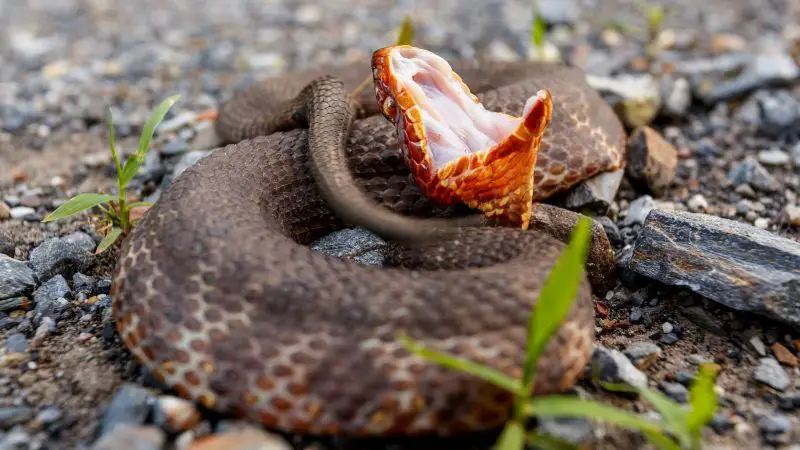
Stories about aggressive snakes spread quickly, especially when fear and mystery mix together. One of the most persistent claims involves water moccasins supposedly chasing people near rivers, lakes, or wetlands. In some regions of the United States, this myth has become so widespread that any dark snake near water is immediately labeled dangerous. Connecticut residents occasionally hear similar rumors, even though the scientific reality is far less dramatic.
Snakes inspire strong reactions. A sudden movement near water can trigger instinctive fear, and memories often exaggerate events over time. A snake moving away can appear as if it is moving toward someone. Add local folklore, social media anecdotes, and misidentification, and the story of “chasing snakes” becomes surprisingly common.
The truth about water moccasins in Connecticut involves ecology, geography, snake behavior, and human perception. Understanding these factors helps separate fact from fiction and reduces unnecessary fear.
Water Moccasins and Their Actual Geographic Range

Where Water Moccasins Really Live
Water moccasins, often called cottonmouths, are venomous semi aquatic snakes native primarily to the southeastern United States. Their range extends through warm coastal plains, river floodplains, swamps, and wetlands where temperatures remain suitable for reptile activity most of the year. States like Florida, Georgia, Alabama, Mississippi, Louisiana, eastern Texas, Arkansas, and portions of the Carolinas provide ideal environmental conditions. These regions offer warm water bodies, dense vegetation, abundant amphibian and fish prey, and long growing seasons that support successful reproduction.
Cottonmouths prefer slow moving or still water habitats. Marshes, cypress swamps, oxbow lakes, bayous, drainage ditches, and shaded streams all provide excellent environments. They are strong swimmers and often bask on logs, rocks, or shoreline vegetation where sunlight helps regulate body temperature. This ecological preference ties them closely to warmer climates with consistent aquatic ecosystems.
Connecticut lies far north of this natural range. Its colder winters, shorter warm seasons, and different wetland ecosystems make it unsuitable for stable cottonmouth populations. State wildlife agencies consistently confirm that water moccasins are not native to Connecticut. Reports of sightings almost always trace back to misidentified nonvenomous snakes rather than confirmed cottonmouth presence.
Rumors still circulate occasionally, especially when people encounter dark snakes near water. However, scientific monitoring, field surveys, and ecological modeling all support the same conclusion. Cottonmouths simply do not have established populations in Connecticut.
Why Climate Matters
Reptiles depend heavily on external temperatures to regulate metabolism, digestion, movement, and reproduction. Cottonmouths require extended warm seasons for feeding and growth. Cold temperatures slow digestion, reduce activity, and can threaten survival if exposure is prolonged.
New England winters present major barriers. Freezing temperatures, snow cover, and frozen water bodies limit available habitat. Even sheltered overwintering sites may not provide the consistent warmth cottonmouths require. Without suitable winter refuges, long term survival becomes unlikely.
Climate change discussions sometimes raise questions about northward range expansion. Some species have shifted gradually as average temperatures increase. However, range shifts require more than warmth alone. Habitat continuity, prey availability, breeding success, and seasonal stability all play important roles.
At present, there is no verified scientific evidence that cottonmouths have established breeding populations in Connecticut. Wildlife biologists continue monitoring distribution patterns, but current data strongly support the conclusion that climate barriers still prevent permanent settlement. Encounters remain extremely unlikely.
Snakes Often Mistaken for Water Moccasins in Connecticut
Northern Water Snakes
The northern water snake is by far the species most frequently mistaken for a cottonmouth in Connecticut. These nonvenomous snakes are common throughout the state and often inhabit ponds, rivers, lakeshores, wetlands, and marshy edges. Their aquatic lifestyle makes them visible to people spending time near water.
Coloration varies considerably. Some individuals display clear banding patterns, while older snakes may appear uniformly dark brown or nearly black. Pattern fading with age can make them resemble cottonmouths from a distance, especially under low lighting or when partially submerged.
When threatened, northern water snakes sometimes flatten their heads, coil defensively, or strike without biting. These defensive displays can look intimidating to observers unfamiliar with snake behavior. Because people often associate these behaviors with venomous species, misidentification becomes common.
Despite their appearance, northern water snakes are harmless to humans and play an important ecological role by controlling fish, amphibian, and rodent populations.
Eastern Garter Snakes
Eastern garter snakes are widespread across Connecticut and often inhabit moist environments such as gardens, wetlands, stream edges, and suburban yards. Their typical striped pattern makes them easy to recognize, but darker individuals occasionally cause confusion.
These snakes are completely nonvenomous and generally shy. Their quick movements sometimes startle people, especially when encountered unexpectedly near water sources or vegetation.
Garter snakes contribute positively to ecosystems by controlling insect populations, slugs, amphibians, and small rodents. Their presence often indicates healthy local biodiversity.
Fear reactions often stem from sudden movement rather than actual threat.
Juvenile Black Racers
Juvenile black racers present another common source of confusion. Unlike adults, which are sleek and solid black, juveniles often display blotched patterns. These markings can resemble those of other snake species, leading to mistaken identification.
Black racers are known for speed. When startled, they may rapidly flee toward nearby cover, sometimes appearing to move directly toward a person before veering away. This behavior often fuels the misconception that snakes are chasing people.
These snakes are nonvenomous, highly alert, and typically avoid confrontation whenever possible.
Misinterpreting escape behavior as aggression contributes significantly to snake myths.
Why People Think Snakes Are Chasing Them
Escape Routes Often Lead Toward Humans
When threatened, snakes instinctively move toward the nearest safe cover. That direction may coincide with a person’s location purely by chance. To the observer, the snake appears to advance deliberately, even though it is simply seeking refuge.
This situation occurs frequently near water where shoreline vegetation, rocks, or logs provide shelter. Human presence may unintentionally block the snake’s preferred escape route.
Perception plays a powerful role here. People naturally interpret movement relative to themselves, especially during moments of surprise or fear.
Misunderstanding escape behavior remains one of the most common sources of chasing stories.
Defensive Displays Can Look Aggressive
Snakes possess a variety of defensive behaviors designed to discourage predators. Hissing, coiling, tail vibration, head flattening, and mock strikes all serve as warning signals.
These displays do not indicate intent to attack. Instead, they aim to create distance between the snake and potential threat.
Observers unfamiliar with these signals may interpret them as aggressive pursuit rather than defensive communication.
Understanding context helps clarify behavior.
Fear Alters Memory
Human perception changes under stress. Sudden encounters with wildlife trigger adrenaline responses that can distort time perception, distance estimation, and movement interpretation.
Psychological studies show that memory often becomes exaggerated after frightening experiences. A brief encounter may later seem longer or more dramatic than it actually was.
Snake encounters frequently involve surprise, making them especially susceptible to memory distortion.
Over time, storytelling can amplify perceived aggression.
Snake Behavior Around Humans
Most Snakes Avoid Conflict
Snakes rely on camouflage, stealth, and escape strategies rather than confrontation. Direct conflict increases injury risk and energy expenditure, which evolutionary pressures discourage.
Even venomous species generally prefer retreat when given space. Human encounters are typically accidental.
Aggression toward humans is extremely rare in wild snakes.
Avoidance remains their primary survival strategy.
Defensive Bites Are Last Resort
Bites usually occur when snakes are stepped on, handled, or cornered. These defensive reactions aim to protect the snake rather than secure prey.
Understanding this distinction reduces fear and promotes safer outdoor behavior.
Maintaining distance greatly decreases risk.
Respect for wildlife benefits both parties.
Seasonal Activity Patterns
Snake visibility fluctuates with temperature and seasonal cycles. Spring emergence from overwintering sites often increases sightings. Late summer activity peaks coincide with feeding and reproductive behaviors.
Basking behavior also makes snakes more visible during warm sunny periods.
Increased sightings reflect normal biological cycles rather than heightened aggression.
Seasonal awareness improves understanding.
Are Cottonmouths Expanding Northward?
Climate Change Considerations
Climate change has influenced distribution patterns for some wildlife species. Warmer average temperatures can allow gradual northward movement under certain conditions.
However, range expansion requires more than temperature. Habitat continuity, prey availability, reproduction success, and winter survival all influence outcomes.
Current research does not indicate established cottonmouth populations in Connecticut. Monitoring continues, but evidence remains limited.
Ecological barriers still dominate.
Human Relocation Cases
Occasionally exotic pet snakes escape or are released intentionally. These isolated incidents rarely result in permanent populations because survival conditions are unsuitable.
Cold winters typically prevent long term establishment.
Wildlife agencies respond quickly to reports of unusual species.
These cases remain rare exceptions.
Real Risks From Snakes in Connecticut
Venomous Species Actually Present
Connecticut has two native venomous snakes: the timber rattlesnake and the northern copperhead. Both species are relatively uncommon and protected in many areas.
Encounters occur infrequently, and bites are rare. Most snakes avoid human contact whenever possible.
Education helps residents recognize these species and respond appropriately.
Coexistence improves with awareness.
Habitat Awareness Helps
Rocky hillsides, forest edges, wetlands, and sunlit trails sometimes host snakes. Watching where you step reduces accidental encounters.
Most snakes provide warning signals before defensive action.
Calm responses prevent escalation.
Simple awareness enhances safety.
How to Respond if You Encounter a Snake
Stay Calm and Still
Sudden movement can startle snakes. Remaining calm allows the animal to move away naturally.
Most encounters resolve quickly without incident.
Patience prevents unnecessary risk.
Calm observation is safest.
Maintain Distance
Keeping several feet of space reduces defensive reactions. Never attempt to handle or provoke a wild snake.
Respecting wildlife boundaries protects both humans and animals.
Distance remains the simplest safety measure.
Space promotes coexistence.
Identify From Afar
Observation from a safe distance allows identification without risk. Zoom photography can assist later confirmation.
Approaching wildlife for closer inspection increases danger.
Curiosity should always be balanced with caution.
Respect ensures safety.
Ecological Importance of Snakes
Rodent Population Control
Snakes play a vital role in regulating rodent populations. This helps protect crops, reduce disease transmission, and maintain ecological balance.
Predator presence stabilizes ecosystems.
Their contribution often goes unnoticed.
Part of Natural Food Webs
Snakes serve as both predators and prey. Hawks, owls, foxes, and other animals depend on them for food.
Balanced ecosystems rely on these interconnected relationships.
Removing one species can affect many others.
Nature functions through balance.
Indicators of Environmental Health
Healthy snake populations often reflect intact habitats and biodiversity. Declines may signal pollution, habitat loss, or ecological imbalance.
Monitoring snake populations provides valuable environmental insight.
Conservation awareness matters.
Protecting habitats benefits many species.
Common Myths About Water Moccasins
Myth They Aggressively Chase Humans
Scientific observation consistently shows avoidance behavior. Snakes prioritize escape over confrontation whenever possible.
Stories about chasing usually stem from misinterpretation or fear.
Evidence does not support intentional pursuit.
Understanding reduces anxiety.
Myth They Exist Everywhere Near Water
Cottonmouths have defined geographic limits. Not every dark snake near water is dangerous or venomous.
Regional knowledge helps prevent misidentification.
Location strongly influences species presence.
Education promotes accuracy.
Myth All Dark Water Snakes Are Dangerous
Color alone cannot identify species reliably. Many harmless snakes display dark coloration.
Accurate identification requires multiple characteristics including head shape, behavior, and geographic range.
Learning these distinctions reduces unnecessary fear.
Knowledge empowers safer interactions.
Safety Tips for Outdoor Activities in Connecticut
Watch Foot Placement
Trails, rocky areas, and wetland edges sometimes host snakes. Looking ahead while walking reduces surprise encounters.
Simple awareness greatly improves safety.
Outdoor enjoyment becomes easier.
Preparation builds confidence.
Wear Protective Footwear
Boots and long pants provide added protection when hiking in potential snake habitat.
Protective clothing reduces risk without limiting mobility.
Comfort and safety can coexist outdoors.
Preparation supports enjoyment.
Avoid Reaching Into Hidden Spaces
Logs, rock piles, vegetation, and shoreline debris may conceal wildlife. Visual checks before reaching prevent unexpected encounters.
Respect natural habitats.
Wildlife deserves space.
Safe habits protect everyone.
FAQs About Water Moccasins in Connecticut
Are water moccasins native to Connecticut?
No. Cottonmouths are native to the southeastern United States and are not established in Connecticut.
Why do people report seeing them?
Most sightings involve misidentified northern water snakes or other harmless species.
Do any snakes chase people?
Scientific evidence shows snakes generally avoid humans. Apparent chasing usually reflects escape behavior.
What venomous snakes live in Connecticut?
Timber rattlesnakes and northern copperheads are the only native venomous species.
Are snake bites common in the state?
Bites are rare and usually occur when snakes are provoked or handled.
Should I kill a snake near my home?
No. Many species are protected and beneficial. Contact wildlife professionals if necessary.
How can I identify a water snake safely?
Observe from a distance, noting pattern, head shape, and behavior. Avoid close contact.
Do snakes enter homes often?
Rarely. Most prefer outdoor habitats and avoid human structures.
Is climate change bringing cottonmouths north?
Current evidence does not show established populations in Connecticut.
What should I do if I see a snake while hiking?
Stay calm, keep distance, and allow it to move away naturally.
Conclusion
Stories about water moccasins chasing people in Connecticut persist largely because of fear, misidentification, and misunderstanding of snake behavior. Scientific evidence shows that cottonmouths are not native to the state, and snakes in general rarely pursue humans. Most encounters involve harmless species attempting to escape rather than confront.
Education remains the best tool for reducing fear. Recognizing local species, understanding natural behavior, and respecting wildlife boundaries promote safe coexistence. Snakes play important ecological roles and contribute to balanced ecosystems across Connecticut landscapes.
Calm awareness replaces myth with knowledge. And knowledge makes outdoor experiences safer and more enjoyable for everyone.