
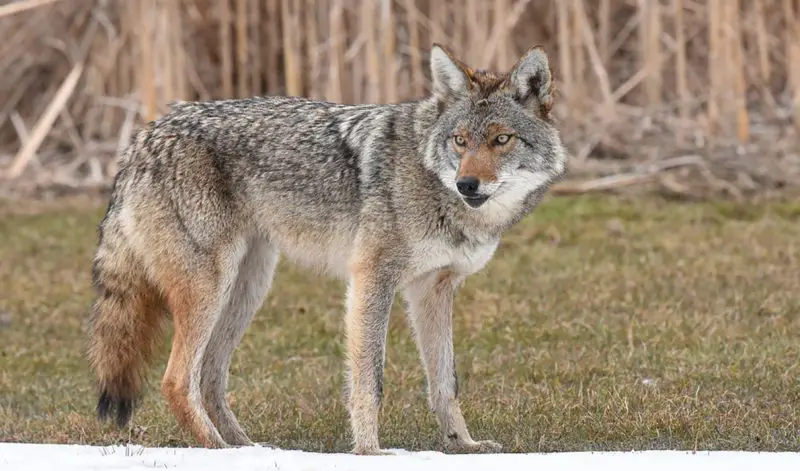
Across rural Maine, and even in some suburban communities, people occasionally ask a question that blends curiosity with concern: Do coyotes ever breed with domestic dogs? The idea of a wild predator mating with a household pet sparks vivid imagination. Some residents report seeing unusually large coyotes. Others describe strange-looking stray dogs roaming wooded edges. Over time, rumors develop about “coydog” hybrids living in the forests of northern New England.
But what does science actually say?
The short answer is this: While it is biologically possible for coyotes and domestic dogs to interbreed, it is extremely rare in the wild — especially in modern Maine. Hybridization can occur under certain conditions, but it is not common, and stable wild populations of coydog hybrids are not documented across the state. Understanding why requires examining genetics, behavior, ecology, and Maine’s unique wildlife history.
Let’s break down what really happens when wild coyotes and domestic dogs share the same landscape.
Coyotes in Maine: A Unique Story

The eastern coyote’s complex ancestry
Coyotes in Maine are not identical to the smaller coyotes commonly found in the western United States. The species known as the Coyote expanded its range eastward over the past two centuries as forests regenerated and wolves declined in the Northeast. During that expansion, western coyotes encountered remnant wolf populations and, in some cases, interbred with them.
This historical mixing helped create what biologists often call the eastern coyote. In casual conversation, some people refer to them as “coywolves,” although they function ecologically as coyotes. Compared to their western relatives, eastern coyotes tend to be slightly larger, with longer legs, broader skulls, and occasionally thicker coats. They also carry a small percentage of wolf ancestry in their DNA.
Because eastern coyotes already contain traces of hybrid ancestry from long ago, many residents assume they may also be mixing frequently with domestic dogs. However, past hybridization with wolves occurred under very specific ecological conditions. That historical context does not mean modern coyotes regularly breed with dogs. Today’s eastern coyote populations are genetically stable and behave as cohesive wild canids rather than ongoing hybrids.
Distribution and habitat in Maine
Coyotes are now established throughout Maine. They occupy southern farmland, central forests, coastal regions, and remote northern woodlands. Their adaptability allows them to thrive in mixed landscapes where forest edges meet agricultural fields or low-density development.
Despite their expanding range, coyotes remain cautious animals. They are highly territorial and maintain structured social units, often centered on breeding pairs and their offspring. While sightings near suburban areas have increased, coyotes typically avoid direct human interaction and prefer to move under cover of darkness.
Because they are present statewide, there are occasional overlaps with domestic animals. However, the simple presence of coyotes near communities does not automatically lead to interbreeding. Ecological overlap does not eliminate behavioral barriers.
Domestic Dogs: Close Relatives but Different Lifestyles
Domestic dogs, scientifically classified as the Domestic Dog, share a distant evolutionary history with coyotes. Both belong to the genus Canis, which includes wolves and several other wild canids. This shared ancestry means that, biologically, interbreeding is possible under certain circumstances.
Because coyotes and domestic dogs have the same chromosome number, they can produce hybrid offspring known as coydogs. These hybrids are typically fertile, which means they could theoretically reproduce further.
However, biological compatibility does not necessarily translate into frequent natural hybridization. Many closely related species remain reproductively isolated in the wild due to behavioral, social, and ecological differences.
Behavioral differences
Domestic dogs live closely with humans. Even feral or loosely supervised dogs display traits shaped by thousands of years of domestication. Their social behaviors, mating cycles, and responses to threats differ significantly from those of fully wild canids.
Coyotes, by contrast, are intensely territorial and socially structured. They rely on communication through scent marking, vocalization, and body language to establish territory and maintain pack stability. During breeding season, coyotes typically form strong monogamous bonds with a single mate.
These behavioral distinctions create powerful natural barriers. A domestic dog wandering into coyote territory is more likely to be viewed as an intruder than as a potential mate. Social incompatibility significantly reduces crossbreeding opportunities.
Is Hybridization Biologically Possible?
Genetic compatibility
Coyotes and domestic dogs both possess 78 chromosomes, which makes hybridization genetically possible. In controlled environments or rare wild circumstances, breeding can occur.
Hybrid offspring, if viable, are usually fertile and capable of reproducing. From a strictly genetic standpoint, nothing prevents a mating event between the two species.
However, genetics represent only one part of the equation. Reproductive timing, behavioral compatibility, and survival pressures play equally important roles.
Why it remains rare in Maine
Several natural factors reduce the likelihood of hybridization in Maine. Coyotes breed once annually, usually in late winter. Domestic dogs may enter estrus more than once per year and are influenced by human management.
Coyotes form seasonal pair bonds and defend territories vigorously. Once paired, a coyote is unlikely to seek additional mates outside its social unit. Domestic dogs, especially those supervised by owners, rarely roam freely during peak breeding season.
Additionally, coyotes generally avoid unfamiliar canids within their territory. An unfamiliar dog may be perceived as competition rather than a reproductive partner. These behavioral and timing mismatches greatly reduce hybridization frequency.
What About Feral or Free-Roaming Dogs?
Potential interaction zones
Hybridization is most likely to occur in rural regions where free-roaming dogs overlap with coyote habitat. In areas where dogs are unsupervised and breeding seasons align, rare mating events could occur.
However, modern pet ownership practices limit such scenarios. Leash laws, fencing, and responsible pet management significantly reduce unsupervised interaction between wild coyotes and domestic dogs.
As a result, opportunities for hybridization are far less common than they might have been historically.
Survival challenges for hybrids
Even when coydog hybrids are born, survival in the wild is not guaranteed. Hybrids may inherit a mix of behavioral traits that complicate adaptation.
A hybrid lacking full coyote wariness might approach human environments too readily. Conversely, it may lack the learned social behaviors necessary to integrate into a coyote pack.
Natural selection tends to favor animals well adapted to their environment. Hybrids that do not fit clearly into wild or domestic niches often face reduced survival rates. This limits the establishment of stable hybrid populations.
Are There Documented Coydogs in Maine?
Historical cases
Across North America, a small number of confirmed coydog cases have been documented through DNA testing. These cases are rare and typically localized rather than widespread.
In Maine, wildlife researchers have not identified persistent or large-scale coydog populations. Most animals suspected of being hybrids turn out to be eastern coyotes exhibiting natural variation.
Occasional unusual-looking individuals may spark speculation, but confirmed evidence remains limited.
Misidentification is common
Eastern coyotes in Maine are often larger than people expect. Adults commonly weigh between 30 and 50 pounds, and some exceed that range. Thick winter coats and inherited wolf traits can give them a more “dog-like” or “wolf-like” appearance.
Color variation also contributes to confusion. Coyotes may display gray, reddish, or even darker fur patterns. Without genetic testing, visual identification alone cannot determine hybrid status.
Many reported “coydogs” are simply large eastern coyotes or mixed-breed domestic dogs observed at a distance.
Behavioral Barriers to Breeding
Territorial defense
Coyotes defend their territories actively, especially during breeding season. An unfamiliar dog entering that space may trigger defensive behavior rather than mating interest.
Territorial aggression helps maintain species boundaries. Protecting territory ensures access to food and safe denning sites.
This instinct acts as a strong deterrent to cross-species breeding attempts.
Pair bonding
Coyotes form monogamous breeding pairs each year. Once bonded, they cooperate to defend territory and raise pups.
This seasonal monogamy reinforces species continuity. A bonded coyote is unlikely to accept an outside mate, particularly one from a different social structure.
Avoidance of humans
Coyotes in Maine generally avoid people and human activity. Domestic dogs remain closely linked to human spaces.
Because coyotes minimize time spent in highly developed areas during breeding season, opportunities for cross-species interaction remain limited. Lifestyle separation reinforces reproductive isolation.
Could Hybridization Increase in the Future?
Changing landscapes
As suburban development spreads into forested regions, contact zones between wildlife and pets may increase. If free-roaming dogs become more common in rural areas, opportunities for hybridization could theoretically rise.
However, trends toward responsible pet ownership reduce that likelihood.
Human behavior plays a key role in maintaining species separation.
Genetic monitoring
Wildlife agencies conduct genetic studies to monitor coyote populations. These analyses detect wolf ancestry and evaluate population health.
If widespread domestic dog introgression occurred, it would likely appear in genetic surveys. To date, such evidence has not shown significant dog mixing in Maine’s coyote populations.
Are Coydogs Dangerous?
Temperament unpredictability
In theory, hybrid animals could show mixed behavioral traits. Some might retain coyote wariness. Others might display reduced fear of humans.
However, because confirmed wild coydogs remain rare in Maine, this concern is largely hypothetical.
Most observed coyotes exhibit typical wild behavior and avoid direct contact with people.
Public perception vs. reality
Fear of hybrids often exceeds documented risk. Coyotes themselves generally avoid confrontation. Aggressive incidents usually involve animals habituated to human food sources rather than hybrid ancestry.
Understanding actual wildlife behavior reduces unnecessary alarm.
Protecting Pets in Coyote Country
Supervision matters
Small dogs left outdoors unattended are more vulnerable to encounters with coyotes. Supervising pets, especially at dawn and dusk, reduces risk.
Secure fencing and leashes provide effective protection.
Avoid feeding wildlife
Leaving pet food outside attracts coyotes and other wildlife. Removing attractants helps prevent unwanted interactions.
Responsible practices reduce conflict without harming wildlife.
Why the Hybrid Myth Persists
Appearance differences
Eastern coyotes often appear larger and more wolf-like than expected. This fuels speculation about hybrid origins.
Seasonal coat thickness and color variation amplify this impression.
Internet amplification
Images of unusual canids spread quickly online. Without DNA evidence, many claims remain unverified.
Stories circulate widely, reinforcing myths even when scientific data does not support them.
The Bigger Ecological Picture
Coyotes’ role in Maine
Coyotes regulate prey populations, including deer, rodents, and small mammals. Their presence supports ecological balance in forest ecosystems.
Focusing excessively on hybrid fears may distract from their important ecological function.
Genetic resilience
Eastern coyotes demonstrate genetic resilience due to historical mixing with wolves. Despite this ancestry, they function as stable wild populations.
Species boundaries remain largely intact, maintained by behavioral and ecological factors rather than simple genetic compatibility.
Understanding these dynamics clarifies that while hybridization is biologically possible, it is not a common or defining feature of Maine’s coyote population.
FAQs About Coyotes and Dogs in Maine
Can coyotes and dogs physically breed?
Yes, they are genetically capable of producing offspring.
Does it happen often in Maine?
No, documented cases are rare.
What is a coydog?
A hybrid offspring of a coyote and domestic dog.
Are eastern coyotes already hybrids?
They carry some historical wolf ancestry, but they function as stable wild populations.
How can you identify a coydog?
Only DNA testing can confirm hybrid status reliably.
Are coydogs more aggressive?
There is no consistent evidence of widespread aggressive hybrid populations in Maine.
Should residents be worried?
No. Normal wildlife precautions are sufficient.
Do coyotes attack pets?
Small pets left unattended outdoors are at higher risk.
Are coyotes protected in Maine?
Wildlife regulations vary seasonally and regionally.
Is hybridization increasing?
There is no strong evidence of widespread increase in Maine.
Conclusion
While coyotes and domestic dogs are genetically capable of interbreeding, such events are rare in Maine’s wild landscapes. Behavioral differences, breeding timing, territorial instincts, and human-associated lifestyles create strong natural barriers.
Most reports of “coydogs” turn out to be large eastern coyotes or mixed-breed domestic dogs. Confirmed hybrid cases remain uncommon and do not represent widespread population trends.
Understanding the science behind hybridization helps replace rumor with reality. Maine’s coyotes remain primarily wild animals adapted to forest and rural ecosystems. Responsible pet ownership, habitat awareness, and informed wildlife education ensure that coexistence remains safe and manageable.
In the end, the question reveals more about human curiosity than about widespread biological change. And in Maine’s forests, coyotes continue living largely as they always have — wild, adaptable, and separate from the domestic companions at our doorsteps.