
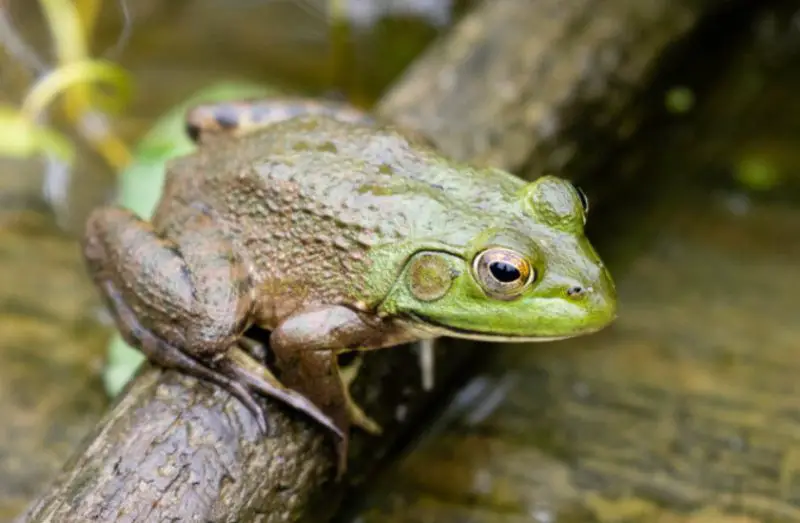
Frogs are some of the most familiar yet overlooked wildlife found across Ohio. From loud spring choruses echoing through wetlands to quiet movements along pond edges in summer, frogs are present in nearly every corner of the state. Their calls often signal seasonal change long before leaves appear or temperatures stabilize.
Ohio’s mix of forests, wetlands, rivers, farmland, and suburban landscapes supports a surprisingly diverse group of frog species. Some are large and highly visible, while others are tiny, secretive, and heard far more often than seen. Many species also look similar at a glance, making identification challenging without careful observation.
This guide explores 14 types of frogs found in Ohio, with pictures and clear identification details to help you recognize each species.
Table of Contents
- 1 Common Types of Frogs in Ohio
- 1.1 American Bullfrog (Lithobates catesbeianus)
- 1.2 Green Frog (Lithobates clamitans)
- 1.3 Northern Leopard Frog (Lithobates pipiens)
- 1.4 Southern Leopard Frog (Lithobates sphenocephalus)
- 1.5 Plains Leopard Frog (Lithobates blairi)
- 1.6 Pickerel Frog (Lithobates palustris)
- 1.7 Wood Frog (Lithobates sylvaticus)
- 1.8 Mink Frog (Lithobates septentrionalis)
- 1.9 Spring Peeper (Pseudacris crucifer)
- 1.10 Western Chorus Frog (Pseudacris triseriata)
- 1.11 Boreal Chorus Frog (Pseudacris maculata)
- 1.12 Eastern Cricket Frog (Acris crepitans)
- 1.13 Gray Treefrog (Hyla versicolor)
- 1.14 Cope’s Gray Treefrog (Hyla chrysoscelis)
- 2 Tips for Observing Frogs in Ohio
- 3 FAQs About Frogs in Ohio
- 4 Final Thoughts
Common Types of Frogs in Ohio
American Bullfrog (Lithobates catesbeianus)

American Bullfrogs are the largest frogs found in Ohio and are immediately recognizable by their massive size and heavy build. Adults commonly reach 6 to 8 inches in body length, with thick hind legs and a broad, flattened head. Their skin ranges from olive green to brown, often marked with darker mottling that blends well with muddy water and shoreline vegetation. Males are easily identified by their oversized circular eardrum.
This species is tightly associated with permanent water across Ohio. Lakes, ponds, marshes, reservoirs, and slow-moving rivers provide ideal habitat, and bullfrogs rarely stray far from the water’s edge. They often float motionless with only their eyes exposed, dropping underwater the moment they sense vibration.
American Bullfrogs are aggressive, opportunistic predators that will attempt to swallow almost anything they can overpower. In Ohio wetlands, their diet includes insects, crayfish, fish, other frogs, small snakes, birds, and even young mammals. Their size allows them to dominate many aquatic environments.
Calling activity increases during warm months, and their deep, booming “jug-o-rum” call becomes a defining nighttime sound around Ohio ponds and lakes from late spring through early fall.
Green Frog (Lithobates clamitans)

Green Frogs are among the most frequently encountered frogs throughout Ohio and are often mistaken for smaller bullfrogs. They are noticeably slimmer, usually measuring 2.5 to 4 inches long, with a pointed snout and variable coloration ranging from bright green to brown with irregular dark blotches.
One of the most reliable identification features is the raised ridge that runs from behind the eye along the back. This ridge is present in Green Frogs found across Ohio and absent in bullfrogs, making it an important field mark.
These frogs thrive in a wide range of aquatic habitats, including ponds, streams, wetlands, drainage ditches, and slow rivers. They are commonly seen sitting along muddy banks or vegetation-lined shorelines and quickly leap into the water when disturbed.
Green Frogs feed mainly on insects, spiders, small crayfish, and aquatic invertebrates. Their call, often compared to a loose banjo string being plucked, echoes through Ohio wetlands on warm summer evenings.
Northern Leopard Frog (Lithobates pipiens)
The Northern Leopard Frog is a medium-sized species recognized by its bold pattern of dark oval spots scattered across a green or brown background. Adults typically grow between 2 and 4 inches long, and the spots are often outlined by lighter borders, creating a high-contrast appearance.
Across Ohio, this species favors open wetlands, marshes, wet meadows, and grassy pond margins. Unlike bullfrogs and green frogs, Northern Leopard Frogs frequently travel far from water during the summer, especially after rainfall.
Their diet consists primarily of insects such as beetles, flies, grasshoppers, and ants. Long, powerful hind legs allow them to escape predators by making long jumps across open ground rather than diving straight into water.
Although populations have declined in some areas of Ohio, the species is still present statewide. Breeding calls are most often heard in early spring and sound like a low, rattling snore rather than a sustained call.
Southern Leopard Frog (Lithobates sphenocephalus)

Southern Leopard Frogs closely resemble their northern relatives but usually appear slimmer, with more irregularly shaped spots. Adults measure about 2 to 3.5 inches long, and a pale stripe along the upper jaw is often visible in Ohio individuals.
This species prefers shallow wetlands, floodplains, roadside ditches, and grassy ponds. Southern Leopard Frogs tolerate warmer temperatures and fluctuating water levels, which allows them to persist in southern portions of Ohio where conditions are less stable.
They feed on insects, spiders, and other small invertebrates, hunting actively during warm, wet conditions. When startled, they often flee by making a rapid series of long jumps rather than diving immediately into water.
Southern Leopard Frogs remain uncommon and localized within Ohio, with most confirmed records coming from the southern part of the state. Their breeding call is softer and shorter than that of the Northern Leopard Frog, often described as a quiet chuckle.
Plains Leopard Frog (Lithobates blairi)

The Plains Leopard Frog is one of the rarest frog species ever recorded in Ohio and is easily confused with other leopard frogs. Adults usually range from 2 to 4 inches long, with rounded dark spots on a tan or light brown background. The spots tend to be more uniform than those of related species.
This frog is associated with open grasslands, prairie wetlands, and shallow marshes, habitats that are extremely limited within Ohio. Because of this, the species is rarely encountered and may go unnoticed even where it still persists.
Plains Leopard Frogs feed on insects and small invertebrates and are most active during warm, rainy periods. During dry conditions, they often remain hidden in vegetation or soil, making detection difficult.
Only a small number of historical and modern records confirm the presence of this species in Ohio. Protecting remaining grassland and wetland habitats is essential for any chance of long-term survival.
Pickerel Frog (Lithobates palustris)

Pickerel Frogs are medium-sized frogs known for their clean, orderly patterning and preference for cool, shaded habitats. Adults usually measure between 1.75 and 3 inches long. Their bodies are tan to light brown, marked with two neat rows of square or rectangular dark spots running down the back. A bright yellow or orange wash is often visible on the inner thighs, a helpful identification clue.
This species is closely tied to cool, clean water sources found across Ohio. Springs, forested streams, seepages, and shaded wetlands provide ideal conditions. Pickerel Frogs are less tolerant of warm, stagnant water than many other frogs and are often absent from heavily disturbed ponds.
Their diet consists mainly of insects, spiders, and other small invertebrates captured along stream banks and forest floors. Pickerel Frogs are strong jumpers but tend to remain close to cover, slipping quickly into water or dense vegetation when approached.
Unlike most frogs in the region, Pickerel Frogs produce skin toxins that make them unpalatable to many predators. Their low, snore-like breeding call is heard in early spring, often before many other frog species begin calling in Ohio.
Wood Frog (Lithobates sylvaticus)

The Wood Frog is instantly recognizable by its dark mask-like marking that runs through the eye, giving it a bandit-like appearance. Adults are relatively small, usually measuring 1.5 to 3 inches long. Coloration ranges from tan to reddish-brown, often changing slightly depending on temperature and surroundings.
This species is strongly associated with deciduous forests and woodland wetlands throughout Ohio. Unlike many frogs, Wood Frogs spend much of their lives on land, returning to temporary pools only during the breeding season. These seasonal pools lack fish, making them safer for eggs and tadpoles.
Wood Frogs feed on insects, spiders, and other small invertebrates found on the forest floor. Their movements are often short and deliberate, blending easily into leaf litter where they are difficult to spot.
One of the most remarkable traits of Wood Frogs in Ohio is their ability to survive freezing temperatures. During winter, their bodies partially freeze, then thaw in spring. Their breeding call, a short series of clucking sounds, is one of the earliest frog calls heard each year.
Mink Frog (Lithobates septentrionalis)

Mink Frogs are medium-sized frogs closely related to Green Frogs and are often mistaken for them. Adults typically measure 2 to 4 inches long and have a smooth, dark green to brown body with subtle mottling. Their skin often appears glossy, especially when wet.
This species is strongly associated with cold, permanent water, particularly in northern Ohio near the Great Lakes region. Lakes, bogs, slow rivers, and marshes with abundant aquatic vegetation provide suitable habitat. Mink Frogs rarely venture far from water.
Their diet includes aquatic insects, small crayfish, and other invertebrates. They are most active during the day and often sit quietly at the water’s edge, diving underwater rather than leaping away when startled.
A unique trait of Mink Frogs in Ohio is the musky odor they release when handled, which resembles the smell of mink. Their breeding call is a rapid series of short clicks, quite different from the banjo-like call of Green Frogs.
Spring Peeper (Pseudacris crucifer)

Spring Peepers are small treefrogs famous for their loud voices rather than their size. Adults measure only about 0.75 to 1.5 inches long and are typically tan, brown, or gray. A dark X-shaped marking on the back is a key identification feature.
Despite their name, Spring Peepers are not limited to trees. They inhabit forests, wetlands, flooded fields, and suburban areas across Ohio, using low vegetation, leaf litter, and shrubs for cover. Their small size allows them to exploit a wide range of habitats.
Spring Peepers feed on tiny insects and other small invertebrates. They are agile climbers and capable jumpers, often disappearing into vegetation almost instantly when disturbed.
Their piercing, high-pitched call is one of the most iconic sounds of early spring in Ohio. Large choruses can be heard on warm evenings as soon as ice melts, often signaling the true start of the amphibian breeding season.
Western Chorus Frog (Pseudacris triseriata)

Western Chorus Frogs are small, slender frogs with excellent camouflage. Adults typically measure 0.8 to 1.5 inches long. Their coloration ranges from gray to brown, marked with three dark stripes running lengthwise down the back, along with a dark stripe through the eye.
This species prefers shallow, temporary wetlands, flooded fields, roadside ditches, and prairie remnants found across parts of Ohio. These habitats fill with water in late winter and early spring, creating ideal breeding conditions before drying out later in the year.
Western Chorus Frogs feed on small insects and other invertebrates, often hunting among low vegetation. They are secretive and rarely seen outside the breeding season, despite being locally common in suitable habitat.
Their call is a rapid, repetitive trill that sounds like running a fingernail along the teeth of a comb. This distinctive sound is commonly heard in early spring across Ohio, sometimes before snow has fully disappeared.
Boreal Chorus Frog (Pseudacris maculata)

The Boreal Chorus Frog is a small, cold-adapted species that closely resembles the Western Chorus Frog but has a more limited presence. Adults are tiny, usually measuring 0.8 to 1.5 inches long. Their coloration ranges from gray to brown, marked with three dark stripes along the back and a distinct dark stripe through the eye.
This frog favors open, shallow wetlands such as flooded fields, prairie potholes, and temporary pools that form in early spring. Suitable habitat exists only in scattered locations, which explains why sightings remain uncommon and localized within Ohio.
Boreal Chorus Frogs feed on small insects and other tiny invertebrates. They are secretive outside the breeding season and spend much of their lives hidden beneath vegetation or soil, making them difficult to detect visually.
Their call is a short, rapid trill similar to that of the Western Chorus Frog but often slower and more rhythmic. Breeding activity begins very early in the year, sometimes while nights are still cold, making their calls one of the earliest amphibian sounds heard in parts of Ohio.
Eastern Cricket Frog (Acris crepitans)

Eastern Cricket Frogs are among the smallest frogs found in the region, rarely exceeding 1.5 inches in length. Their appearance is highly variable, ranging from gray and brown to greenish tones, often with dark blotches or striping. The skin is slightly rough, and the body is compact with long hind legs.
This species prefers sunny, open shorelines along ponds, streams, lakes, and rivers. Low vegetation and exposed mud or gravel provide ideal conditions. Historically widespread, Eastern Cricket Frogs have declined significantly and are now much less common in Ohio than they once were.
Cricket Frogs feed on ants, flies, beetles, and other small insects. They are extremely quick and alert, often escaping danger by making a series of short, rapid jumps rather than long leaps.
Their call is a sharp, metallic clicking sound that resembles two pebbles being tapped together. During warm months, this call once formed a constant background noise along Ohio waterways, though it is now heard far less frequently due to population declines.
Gray Treefrog (Hyla versicolor)

Gray Treefrogs are medium-sized treefrogs known for their remarkable ability to change color. Adults typically measure 1.5 to 2.5 inches long and can appear gray, green, or mottled, depending on temperature, humidity, and background. Their skin has a rough, warty texture compared to other treefrogs.
This species uses woodlands, forest edges, swamps, and suburban areas throughout Ohio. Although called treefrogs, they spend much of their time hidden on tree trunks, branches, or wooden structures, blending in with bark and lichen.
Gray Treefrogs feed on a wide range of insects, including moths, beetles, flies, and spiders. Sticky toe pads allow them to climb vertical surfaces with ease, and they often remain motionless during the day to avoid detection.
Breeding occurs in ponds and wetlands during late spring and early summer. Their call is a slow, musical trill that lasts several seconds and is commonly heard on warm, humid nights across Ohio.
Cope’s Gray Treefrog (Hyla chrysoscelis)

Cope’s Gray Treefrog looks nearly identical to the Gray Treefrog, making visual identification nearly impossible. Adults are similar in size and coloration, measuring about 1.5 to 2.5 inches long, with the same ability to shift between gray and green tones. Bright yellow-orange patches are often visible on the inner thighs.
This species occupies wooded habitats, wetlands, and residential areas in Ohio, frequently overlapping with the Gray Treefrog. Like its close relative, it spends much of its time in trees and shrubs, descending to water only for breeding.
Cope’s Gray Treefrogs feed on insects and other small invertebrates captured on vegetation or near lights at night. They are nocturnal and usually active after sunset, when humidity is higher.
The key difference between the two gray treefrogs lies in their calls. Cope’s Gray Treefrog produces a faster, more buzzing trill, compared to the slower, more melodic call of the Gray Treefrog. In Ohio, identifying the species often depends entirely on listening rather than sight.
Tips for Observing Frogs in Ohio
Successful frog observation depends heavily on timing and sound. Most frogs are most active during the evening and nighttime, especially after rain. Warm, humid nights in spring and early summer are ideal, as many species gather to breed and call simultaneously.
Location matters. Wetlands, ponds, marsh edges, slow-moving streams, flooded fields, and forested vernal pools are prime habitats. Temporary pools that appear in early spring are especially important for species like Wood Frogs, Chorus Frogs, and Spring Peepers.
Listening is often more effective than looking. Learning basic frog calls helps narrow down species before visual confirmation. Many frogs remain hidden in vegetation or water and only reveal their presence through sound.
When observing frogs, avoid handling them whenever possible. Amphibians have sensitive skin that absorbs oils and chemicals. If photography or close viewing is desired, keep interactions brief and hands clean, or observe without contact.
FAQs About Frogs in Ohio
How many frog species live in Ohio?
Ohio is home to 14 native frog species, not including toads.
What is the most common frog in Ohio?
The Green Frog and American Bullfrog are among the most widespread and commonly encountered species.
When is the best time to hear frog calls?
Evenings during warm, wet weather, especially in spring and early summer, offer the best listening opportunities.
Are any frogs in Ohio dangerous?
No. All frog species in Ohio are harmless to humans.
Why do some frogs appear only briefly each year?
Many species rely on temporary breeding pools and spend most of their lives hidden in forests or underground.
Can frogs survive winter in Ohio?
Yes. Frogs use various strategies, including burrowing into mud, hiding under leaf litter, or partially freezing and thawing in spring.
Why are some frog species declining?
Habitat loss, pollution, road mortality, disease, and climate change all contribute to population declines.
Final Thoughts
Frogs play a vital role in Ohio’s ecosystems, serving as both predators and prey while acting as indicators of environmental health. Their presence reflects clean water, healthy wetlands, and balanced habitats.
Learning to identify Ohio’s frogs by sound, shape, and habitat deepens appreciation for landscapes that might otherwise go unnoticed. From the booming call of the bullfrog to the delicate trill of chorus frogs, these amphibians remind us how closely nature and seasonal rhythms are connected.
Protecting wetlands, reducing pollution, and respecting wildlife habitats ensures that future generations will continue to experience the rich diversity of frogs across Ohio.