
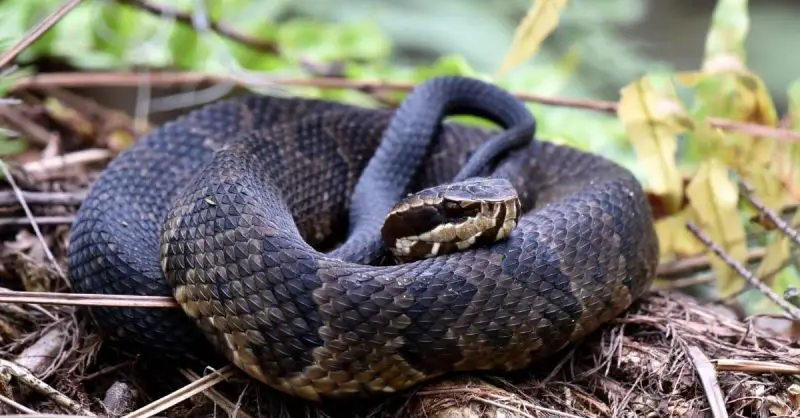
In Georgia, cottonmouths are not rare animals hiding deep in wilderness. They live where people live. Along ponds behind homes. In drainage ditches near roads. Around creeks that cut through farmland and suburbs alike.
Because encounters are frequent, opinions are strong. Many residents believe cottonmouths chase humans. Not as rumor. As lived experience. People describe snakes moving toward them. Holding ground. Refusing to flee.
To understand whether this belief reflects reality, fear alone is not enough. Cottonmouth behavior must be examined carefully. What they do. Why they do it. And how human perception often reshapes those moments.
This article focuses on documented cottonmouth behavior, environmental context in Georgia, and the specific actions that cause people to interpret defense as pursuit.
Cottonmouths in Georgia: Distribution and Daily Contact

Georgia lies entirely within the natural range of the eastern cottonmouth. This species is not at the edge of its habitat here. It is well established and widespread. Warm temperatures, long growing seasons, and abundant freshwater make Georgia one of the most suitable states for cottonmouth survival.
Cottonmouths are commonly found throughout the coastal plain, along major river systems, in floodplains, swamps, marshes, and forested wetlands. They also occupy man-made water sources such as farm ponds, retention basins, irrigation canals, and drainage ditches. These environments remain wet for long periods and support the prey cottonmouths depend on.
Many of these locations overlap directly with human activity. Fishing access points, boat ramps, backyard ponds, walking trails, livestock watering areas, and low-lying yards are all places where people regularly move through cottonmouth habitat. Because these areas are used daily, encounters do not feel rare or accidental. They feel routine.
Repeated exposure creates familiarity. Familiarity builds expectations. Over time, expectations shape how people interpret snake behavior during brief encounters.
What Cottonmouths Are Biologically Designed to Do
Cottonmouths are ambush predators. Their anatomy reflects this strategy clearly. They have thick, muscular bodies designed for short bursts of motion rather than sustained speed. Their hunting success depends on remaining still and striking suddenly when prey comes within range.
They rely heavily on camouflage and patience. A cottonmouth may remain motionless for long periods near water edges, waiting for fish, frogs, or small mammals. Once a strike is made, the snake releases and retreats, allowing venom to work.
Extended pursuit offers no advantage. Chasing prey across open ground would waste energy and increase risk. This is especially true for large animals like humans that cannot be subdued or consumed.
Venom production is metabolically expensive. Bites are reserved for feeding and last-resort defense. From a biological standpoint, chasing humans would provide no benefit and introduce unnecessary danger.
Defensive Strategy Versus Aggressive Behavior
Cottonmouths rely on defense displays more than flight. This sets them apart from many nonvenomous snakes.
When threatened, a cottonmouth may remain visible rather than fleeing immediately. It may coil its body, flatten slightly, vibrate its tail, or gape its mouth to display the bright white interior. These behaviors are signals. They communicate awareness and readiness without requiring contact.
These displays are designed to stop an approach. They often succeed with predators that understand the warning. No strike is necessary if the threat retreats.
To humans, however, stillness is unsettling. A snake that does not flee appears bold. Boldness is often interpreted as aggression. This gap between biological purpose and human perception fuels misunderstanding.
Why Cottonmouths Often Do Not Flee Immediately
Many snakes depend on speed and concealment. Cottonmouths depend on intimidation.
Their heavy bodies are less suited for rapid retreat on land. Instead of fleeing instantly, they often pause to assess the threat. Warning displays are used first because they conserve energy and reduce risk.
When a cottonmouth does move away, its movement is often slow and deliberate. It does not explode into motion like smaller or lighter snakes. To a human observer, slow movement feels intentional.
This deliberate retreat is often misread as an approach decision rather than an escape choice.
The Role of Water as an Escape Route
Water is the primary escape route for cottonmouths. It provides cover, buoyancy, and familiarity.
When startled, cottonmouths usually move toward water instead of away from it. In Georgia, water is present almost everywhere. Creeks, ditches, ponds, flooded grass, and marsh edges are common.
If a person is standing between the snake and the nearest water, the snake may move in the same direction as the person. This movement is not pursuit. It is the fastest path to safety.
From the human perspective, the snake turned toward them. Intent is assumed where none exists.
How Georgia’s Landscape Affects Perception
Georgia’s terrain plays a major role in how snake movement is interpreted.
In mountainous or rocky regions, snakes often flee downhill or disappear into visible crevices. In Georgia’s flat wetlands, movement is more linear. There are fewer visual cues to show avoidance.
When a snake moves across open ground toward water, it may appear to be moving directly at a person even when attempting to pass by them.
Without elevation change or obvious barriers, humans perceive approach rather than avoidance.
Swimming Behavior That Looks Like Chasing
Cottonmouths are strong swimmers. Swimming is a normal part of their daily behavior.
When swimming, their bodies create ripples that draw attention. Humans tend to track these ripples relative to their own position rather than the snake’s destination.
If a person moves toward shore while a cottonmouth swims toward the same shoreline, it can feel like the snake is following them. The shared destination creates the illusion of pursuit.
In reality, both are simply moving toward land. This situation accounts for many reported chasing encounters.
Short Defensive Advances Explained
Cottonmouths may occasionally move forward a short distance when threatened.
This behavior is a defensive bluff. It creates space and signals readiness. It discourages further approach without escalating to a bite.
These advances are brief. Once distance is established, the movement stops. There is no continued pursuit.
Human memory often emphasizes the forward motion and minimizes the stop. Over time, the event becomes simplified into a single narrative.
The snake moved toward me becomes the snake chased me.
Misidentification of Other Water Snakes
Georgia is home to several nonvenomous water snake species that are frequently mistaken for cottonmouths.
These snakes may flee erratically, change direction repeatedly, or move unpredictably along shorelines. Such behavior can appear aggressive to an untrained observer.
When people already expect cottonmouths to chase humans, any unusual movement reinforces that belief. Once a snake is labeled a cottonmouth, the story aligns automatically with the myth.
Correct identification rarely happens after the fact.
Fear and Memory Reconstruction
Fear alters perception in measurable ways.
During sudden encounters, adrenaline narrows attention. Peripheral awareness decreases. Motion appears faster. Distance appears shorter.
Afterward, memory reconstructs the event using emotion rather than precise detail. The brain creates a coherent story from fragmented sensory input.
This does not mean people invent experiences. It means the brain prioritizes meaning and survival over accuracy during stress.
Why Stories Spread So Easily in Georgia
Georgia has a strong outdoor culture built around hunting, fishing, farming, and land use.
Wildlife stories are shared to warn others, teach lessons, and reinforce community identity. Stories involving danger spread faster than neutral observations.
Social media intensifies this effect. Dramatic encounters receive attention and validation. Calm explanations are often ignored.
Over time, repetition gives stories authority.
What Scientific Observation Shows
Herpetologists and wildlife biologists have studied cottonmouth behavior extensively in both field and controlled settings.
Their observations consistently describe defensive responses rather than aggression. Cottonmouths rely on warning displays and retreat when given space. Strikes occur primarily when contact feels unavoidable.
There is no documented evidence of cottonmouths intentionally pursuing humans.
Scientific data does not support the chasing narrative.
Why the Myth Persists Despite Evidence
Facts struggle against emotional experience.
A person who felt chased trusts that experience more than expert explanation. Fear imprints deeply. Correction can feel dismissive.
Because encounters are common in Georgia, the sheer number of stories overwhelms scientific voices.
The myth persists because it feels true to those who experienced fear.
Understanding Cottonmouth Behavior in Real Encounters
Understanding behavior does not mean dismissing danger. Cottonmouths are venomous and deserve respect.
However, understanding allows better decisions. Giving space. Avoiding sudden movements. Recognizing warning displays.
When people understand what cottonmouths are actually doing, many past encounters become clearer.
Living Safely With Cottonmouths in Georgia
Most negative encounters are preventable.
Watch where you step near water. Use lights at night. Do not attempt to handle or kill snakes. Allow them space to retreat.
Cottonmouths do not seek conflict. They seek safety.
Distance remains the most effective response.
FAQs About Cottonmouths in Georgia
Do cottonmouths chase people?
There is no evidence that cottonmouths intentionally pursue humans.
Why do people believe they were chased?
Escape routes overlap. Defensive movement looks intentional. Fear alters perception.
Are cottonmouths aggressive?
They are defensive and rely on warning displays.
Are cottonmouths common in Georgia?
Yes. Georgia provides ideal habitat across much of the state.
Can cottonmouths swim toward people?
They may swim toward shared exit points or cover.
Are many sightings misidentified?
Yes. Nonvenomous water snakes are frequently mistaken for cottonmouths.
What should you do if you see one?
Maintain distance and allow the snake space to retreat.
Final Thoughts
The belief that cottonmouths chase people in Georgia is rooted in real encounters, real fear, and real misunderstanding.
Cottonmouths do not pursue humans. They defend themselves. They seek escape. They behave according to biology, not folklore.
Understanding this does not eliminate caution. It replaces myth with clarity.
In a state where people and cottonmouths share the same ground, clarity matters.