
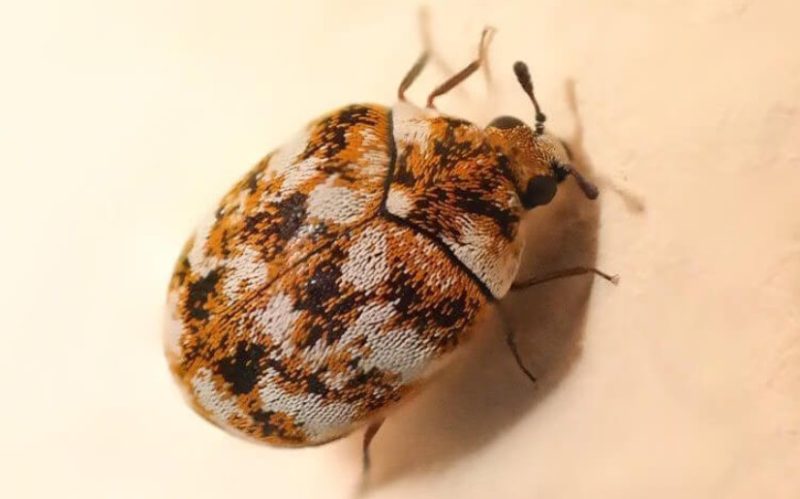
Rarely do carpet beetles appear randomly inside Virginia homes. When they are found repeatedly near windows, sills, and nearby walls, the location itself is the clue.
Virginia homeowners often assume these beetles are drawn to light alone, much like moths. In reality, windows attract carpet beetles for several layered reasons involving outdoor access, temperature, airflow, food sources, and the beetle’s life cycle. The behavior is not accidental, and it is not limited to old or poorly maintained houses.
In Virginia’s climate, windows act as transition zones between the outdoor environment and the interior ecosystem of a home. Carpet beetles use these zones strategically, especially during seasonal changes. Understanding why they gather there explains both how they enter and why they persist.
Carpet Beetles Are Outdoor Insects First

Carpet beetles do not originate inside homes.
They live outdoors in gardens, under bark, in bird nests, spider webs, and soil rich with organic debris. Adult carpet beetles feed on pollen and nectar, not fabrics. This outdoor dependence matters because windows are the most direct boundary between their natural environment and indoor spaces.
When carpet beetles appear near windows, it usually means adults entered from outside rather than emerged indoors.
Virginia’s mixed landscape of forests, yards, ornamental plants, and flowering trees supports strong outdoor beetle populations for much of the year.
Adult Carpet Beetles Are Drawn to Lighted Surfaces
Adult carpet beetles are moderately attracted to light.
Windows reflect daylight and indoor lighting at night, creating visual cues beetles use to orient themselves. South-facing and west-facing windows are especially attractive because they receive strong sunlight during the day and remain warm longer into the evening.
In Virginia, where seasonal daylight shifts sharply between spring and fall, windows become consistent visual markers during beetle movement periods.
This is why sightings often cluster around window sills rather than random rooms.
Windows Are the Most Common Entry Points
Carpet beetles do not chew their way inside.
They enter through existing openings, many of which are concentrated around windows:
Small gaps in window frames
Aging or cracked caulk
Loose trim
Improperly sealed screens
Weep holes and drainage gaps
Even well-maintained Virginia homes develop micro-gaps over time due to humidity, temperature swings, and structural settling.
Windows offer the highest density of these access points.
Virginia’s Climate Encourages Seasonal Entry
Virginia experiences humid summers and cool winters.
This seasonal contrast drives carpet beetle movement. In spring and early summer, adult beetles fly actively outdoors, especially near flowering plants. During this time, open windows and screens increase entry risk.
In fall, beetles seek sheltered spaces as outdoor resources decline. Windows again become primary access routes.
This seasonal rhythm explains why window sightings spike during specific months rather than year-round.
Why Beetles Gather Instead of Dispersing
Carpet beetles use chemical cues.
When one beetle finds a favorable entry point or resting surface, others follow. This aggregation behavior causes multiple beetles to appear in the same window area over a short period.
To homeowners, it looks like a sudden infestation.
In reality, it is repeated use of the same access point.
Window Sills Trap Heat and Airflow
Windows create microclimates.
Sunlight warms glass and frames during the day. At night, temperature differences between indoor and outdoor air cause gentle airflow around window edges.
Carpet beetles are sensitive to both heat and air movement. These conditions guide them toward windows even after entry.
Once inside, beetles remain near these zones instead of moving deeper immediately.
Why You Often See Adults, Not Larvae, Near Windows
Adult carpet beetles are mobile and visible.
Larvae behave differently. They avoid light and open areas. Larvae retreat into dark, protected locations such as:
Baseboards
Closets
Under furniture
Inside HVAC ducts
Stored fabrics
This creates a misleading pattern where adults are seen near windows while damage appears elsewhere.
The window is the entry point, not the feeding site.
Carpet Beetle Larvae Are the Real Problem
Adult carpet beetles do not damage homes.
Larvae do.
Larvae feed on natural fibers and proteins, including:
Wool
Silk
Cotton
Fur
Leather
Feathers
Pet hair
Dust and skin flakes
After adults enter through windows, they lay eggs in hidden locations where larvae can feed undisturbed.
The adult sightings near windows are often the first warning sign.
Why Virginia Homes Are Especially Vulnerable
Virginia combines several risk factors:
High humidity
Abundant vegetation
Seasonal flowering cycles
Older housing stock
Mixed rural and suburban development
These conditions support large outdoor beetle populations and create frequent indoor-outdoor movement.
Homes near wooded areas, gardens, or flowering shrubs see higher window activity.
Indoor Plants Near Windows Increase Risk
Houseplants placed near windows attract adult beetles.
Plants mimic outdoor nectar sources and provide resting areas. Soil and organic debris add scent cues.
Beetles landing on plants near windows are more likely to explore nearby cracks and enter living spaces.
This increases sightings without any structural failure.
Screens Are Not Always Protective
Screens stop flying insects but do not seal window frames.
Tiny gaps around screen edges, bent frames, or improper installation allow beetles to bypass screens entirely.
Additionally, beetles often enter before screens are installed in spring.
Relying on screens alone does not prevent entry.
Why New Homes Still Get Carpet Beetles
New construction does not guarantee protection.
Modern homes contain abundant materials larvae can feed on, including:
Carpet backing
Insulation fibers
Construction dust
Cardboard packaging
Stored clothing
New windows still require caulking and sealing. Improper installation creates entry gaps.
Virginia’s humidity accelerates material expansion and contraction even in new homes.
Why Beetles Keep Returning to the Same Window
Carpet beetles leave pheromone traces.
If a window was used successfully once, future beetles are more likely to return to the same location.
Without sealing, the cycle repeats year after year.
This explains why homeowners notice the same window affected repeatedly.
Heating and Cooling Systems Reinforce Movement
Windows interact with HVAC systems.
Air pressure differences pull outdoor air inward through small gaps. This passive airflow guides beetles inside.
In Virginia homes that use central air, this effect is strongest during seasonal transitions.
Beetles follow the airflow.
Why Vacuuming Alone Does Not Solve the Problem
Vacuuming removes visible adults but does not address entry or larvae.
Adults will continue entering through windows. Larvae remain hidden in feeding areas.
Without sealing and targeted cleaning, vacuuming becomes a temporary fix.
Why Chemical Sprays Near Windows Often Fail
Sprays kill beetles on contact but do not stop entry.
They may also repel beetles temporarily without eliminating access points.
In some cases, sprays drive beetles deeper into wall voids where eggs are laid.
Physical exclusion is more effective.
What Actually Reduces Window-Related Activity
Effective control focuses on:
Sealing window frames and trim
Replacing old caulk
Repairing screens
Reducing vegetation near windows
Removing indoor attractants near sills
Timing matters. Sealing before peak beetle season reduces sightings dramatically.
Why Window Sills Accumulate Beetle Debris
Dead beetles often collect on sills.
This is not coincidence. Beetles become trapped near light and heat sources, exhaust energy, and die.
Seeing dead beetles does not mean the problem is gone. It often means repeated entry is occurring.
Why Carpet Beetles Are Often Misdiagnosed
Many people confuse carpet beetles with bed bugs or pantry pests.
Because adults appear near windows while damage appears elsewhere, the connection is missed.
Correct identification is essential for effective control.
Seasonal Patterns in Virginia
Spring brings adult activity near windows.
Summer allows egg laying and larval growth.
Fall brings renewed adult movement.
Winter reveals larval damage indoors.
Understanding this cycle explains delayed damage.
Why Attics and Upper Floors See More Activity
Upper floors are closer to rooflines and treetops.
Flying insects reach these levels more easily. Warm air rises, increasing airflow through upper windows.
This is why carpet beetles often appear upstairs first.
When Window Sightings Indicate a Larger Issue
Repeated sightings combined with fabric damage suggest established larvae.
Signs include:
Holes in wool clothing
Shedding skins near baseboards
Damage in closets
Larvae near vents
At this stage, entry prevention must be paired with interior treatment.
Why Virginia’s Older Homes Face Higher Risk
Older homes have more gaps.
Wood framing expands and contracts. Older windows lack modern sealing. Renovations introduce new penetrations.
These homes require more thorough exclusion work.
Why Complete Elimination Takes Time
Carpet beetle eggs hatch slowly.
Larvae grow over months. Even after sealing windows, existing larvae must complete their life cycle.
Reduction is gradual, not immediate.
FAQs About Carpet Beetles Near Windows in Virginia
Are carpet beetles coming from outside?
Yes. Adults usually enter from outdoors.
Why are they always near windows?
Windows combine light, heat, and entry gaps.
Do carpet beetles damage window frames?
No. Damage occurs to fabrics, not structures.
Will replacing windows stop them?
Only if sealing is improved.
Are sprays necessary?
Usually not unless larvae are widespread.
Why do they return every year?
Unsealed entry points and pheromone cues.
Are new homes immune?
No. New materials still attract larvae.
Is this a sign of poor cleanliness?
No. It is structural and environmental.
Conclusion
Carpet beetles are often found near windows in Virginia because windows sit at the intersection of outdoor insect biology and indoor shelter.
They provide light, warmth, airflow, and the smallest gaps needed for entry. Virginia’s climate and landscape amplify this behavior, making window areas consistent hotspots year after year.
Once homeowners understand that windows are the gateway rather than the destination, control becomes far more effective.
Sealing access points, reducing attractants, and addressing larvae where they feed transforms carpet beetles from a recurring mystery into a manageable, predictable issue rooted in simple biology rather than chance.