
In Oklahoma, few snake stories spread faster than the claim that cottonmouths chase people. The story often sounds the same. Someone walks near water. A snake appears. The person backs away. The snake moves. Fear takes over. By the time the story is retold, the snake was no longer moving defensively. It was chasing.
These accounts feel real because the fear is real. Cottonmouths are large, dark, thick-bodied snakes. They live near places where people fish, wade, and walk. Encounters are sudden and unexpected. But fear does not equal intent, and movement does not equal pursuit.
To understand why this belief persists in Oklahoma, it helps to examine where cottonmouths live, how they move through space, how humans react under stress, and how memory reshapes events after the danger has passed.
Where Cottonmouth Encounters Really Occur in Oklahoma

Cottonmouth encounters in Oklahoma are far from random. These snakes are not scattered evenly across the state, and they do not appear in just any body of water. Their presence is strongly tied to a specific ecological zone concentrated in southeastern Oklahoma, where wetland systems dominate the landscape.
This region includes slow-moving rivers, forested swamps, oxbow lakes, floodplain backwaters, and low-lying wetlands connected to the Red River watershed. These habitats provide the warmth, cover, and prey cottonmouths depend on. Outside of these environments, encounters drop sharply, which explains why many reported sightings elsewhere in the state involve misidentified species.
The physical structure of these habitats plays a major role in shaping encounters. Dense vegetation limits visibility. Muddy banks restrict footing. Narrow trails and levees compress movement. Fishing access points and water edges force people and snakes into the same corridors. When a cottonmouth is encountered here, there is rarely an open field or wide escape route available. Both human and snake are suddenly required to react within seconds, often while standing only a few feet apart.
How Cottonmouths Use Space Differently Than People Expect
Cottonmouths do not use space the way people intuitively assume animals do. They do not defend territory in the mammalian sense, and they do not patrol areas looking for intruders. Their movement decisions are based on environmental needs rather than ownership or aggression.
A resting cottonmouth is already positioned with safety in mind. It chooses locations near water, tangled roots, fallen logs, or thick vegetation that provide immediate refuge. When disturbed, the snake’s priority is reaching that refuge as efficiently as possible.
Humans react differently. When startled, people retreat toward open ground, trails, or the direction they arrived from. Dense vegetation feels unsafe and unfamiliar. This difference in movement preference creates overlap. When both human and snake choose the same general direction, the snake’s escape path is mistaken for pursuit, even though neither is responding to the other as a target.
Why Movement Feels Like Pursuit During Snake Encounters
Snake encounters trigger a powerful stress response. Adrenaline floods the system. Vision narrows. Peripheral details fade. The brain shifts into survival mode, prioritizing escape over observation.
During this state, the human mind links movement with intent. If a person backs away and the snake moves, those actions are mentally connected. The snake is no longer simply moving. It is perceived as following.
In reality, both are responding to the same environmental pressure. The snake is attempting to reach cover. The human is trying to create distance. Neither is focused on chasing or being chased. The illusion arises from timing and shared space, not from intent.
Defensive Stillness Is Often Misread as Aggression
Many people expect snakes to flee immediately. Cottonmouths often do not. Their first defensive response is stillness. Their dark coloration blends into muddy water, leaf litter, and wet soil, making them difficult to detect unless they move.
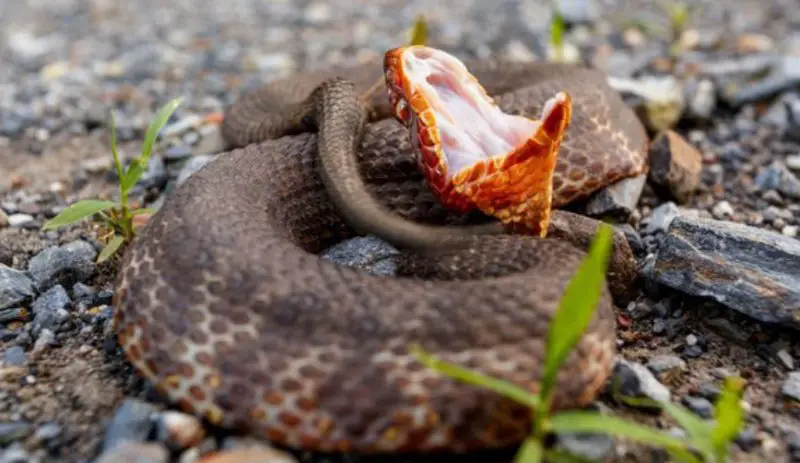
When stillness fails and the threat continues to approach, cottonmouths escalate visually rather than physically. They coil tightly, vibrate their tails, and open their mouths to reveal the white interior that serves as a high-contrast warning signal.
To an observer expecting flight, this behavior appears bold and confrontational. It feels aggressive. But the purpose is deterrence. The snake is attempting to stop forward movement, not initiate an attack.
Why Cottonmouths Appear to “Stand Their Ground”
Cottonmouths are not designed for sustained running. Their bodies are thick and muscular, optimized for ambush and short movements rather than long-distance escape on land.
Blind flight would expose them to predators and exhaustion. Instead, they rely on intimidation to buy time. By appearing larger and more threatening, they increase the chance that the perceived threat will alter its course.
If a person continues moving closer or circles around, the snake may reposition slightly to maintain a defensive buffer. This repositioning is often subtle and slow, but it becomes a central detail in chase stories once fear takes hold.
The Role of Water in Chase Stories
Water is the defining element in most cottonmouth chase claims. This is not coincidence. Water is the cottonmouth’s primary refuge and escape route.
When startled, a cottonmouth instinctively moves toward water. If the water lies behind a person or along the same bank the person is retreating on, the snake may briefly move in that direction. That moment becomes the emotional core of the encounter.
From the snake’s perspective, the person is an obstacle between it and safety. From the person’s perspective, the snake is advancing. Neither perspective involves intent to chase, but fear fills the gap.
Misidentification Amplifies Fear Across Oklahoma
Oklahoma is home to multiple nonvenomous water snake species that are frequently mistaken for cottonmouths. These snakes are slimmer, faster, and more reactive, especially when startled.
When disturbed, water snakes often flee rapidly across open ground. They may double back, cross paths, or dart toward movement simply because they are panicking. These behaviors look far more like pursuit than cottonmouth behavior ever does.
Once misidentified, the encounter reinforces the belief that cottonmouths chase people, even when the species involved was harmless.
Why Cottonmouths Carry Such a Powerful Reputation
Cottonmouths look dangerous. Their thick bodies, broad heads, and dark coloration trigger instinctive fear responses in humans. Evolution has wired people to notice and remember animals that appear capable of harm.
This visual impact alters memory. The encounter feels longer. The movement feels faster. The snake feels more deliberate and aggressive than it actually was. Over time, reputation replaces observation, and each new encounter is filtered through that expectation.
What Scientific Observation Actually Shows
Decades of field observation paint a consistent picture. Cottonmouths rely on avoidance and defensive displays, not pursuit. When given space, they retreat. When cornered, they warn. When physically threatened, they strike defensively at close range.
There is no documented evidence of cottonmouths actively chasing humans as a behavioral strategy. Bites occur during accidental contact, handling, or harassment, not during pursuit.
From an evolutionary perspective, chasing large animals that are neither prey nor competitors offers no benefit and substantial risk.
Environmental Triggers That Increase Close Encounters
Flooding is one of the strongest drivers of increased encounters in Oklahoma. Rising water displaces snakes from normal shelter, forcing them onto higher ground, trails, and roads.
During drought, the opposite occurs. Snakes concentrate near remaining water sources used by people. Visibility increases. Encounters increase. Aggression does not.
These conditions create proximity, not hostility.
Why Running Makes Encounters Worse
Running maintains movement overlap. A moving person stays within the snake’s awareness longer, increasing the chance of defensive repositioning.
Sudden movement also reduces situational awareness. People stop scanning surroundings and focus solely on escape, increasing the risk of tripping or stepping near another snake.
Calm, deliberate movement resolves encounters more quickly and with less perceived threat.
The Role of Storytelling in Reinforcing the Myth
Snake encounters are emotionally charged. Retelling emphasizes fear. Details sharpen. Intent is added.
Online platforms amplify dramatic stories. Short clips lack context. Comments reinforce expectations. The myth spreads faster than correction.
Fear travels farther than explanation.
What Oklahoma Residents Should Do Instead
Stopping reduces confusion. Distance de-escalates behavior. Most cottonmouths disengage once pressure drops.
Backing away slowly allows the snake to orient toward cover. Turning and running often removes that option visually.
Awareness, not speed, keeps people safer.
Why Accurate Understanding Matters for Safety
Fear-driven reactions increase risk. Calm observation reduces it.
Misunderstanding cottonmouth behavior leads to unnecessary killing, ecological imbalance, and continued misinformation.
Cottonmouths are part of Oklahoma’s wetland systems. Understanding how they actually behave allows people and wildlife to share the landscape with fewer conflicts and far less fear.
FAQs About Cottonmouths Chasing People in Oklahoma
Do cottonmouths intentionally chase humans?
No. There is no scientific evidence supporting intentional pursuit behavior.
Why do encounters feel so aggressive?
Defensive displays, limited space, and fear-based perception amplify movement.
Are cottonmouths found statewide in Oklahoma?
No. They are largely limited to southeastern wetland regions.
What snake is most often mistaken for a cottonmouth?
Nonvenomous water snakes are the most common source of confusion.
Do cottonmouths bite without warning?
Bites occur at close range, usually after warning displays or accidental contact.
Does running help during an encounter?
No. Calm, slow movement reduces risk more effectively.
Are cottonmouths more aggressive than other snakes?
They are more defensive visually, not more aggressive behaviorally.
Conclusion
Cottonmouths do not chase people in Oklahoma. What people experience instead is a collision of defensive behavior, shared terrain, and fear-driven interpretation. In wetland environments where movement options are limited, overlap creates convincing illusions.
Once fear assigns intent, memory reshapes the event. The myth grows. But the snake’s behavior remains the same. It seeks cover, not conflict.
Understanding that difference replaces fear with clarity and turns a frightening encounter into a manageable moment of coexistence.