
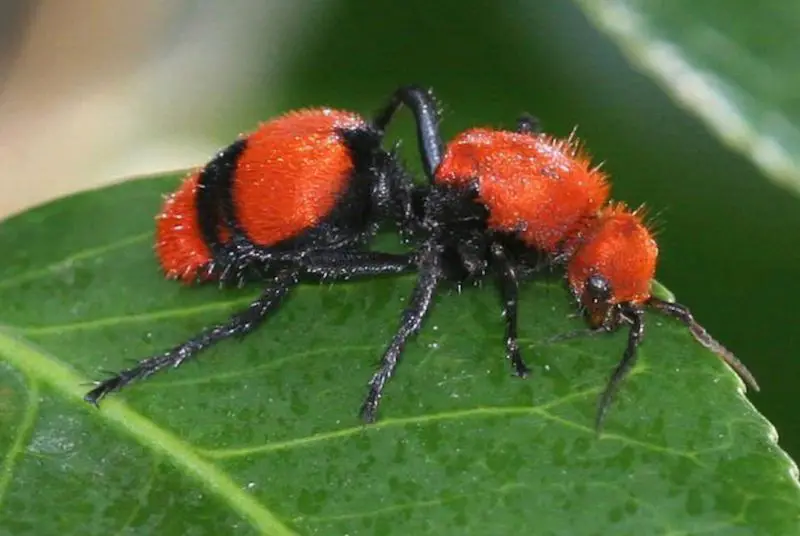
Velvet ants have one of the most intimidating reputations among insects in the southern Great Plains. In Oklahoma, ranchers, farmers, and rural residents often refer to them as “cow killers,” a name that immediately suggests danger to livestock. Bright red and black, fast-moving, and armed with a painful sting, velvet ants are easy to fear when they appear in pastures or around barns.
But reputation does not always match reality.
This article takes a detailed look at whether velvet ants truly pose a real threat to cattle in Oklahoma, separating myth from biology, fear from documented risk, and rumor from what science and field observations actually show.
What Velvet Ants Actually Are

Despite their name, velvet ants are not ants at all. They are a group of solitary wasps in the family Mutillidae. The females are wingless and resemble large, fuzzy ants, while males have wings and are rarely noticed.
In Oklahoma, the most commonly encountered species is Dasymutilla occidentalis, often called the eastern velvet ant. Females are easily recognized by their dense red-orange hair covering the head and thorax, contrasted with a black abdomen. Males are similar in color but slimmer and capable of flight.
Velvet ants are solitary insects. They do not form colonies, do not build nests like ants or hornets, and do not defend territory. Each individual lives independently, which is an important detail when considering risk to large animals.
Why Velvet Ants Are Called “Cow Killers”
The nickname “cow killer” is deeply ingrained in rural folklore across Oklahoma and neighboring states. It comes from the velvet ant’s sting, which is widely regarded as one of the most painful insect stings in North America.
The sting ranks extremely high on pain scales because it delivers intense, immediate pain that can last for several minutes. This pain, however, is localized, not toxic in a systemic way.
The name does not come from documented cases of cattle deaths. Instead, it likely arose from exaggeration, storytelling, and the shock value of the sting when experienced by humans.
Pain does not equal lethality.
Understanding the Velvet Ant Sting
Only female velvet ants can sting, as males lack a stinger entirely. The female’s stinger is long and strong, capable of penetrating thick skin. This allows her to defend herself against predators such as birds, lizards, or small mammals.
The venom itself is not designed to kill large animals. It is a defensive venom meant to cause pain, discourage attack, and allow escape.
In humans, velvet ant stings are intensely painful but rarely medically dangerous unless an allergic reaction occurs. There is no evidence that velvet ant venom contains compounds capable of causing organ failure, paralysis, or death in large mammals.
Do Velvet Ants Attack Cattle?
No. Velvet ants do not attack cattle.
They are not aggressive insects. They do not seek out animals to sting, and they do not defend nests or food sources. A velvet ant will only sting if it is physically threatened, stepped on, grabbed, or crushed.
Cattle are not targets. Velvet ants do not climb onto livestock, do not swarm, and do not behave in a way that would lead to intentional stinging.
Any interaction between a velvet ant and a cow would be accidental.
Could a Velvet Ant Sting Kill a Cow?
There is no documented evidence that a velvet ant sting can kill a cow.
For a sting to be fatal to a large animal like cattle, one or more of the following would need to occur:
• A highly toxic venom capable of systemic damage
• Multiple stings delivered rapidly
• A severe allergic reaction
Velvet ants fail to meet all three conditions.
They are solitary, meaning mass stinging is impossible. Their venom is painful but not systemically toxic. Allergic reactions in cattle to velvet ant venom are virtually undocumented.
Even if a cow were stung once, the likely outcome would be a brief pain response, such as a flinch or step away, not a medical emergency.
Why the Myth Persists in Oklahoma
The cow killer myth persists for several reasons.
First, velvet ants are visually striking. Their bright coloration is a classic warning signal in nature, meant to advertise danger. Humans interpret this as extreme threat.
Second, the sting is legendary among people who have experienced it. Stories spread quickly in rural communities, and pain-based anecdotes often grow with retelling.
Third, velvet ants are commonly seen in open pastures, sandy soils, and ranch environments. Their presence near cattle leads to assumptions of danger by association.
Finally, the name itself reinforces fear. Once something is called a “cow killer,” logic often takes a back seat.
How Velvet Ants Actually Live in Oklahoma
Velvet ants thrive in dry, open habitats. In Oklahoma, they are commonly found in:
• Pastures and rangeland
• Sandy or loose soils
• Field edges and dirt roads
• Open woodlands
• Areas with ground-nesting bees or wasps
They spend much of their time searching for hosts. Female velvet ants lay their eggs inside the nests of other insects, especially ground-nesting bees and wasps. The velvet ant larva then develops as a parasite on the host.
They do not feed on plants, animals, or livestock. Adults primarily consume nectar.
Why Velvet Ants Are Seen in Cattle Pastures
Cattle pastures provide ideal conditions for velvet ants, but not because of the cattle themselves.
Pastures often have:
• Open, sunny ground
• Sandy or disturbed soil
• Ground-nesting insects
• Minimal tree cover
These conditions support the insects velvet ants depend on for reproduction. Cattle presence is incidental.
Velvet ants are not attracted to manure, feed, blood, or livestock activity. They simply share the same environment.
Risk of Multiple Stings to Livestock
Unlike bees or social wasps, velvet ants cannot swarm.
Each female is alone. There is no colony to defend. There is no alarm pheromone to recruit others.
This makes the idea of multiple stings to cattle extremely unlikely. A cow would have to repeatedly step on or crush several velvet ants in a short time frame, which is not realistic.
Even then, pain would be the primary effect, not toxicity.
Do Velvet Ants Cause Secondary Injuries?
One theoretical concern is whether a sudden sting could cause a cow to panic, stumble, or injure itself.
In practice, this risk is extremely low.
Cattle regularly experience painful stimuli, including insect bites from flies, ticks, and biting insects. A single sharp sting is unlikely to cause more than a brief reaction.
There is no evidence that velvet ants contribute meaningfully to cattle injuries or stress-related incidents.
Are Calves More Vulnerable?
Calves are smaller and more sensitive than adult cattle, which sometimes raises concern.
However, calves are still far larger than any animal velvet ant venom could endanger. As with adult cattle, the main risk would be momentary pain if stepped on, not poisoning or death.
There are no documented cases of calves harmed or killed by velvet ants in Oklahoma or elsewhere.
How Ranchers Should Respond to Velvet Ants
In most cases, no response is necessary.
Velvet ants do not infest areas in large numbers, and they do not damage forage, fencing, or infrastructure. They are a natural part of Oklahoma’s insect ecosystem.
If velvet ants are frequently encountered near human activity areas, simple precautions can help:
• Avoid handling them
• Educate workers and family members
• Wear boots in sandy areas
• Do not attempt to crush them by hand
Chemical control is rarely justified and often ineffective, as velvet ants are mobile and solitary.
Are Velvet Ants Protected or Beneficial?
Velvet ants play a role in regulating populations of ground-nesting insects. By parasitizing certain bees and wasps, they help maintain ecological balance.
They also serve as prey for some specialized predators that can tolerate their defenses.
While they may appear threatening, velvet ants are not pests in the traditional sense.
Comparing Velvet Ants to Real Livestock Threats
When evaluating risk to cattle in Oklahoma, velvet ants rank extremely low compared to genuine threats such as:
• Heat stress
• Poisonous plants
• Ticks and tick-borne diseases
• Biting flies
• Snakebite
• Nutritional deficiencies
Focusing concern on velvet ants distracts from risks that actually impact cattle health and productivity.
What Science Says, Clearly
Based on available evidence:
• Velvet ants do not attack cattle
• Velvet ant venom is not lethal to livestock
• There are no verified cases of cattle deaths from velvet ant stings
• The “cow killer” name is a myth, not a medical reality
The threat is perceived, not real.
FAQs About Velvet Ants and Cattle in Oklahoma
Can velvet ants really kill cows?
No. There is no documented evidence that velvet ants can kill cattle. Their sting is extremely painful but not toxic enough to cause serious harm to large animals.
Why are velvet ants called “cow killers”?
The nickname comes from folklore and the intense pain of the sting, not from real cases of livestock deaths. It reflects fear, not biological reality.
Do velvet ants attack cattle on purpose?
No. Velvet ants are solitary and non-aggressive. They only sting when threatened, such as when stepped on or handled.
Could multiple velvet ant stings harm a cow?
This is extremely unlikely. Velvet ants do not swarm or attack in groups, and multiple stings to cattle have not been documented as dangerous.
Are calves at higher risk than adult cattle?
No. Even calves are far too large to be seriously affected by velvet ant venom. At most, a sting would cause brief discomfort.
Do velvet ants live in cattle pastures because of livestock?
No. They are attracted to open, sandy soil and ground-nesting insects, not to cattle, manure, or feed.
Should ranchers try to eliminate velvet ants from pastures?
Usually no. Velvet ants do not damage forage or livestock and play a role in controlling other insect populations.
Can velvet ants cause cattle to panic or injure themselves?
There is no evidence that velvet ants cause meaningful stress or injury to cattle. A single sting may cause a brief reaction, similar to other insect encounters.
Are velvet ants dangerous to people working around cattle?
They can sting if handled, and the sting is painful. Wearing boots and avoiding contact are usually sufficient precautions.
What should I do if I see velvet ants in my pasture?
Leave them alone. They are part of the natural ecosystem and pose little to no risk to cattle.
Final Thoughts
Velvet ants are dramatic insects with a painful defense, but they are not a danger to cattle in Oklahoma. Their reputation as “cow killers” is rooted in folklore and fear rather than science.
For ranchers and landowners, velvet ants are best understood as a natural part of the landscape, not a livestock threat. Awareness, not alarm, is the appropriate response.
In Oklahoma’s wide-open pastures, velvet ants look intimidating, but cattle face far greater risks from things far less colorful and far more real.