
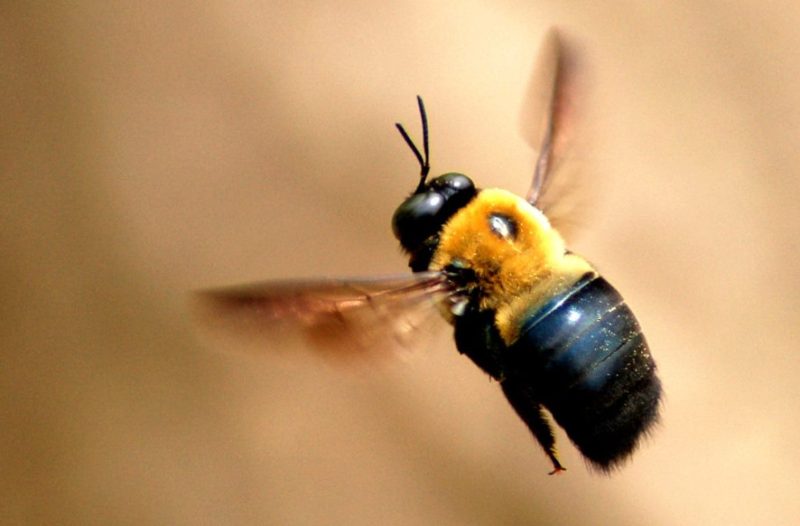
Homeowners across Colorado often notice the same puzzling scene each spring. Large black bees begin hovering around wooden decks, roof eaves, fence posts, or porch beams. They fly slowly and deliberately, sometimes pausing midair as if watching anyone who walks nearby. The insects may appear territorial, circling the same section of wood day after day.
At first, many residents assume they are dealing with aggressive bees or even wasps.
The insects look large and intimidating. Their buzzing flight can seem confrontational, especially when one hovers near a person standing on a porch or deck.
Yet these insects are usually something far less dangerous.
They are carpenter bees.
Understanding why carpenter bees keep appearing around Colorado homes requires looking closely at how these insects live. Their behavior is closely tied to wood, temperature, and seasonal cycles that repeat across the state every year.
For homeowners unfamiliar with their habits, carpenter bee activity can feel sudden or mysterious. In reality, the insects are simply following a life cycle that has evolved over thousands of years in environments filled with natural wood.
Table of Contents
- 1 The Large Bee Many Homeowners Notice
- 2 Why Wood Structures Attract Carpenter Bees
- 3 The Hidden Tunnels Inside Wood
- 4 Why Carpenter Bees Return Every Spring
- 5 Why Carpenter Bees Hover Around People
- 6 Why Colorado’s Climate Supports Carpenter Bees
- 7 Carpenter Bees and Pollination
- 8 Natural Predators of Carpenter Bees
- 9 Why Carpenter Bee Activity Peaks in Spring
- 10 Do Carpenter Bees Damage Homes?
- 11 Why Carpenter Bees Prefer Certain Types of Wood
- 12 FAQs About Carpenter Bees Around Homes
- 13 Final Thoughts
The Large Bee Many Homeowners Notice

The insects responsible for these sightings are most commonly the Eastern Carpenter Bee and closely related carpenter bee species found across North America.
Carpenter bees are among the largest bees people commonly see around homes. Many measure nearly an inch in length, with thick bodies and powerful wings.
They often resemble bumblebees at first glance.
However, carpenter bees can be distinguished by their shiny black abdomens. Bumblebees have fuzzy bodies from head to tail, while carpenter bees appear smooth and glossy on the back half of their bodies.
This difference helps identify them when they hover around wooden structures.
Despite their size, carpenter bees are generally not aggressive toward humans. Most of the bees homeowners see hovering nearby are males that cannot sting.
Their hovering behavior often gives the impression that they are guarding territory, but they are usually just investigating their surroundings or defending nesting areas from other bees.
Why Wood Structures Attract Carpenter Bees
Carpenter bees receive their name from the unusual way they build nests.
Instead of constructing hives like honeybees, female carpenter bees excavate tunnels inside wood. They use strong jaws to chew through the surface of wooden structures and create round entry holes about the size of a pencil.
These tunnels become nesting chambers where eggs develop safely.
Natural environments originally provided the wood carpenter bees needed for nesting. Dead tree branches, fallen logs, and weathered trunks offered ideal nesting sites.
However, human structures now provide similar materials.
Deck railings, porch beams, wooden siding, and fence posts often consist of untreated or weathered wood that carpenter bees can easily excavate.
Softwoods such as pine or cedar are especially attractive.
Because many Colorado homes include outdoor wooden structures, they unintentionally create perfect nesting opportunities for these insects.
The Hidden Tunnels Inside Wood
Once a female carpenter bee begins nesting, she drills straight into the wood surface before turning the tunnel sideways. This creates a long chamber that runs parallel to the grain of the wood.
Inside the tunnel, the female builds several small compartments.
Each compartment contains a mixture of pollen and nectar gathered from nearby flowers. This food supply becomes nourishment for the developing larva.
After placing an egg on the pollen mass, the female seals the chamber with a wall made from chewed wood pulp.
She then creates another chamber behind it.
This process continues until the tunnel contains several sealed cells.
Each egg eventually develops into a larva, then a pupa, and finally an adult bee.
Although the activity remains hidden within the wood, these tunnels may extend several inches or even a foot beneath the surface.
Why Carpenter Bees Return Every Spring
Many Colorado homeowners notice carpenter bees appearing in the same locations each year.
This repeated activity occurs because carpenter bees often reuse existing tunnels.
Young adult bees that emerge from tunnels later in the season may remain near the area where they were born. When spring returns, females may expand the same tunnels or create new branches connected to the original ones.
Old nesting sites therefore become attractive locations for new generations.
Over time, multiple tunnels may form within the same wooden beam or railing.
Because the entrances are small and difficult to see from a distance, homeowners sometimes remain unaware of the nesting activity until bees begin hovering nearby again the following year.
The presence of old tunnels can make a structure particularly appealing to carpenter bees searching for nesting sites.
Why Carpenter Bees Hover Around People
One of the most noticeable behaviors associated with carpenter bees involves their tendency to hover near people.
Homeowners standing on a porch or deck may see a bee floating in front of them, sometimes moving closer before flying away again.
This behavior is usually performed by male bees.
Male carpenter bees patrol areas around nesting tunnels while searching for females. When a person enters the area, the male may investigate briefly.
Although this hovering can appear threatening, males cannot sting.
Female carpenter bees possess stingers but rarely use them unless physically handled.
For most people, the hovering behavior simply represents a territorial display rather than aggression.
Once the bee determines that a person is not another bee entering the nesting area, it typically flies away.
Why Colorado’s Climate Supports Carpenter Bees
Colorado’s climate creates favorable conditions for carpenter bee activity during much of the spring and summer.
Warmer temperatures encourage bees to become active earlier in the season. Flowering plants across gardens and natural landscapes provide the nectar and pollen needed to feed developing larvae.
At the same time, dry conditions common across parts of Colorado help preserve wooden structures.
While this dryness protects wood from rot, it also leaves the material firm but workable for carpenter bees.
The combination of warm temperatures, abundant flowers, and accessible wood makes many Colorado neighborhoods suitable habitats for these insects.
Suburban environments often contain flowering gardens alongside wooden decks and fences, creating ideal nesting and feeding conditions within the same location.
Carpenter Bees and Pollination
Although homeowners sometimes focus on the holes carpenter bees create in wood, these insects also serve as valuable pollinators.
While collecting nectar and pollen, carpenter bees transfer pollen between flowers, helping plants reproduce.
Many native plants rely on large bees for effective pollination.
Carpenter bees possess strong bodies capable of vibrating flowers to release pollen, a process sometimes called buzz pollination.
This behavior allows them to pollinate certain plants more efficiently than smaller insects.
Because of their size and strength, carpenter bees contribute significantly to pollination in natural ecosystems.
They also visit many garden plants, including tomatoes, eggplants, and various wildflowers.
Their presence therefore reflects a healthy pollinator community in the surrounding environment.
Natural Predators of Carpenter Bees
Carpenter bees face several predators within natural ecosystems.
Birds such as woodpeckers occasionally dig into wooden structures searching for larvae hidden within tunnels. While this behavior may damage wood further, it represents part of the natural predator-prey relationship.
Other insects also interact with carpenter bees.
Certain parasitic wasps may lay eggs near carpenter bee nests. When the larvae hatch, they consume the developing bee larvae within the tunnels.
Spiders sometimes capture adult bees that fly too close to webs built near vegetation or structures.
These predator relationships help regulate carpenter bee populations in natural environments.
Even though homeowners may notice individual bees around their houses, many of these insects become prey before completing their life cycle.
Why Carpenter Bee Activity Peaks in Spring
Carpenter bee activity becomes most noticeable during spring months when adult bees emerge from winter shelters.
After surviving the winter in protected locations such as hollow stems or old tunnels, adult bees become active when temperatures rise.
Males begin patrolling nesting areas while females search for suitable wood to excavate.
This period often produces the highest level of visible activity around homes.
By early summer, most nests are already established and the bees become less noticeable.
New adult bees later emerge from tunnels toward the end of summer.
These younger bees often spend time feeding on flowers before seeking sheltered places to overwinter.
The cycle then repeats the following year.
Do Carpenter Bees Damage Homes?
Carpenter bees rarely cause severe structural damage to homes.
The tunnels they create usually remain limited to the outer layers of wood such as railings, siding, or trim boards.
However, repeated nesting in the same area over many years may gradually weaken certain pieces of wood.
Additional damage sometimes occurs when woodpeckers attempt to reach larvae inside tunnels.
Because of these factors, homeowners often notice small holes and sawdust-like material near wooden surfaces where bees have been active.
Understanding how carpenter bees build their nests helps explain why these signs appear.
Why Carpenter Bees Prefer Certain Types of Wood
Not all wooden surfaces attract carpenter bees equally.
Bees usually prefer bare, untreated wood with exposed grain. Weathered wood often becomes more attractive because the outer fibers soften slightly over time.
Softwoods such as pine, cedar, redwood, and fir are easier for bees to excavate than dense hardwoods.
Painted or sealed wood surfaces tend to discourage nesting because the protective coating creates a harder barrier.
As a result, unfinished wood structures often experience the highest levels of carpenter bee activity.
Decks, pergolas, and fence posts made from untreated lumber frequently become nesting locations.
Understanding these preferences helps explain why some structures attract bees while others remain untouched.
FAQs About Carpenter Bees Around Homes
Are carpenter bees dangerous?
Carpenter bees are generally not aggressive. Male bees cannot sting, and females rarely sting unless handled.
Why do carpenter bees hover near people?
Male bees often patrol nesting areas and may investigate movement nearby.
Do carpenter bees return every year?
Yes. Bees often reuse old tunnels or build new ones in the same area.
Do carpenter bees pollinate flowers?
Yes. Carpenter bees are effective pollinators for many plants and wildflowers.
Why do carpenter bees drill holes in wood?
Females excavate tunnels to create nesting chambers where their eggs develop.
Final Thoughts
Homeowners across Colorado frequently notice carpenter bees hovering around decks, fences, and porch beams each spring. While their presence may seem alarming at first, these insects are simply following a natural life cycle tied closely to wood and seasonal temperatures.
Their nesting behavior evolved long before human homes existed, when fallen trees and branches served as nesting sites across forests and grasslands.
Today, wooden structures provide similar environments where carpenter bees continue this ancient behavior.
Although the holes they create in wood may draw attention, carpenter bees also play an important role as pollinators within local ecosystems.
Understanding why carpenter bees keep appearing around Colorado homes reveals that their activity reflects the complex interaction between insects, plants, and human-built environments that shape life across the landscape.