
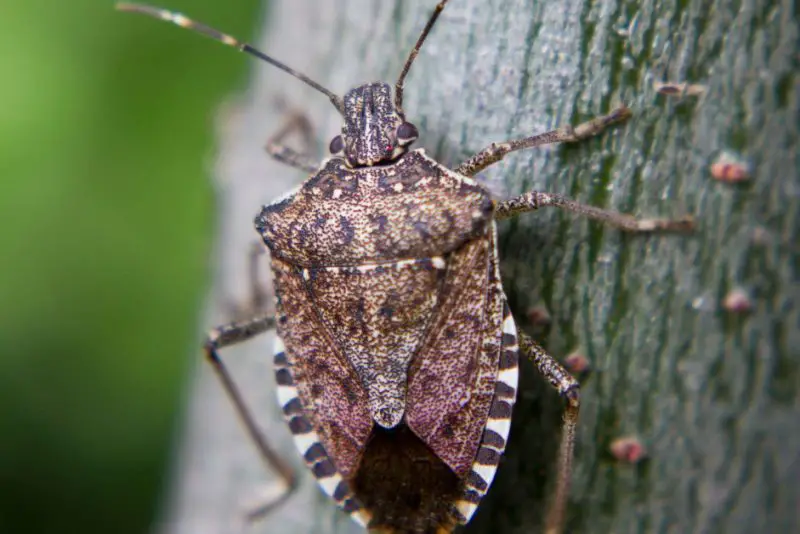
When nighttime temperatures begin dropping in Oklahoma, adult stink bugs shift their behavior. Instead of dispersing widely across crops and trees, they begin concentrating on vertical surfaces that hold residual warmth. Sunlit siding, brick, and stone walls provide short-term thermal stability during cooling evenings. What appears to be clustering is actually a temperature-driven regrouping phase before overwintering begins.
What most Oklahoma residents don’t realize about stink bug swarms is that this visible regrouping represents the final stage of a months-long outdoor cycle. The insects gathering on homes have already completed their summer feeding and development in surrounding agricultural and wooded landscapes. Structures do not create the population. They simply provide insulated voids that allow adults to survive winter dormancy. The concentration on exterior walls is about microclimate selection, not indoor reproduction.
The swarm feels intrusive because it concentrates on structures.
But the biology driving it begins far beyond the house.
Understanding that landscape scale changes how you interpret what seems like sudden infestation.
The Species Behind Oklahoma’s Swarms

Several stink bug species exist in Oklahoma, but the one most associated with fall swarming behavior is the Brown Marmorated Stink Bug. Although more heavily documented in eastern states, established populations have expanded across portions of Oklahoma, especially in areas with strong agricultural corridors and suburban development.
Native stink bug species are also present, yet they tend to overwinter in leaf litter and natural cavities rather than clustering in large numbers on homes. The brown marmorated stink bug displays stronger aggregation behavior around human structures, particularly in fall.
This species feeds on a wide range of crops and ornamental plants, including soybeans, corn, fruit trees, and various garden vegetables. Throughout the warm months, it disperses widely. By late summer, adults begin shifting from feeding to shelter-seeking behavior as daylight shortens and nighttime temperatures decline.
The insects are not multiplying on siding.
They are leaving feeding grounds.
Their movement reflects environmental signals, not household invitation.
Why Oklahoma’s Climate Amplifies Swarm Visibility
Oklahoma’s climate plays a critical role in swarm intensity. The state experiences strong seasonal contrast, with hot summers, warm falls, and periodic abrupt cold fronts. These temperature swings sharpen the migration window.
During late summer, stink bugs feed heavily in crop fields and gardens. When the first consistent cool nights arrive, adults detect photoperiod change and begin preparing for diapause, a dormant overwintering state. Warm sunny afternoons combined with cool evenings create strong thermal gradients on buildings.
South- and west-facing walls absorb solar radiation throughout the day and release heat slowly at night. In open Oklahoma landscapes where structures stand prominently against fields or low tree lines, these warm surfaces become highly visible landing sites.
The insects are responding to heat retention.
They are seeking insulated cavities.
The house functions as a thermal landmark.
The Agricultural Engine Behind Swarms
Oklahoma’s agricultural footprint strongly influences stink bug population density. Soybeans, sorghum, corn, and fruit crops provide abundant summer feeding habitat. As harvest approaches in late summer and early fall, food availability drops sharply.
When combines clear fields, adult stink bugs disperse in search of shelter. Homes located near farmland often experience heavier clustering because they sit directly along dispersal routes. Even suburban neighborhoods bordering agricultural zones may see intensified migration during peak harvest.
The insects are not emerging from inside homes.
They are exiting crops.
Harvest compresses populations toward overwintering structures.
The swarm reflects agricultural timing.
Why Swarms Feel Sudden
Homeowners frequently describe stink bug swarms as appearing overnight. One afternoon the siding looks clear. The next morning dozens cling to sunlit walls.
In reality, migration builds gradually across the landscape. As fields are harvested in waves, insects disperse incrementally. When atmospheric conditions align—clear skies, moderate winds, bright afternoon sun—flight activity peaks simultaneously.
This synchronized movement creates the illusion of sudden arrival.
Oklahoma’s open terrain magnifies visibility. Structures stand prominently against fields and prairie edges, making aggregation highly noticeable.
The buildup occurred quietly.
The concentration became visible all at once.
Perception reacts to density.
Biology responds to temperature.
Why They Cluster on Specific Sides of Homes
Not all sides of a home experience equal clustering. South- and west-facing walls typically host heavier aggregations because they receive maximum afternoon sun. Dark siding, brick, and stone amplify heat retention.
Stink bugs often land and remain on exterior surfaces for hours or even days before entering. This staging period allows them to assess structural suitability. Chemical aggregation pheromones released by early arrivals attract additional individuals, increasing cluster density.
The wall is not necessarily the final shelter.
It is the evaluation point.
Cracks around windows, gaps in siding, attic vents, and soffit openings provide entry once assessment is complete.
The clustering is purposeful.
It is not random wandering.
Why Some Oklahoma Years Are Worse
Stink bug density fluctuates annually. Mild winters increase overwinter survival of adults hidden in natural and structural shelters. Warm springs accelerate egg-laying and nymph development. Strong crop yields support higher feeding success.
When favorable conditions stack across seasons, fall migration intensifies. Residents experience what feels like an explosion of insects, though the buildup began months earlier.
Conversely, severe winter freezes or prolonged drought may reduce survival rates temporarily.
Population density reflects climate memory.
Each mild winter adds survivors.
Each productive growing season fuels migration.
Swarm size carries the signature of prior weather patterns.
Indoor Sightings During Winter
After entry into wall voids or attics, adult stink bugs enter diapause. They remain largely inactive during winter, conserving energy. However, Oklahoma’s fluctuating winter temperatures may periodically stimulate movement.
Warm spells in January or February can activate overwintering individuals. Indoor heating may also warm wall cavities, prompting occasional emergence into living spaces.
Homeowners often interpret mid-winter sightings as ongoing infestation.
In most cases, these are overwintering adults disturbed by temperature change.
They are not reproducing indoors.
They are responding to warmth.
Spring arrival triggers outward migration rather than multiplication.
The Odor Factor and Defensive Behavior
Stink bugs release volatile compounds when crushed or threatened. The odor functions as a predator deterrent in natural ecosystems. Indoors, crushing the insect intensifies smell and may release alarm pheromones that stimulate movement in nearby individuals.
Mechanical removal using vacuum devices with disposable bags typically reduces odor compared to crushing.
The smell is unpleasant but not dangerous.
It is defensive chemistry.
The insect is protecting itself, not attacking.
Urban vs. Rural Pressure in Oklahoma
Rural homes near crop fields experience heavier fall pressure due to proximity to feeding habitat. Suburban neighborhoods adjacent to greenbelts, orchards, or unmanaged lots may also see moderate clustering.
Urban cores with limited vegetation typically experience lower swarm density, though isolated infestations may still occur.
Landscape context shapes intensity.
Distance from agricultural corridors influences pressure.
Not every Oklahoma neighborhood experiences equal swarm scale.
Why Spraying Alone Rarely Works
Surface spraying may temporarily reduce visible numbers on siding, but it does not eliminate migrating populations across broad landscapes. Effective management focuses on exclusion.
Sealing cracks around window frames, installing fine mesh on vents, repairing damaged siding, and ensuring tight-fitting door sweeps reduce entry opportunities significantly.
Preventive sealing before migration season is more effective than reactive spraying during peak clustering.
The building envelope is the barrier.
Reduce access, reduce indoor presence.
Without exclusion, migration pressure returns each fall.
Climate Variability and Future Trends
Oklahoma’s climate includes periods of drought, intense storms, and variable winter severity. These fluctuations influence stink bug survival and host plant health.
Warmer falls may extend staging periods, increasing visible clustering duration. Increased storm variability may influence agricultural yield, indirectly shaping feeding success.
Climate does not eliminate stink bug presence.
It modifies density and timing.
Long-term trends may adjust migration windows rather than remove the phenomenon.
The insects respond to thermal cues, not calendar dates.
Psychological Amplification of Swarms
Large clusters of shield-shaped insects trigger discomfort because of scale and unpredictability. Their size and slow crawling movement along walls amplify unease.
Yet stink bugs do not bite, sting, or cause structural damage. Their primary impact is nuisance and odor.
Human perception reacts strongly to visible density.
Ecology explains that density as seasonal compression.
Understanding this distinction reframes the experience from invasion to migration.
Long-Term Outlook for Oklahoma
Stink bug populations in Oklahoma are likely to persist. Agricultural landscapes, climate suitability, and structural heat retention ensure continued seasonal migration.
Population levels will fluctuate with winter severity and crop success. Homes that improve structural sealing will experience fewer indoor encounters.
Fall swarms are not anomalies.
They are predictable biological events.
Fields fuel summer growth.
Harvest triggers dispersal.
Sunlit walls provide staging warmth.
Small gaps offer shelter.
What most Oklahoma residents don’t realize is that stink bug swarms reflect landscape-scale timing rather than household vulnerability.
The insects are following heat and survival cues.
They are not targeting your home.
They are following the season.
FAQs About Stink Bug Swarms in Oklahoma
Are stink bugs breeding inside homes?
No. Most indoor individuals are overwintering adults seeking shelter.
Why are they worse near farmland?
Agricultural crops provide summer feeding habitat, increasing fall migration density nearby.
Do they damage houses?
They are nuisance pests but do not structurally damage buildings.
Why do they gather on sunny walls?
Heat retention signals suitable overwintering microclimates.
Will they disappear after winter?
Most leave structures in spring to resume outdoor feeding and reproduction.
Final Thoughts
What most Oklahoma residents don’t realize about stink bug swarms is that they are not sudden invasions but predictable seasonal migrations shaped by agriculture, temperature gradients, and building design.
Summer crops fuel population growth.
Cooling nights trigger dispersal.
Warm siding provides temporary refuge.
Structural gaps allow entry.
The swarm feels personal because it concentrates on your house. Yet its origin lies in fields, orchards, and seasonal change across the broader Oklahoma landscape.
Understanding that scale replaces frustration with pattern recognition.
And pattern recognition leads to smarter prevention rather than panic.