
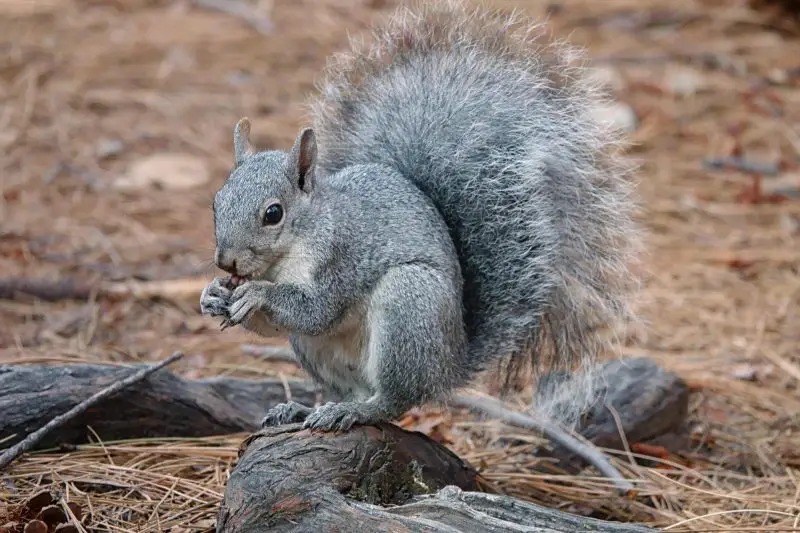
Oregon’s forests, woodlands, and mountain slopes are home to a surprising variety of squirrels, each adapted to a specific landscape and lifestyle. From large tree squirrels moving through oak canopies to small ground-dwelling chipmunks darting across forest floors, these mammals are a constant presence across the state.
Some species are easy to spot in parks and neighborhoods, while others remain hidden in dense forests or only appear after sunset. Their differences in size, behavior, and habitat often make identification confusing, especially for casual observers.
This guide explores seven types of squirrels found in Oregon, focusing on clear identification traits and where each species is most likely to be seen in the wild.
Table of Contents
- 1 Different Types of Squirrels Found in Oregon
- 1.1 Western Gray Squirrel (Sciurus griseus)
- 1.2 Eastern Gray Squirrel (Sciurus carolinensis)
- 1.3 Douglas Squirrel (Tamiasciurus douglasii)
- 1.4 American Red Squirrel (Tamiasciurus hudsonicus)
- 1.5 Northern Flying Squirrel (Glaucomys sabrinus)
- 1.6 Townsend’s Chipmunk (Neotamias townsendii)
- 1.7 Yellow-pine Chipmunk (Neotamias amoenus)
- 2 Tips for Observing Squirrels in Oregon
- 3 Best Time of Day to See Squirrels
- 4 Best Places to Observe Squirrels in Oregon
- 5 FAQs About Squirrels in Oregon
- 5.1 Are squirrels active year-round in Oregon?
- 5.2 What is the rarest squirrel species in Oregon?
- 5.3 Do squirrels cause harm to forests?
- 5.4 Are flying squirrels dangerous or aggressive?
- 5.5 Can squirrels glide long distances?
- 5.6 Do chipmunks climb trees?
- 5.7 Is it legal to feed squirrels in Oregon?
- 5.8 When is the best season to observe squirrels?
- 6 Conclusion
Different Types of Squirrels Found in Oregon
Western Gray Squirrel (Sciurus griseus)

Key Identification Features
-
Large tree squirrel with a long, bushy tail
-
Silvery gray back with lighter gray to white underside
-
No rusty or red coloration on body or tail
-
Strong hind legs adapted for climbing and jumping
The Western Gray Squirrel is the largest native tree squirrel in Oregon and has a noticeably sleek, pale gray appearance. Its long, plume-like tail often appears almost as long as its body, helping with balance while moving through tree canopies. Unlike some other squirrels, it lacks reddish tones, which helps distinguish it from red or Douglas squirrels at a glance.
Adults are robust and heavy-bodied, typically larger than introduced gray squirrels found in urban areas. Their size gives them an advantage when foraging for hard mast such as acorns and walnuts. Their strong jaws allow them to crack open tough shells that smaller squirrels may struggle with.
Behaviorally, Western Gray Squirrels are cautious and less tolerant of human disturbance. They spend much of their time high in trees, moving quietly and freezing when alarmed. When threatened, they rely on height and stillness rather than aggressive vocalizations.
In Oregon, this species is most closely associated with oak woodlands, mixed hardwood forests, and forest edges. They are especially tied to Oregon white oak ecosystems. A notable fun fact is that Western Gray Squirrels play an important role in forest regeneration by burying acorns and forgetting some of them, allowing new trees to grow.
Eastern Gray Squirrel (Sciurus carolinensis)

Key Identification Features
-
Medium to large tree squirrel with variable gray coloration
-
White or pale underside
-
Bushy tail with white-edged hairs
-
Color can range from silver-gray to dark gray or black
The Eastern Gray Squirrel is not native to Oregon but has become one of the most familiar squirrels in urban and suburban areas. Its coloration varies widely, which can sometimes cause confusion with native species. The tail is full and expressive, often flicked rapidly during movement or alarm.
In terms of size, Eastern Gray Squirrels are slightly smaller than Western Gray Squirrels but still relatively large compared to other species. They have a sturdy build and are well adapted to climbing trees, navigating rooftops, and exploiting human-altered environments.
These squirrels are highly adaptable and bold. They readily approach bird feeders, parks, and residential neighborhoods, often showing little fear of people. Their intelligence and problem-solving ability allow them to access food sources that other wildlife cannot.
In Oregon, Eastern Gray Squirrels are most common in cities, towns, and landscaped areas west of the Cascades. A fun fact about this species is its exceptional memory, which helps it recover buried food caches months later, even under snow or leaf litter.
Douglas Squirrel (Tamiasciurus douglasii)

Key Identification Features
-
Small squirrel with dark brown to reddish-brown fur
-
Distinct white or pale eye ring
-
Shorter, less bushy tail compared to gray squirrels
-
Often seen with an alert, upright posture
The Douglas Squirrel, also known as the Chickaree, is a compact and energetic species common throughout Oregon’s conifer forests. Its darker coloration blends well with evergreen trees, making it harder to spot despite its loud presence. The eye ring is one of the most reliable identification clues.
This species is much smaller than gray squirrels, with a more compact body and shorter tail. Despite its size, it is extremely agile and fast, darting along branches and tree trunks with quick, jerky movements.
Douglas Squirrels are famously aggressive and vocal. They defend food caches, known as middens, with sharp chatter and alarm calls. These squirrels are highly territorial and will chase away birds, other squirrels, and even animals much larger than themselves.
They are found primarily in dense coniferous forests across western and central Oregon. A fun fact is that their middens, made up of cone scales, can be reused year after year and often become important food sources for other animals once abandoned.
American Red Squirrel (Tamiasciurus hudsonicus)

Key Identification Features
-
Small squirrel with reddish-brown back and lighter belly
-
White eye ring similar to Douglas Squirrel
-
Short, bushy tail often edged with black
-
Compact body with alert facial expression
The American Red Squirrel closely resembles the Douglas Squirrel but tends to have brighter reddish tones. In Oregon, it is far less widespread, making sightings more notable. Its facial features are sharp, giving it an intense, watchful appearance.
This squirrel is small but muscular, built for rapid movement through trees. Its size allows it to maneuver easily in dense forest canopies, especially in colder regions where heavier snow is common.
Behavior is bold and assertive. American Red Squirrels are highly vocal, using sharp calls to warn predators and defend territory. They are known for their strong attachment to food caches and will actively guard them year-round.
In Oregon, American Red Squirrels are primarily found in northeastern mountain forests. A fun fact is that this species can survive extremely cold winters by relying on cached food and well-insulated tree nests, making it one of the most cold-hardy squirrels in North America.
Northern Flying Squirrel (Glaucomys sabrinus)

Key Identification Features
-
Medium-sized flying squirrel with soft gray-brown fur
-
Large dark eyes adapted for night vision
-
Loose skin membrane (patagium) stretching from wrist to ankle
-
Flat, bushy tail used for steering while gliding
The Northern Flying Squirrel is one of Oregon’s most elusive squirrel species due to its strictly nocturnal habits. Its soft, dense fur helps conserve body heat in cool forest environments, while its oversized eyes reflect its reliance on low-light vision. During the day, it remains hidden inside tree cavities or abandoned woodpecker holes.
Although similar in size to smaller tree squirrels, this species is lighter and more compact. Its body structure is specialized for gliding rather than climbing or sprinting. When leaping from tree to tree, the patagium stretches out to create a wing-like surface, allowing controlled glides of over 100 feet.
Behaviorally, Northern Flying Squirrels are quiet and rarely seen. They move carefully through the canopy at night, feeding on fungi, lichens, seeds, and insects. A significant portion of their diet includes underground fungi, which they locate using scent rather than sight.
In Oregon, they inhabit mature conifer and mixed forests with complex canopy structure. A fun fact is that Northern Flying Squirrels play a crucial role in forest health by dispersing fungal spores that help trees absorb nutrients through their roots.
Townsend’s Chipmunk (Neotamias townsendii)

Key Identification Features
-
Medium-sized chipmunk with bold dark and light stripes
-
Gray-brown body with contrasting facial markings
-
Long tail with darker upper surface
-
Sturdy build adapted for ground movement
Townsend’s Chipmunk is a common ground-dwelling squirrel in western Oregon. Its striped pattern provides excellent camouflage among leaf litter and forest debris. The facial stripes are particularly sharp, helping distinguish it from other chipmunk species in the region.
This species is relatively large for a chipmunk, with a stocky body and strong limbs suited for digging and climbing low vegetation. While capable of climbing trees, it spends most of its time on or near the ground.
Townsend’s Chipmunks are active during daylight and are often seen darting between shrubs, logs, and forest edges. They gather seeds, berries, and nuts, storing food in underground burrows to prepare for winter.
They inhabit moist forests, woodland edges, and shrubby areas throughout western Oregon. A fun fact is that unlike true hibernators, Townsend’s Chipmunks enter periods of torpor during winter but wake periodically to feed on stored food.
Yellow-pine Chipmunk (Neotamias amoenus)

Key Identification Features
-
Small chipmunk with bright, well-defined stripes
-
Yellow-brown sides with black and white striping
-
Slender body with a relatively long tail
-
Sharp facial markings and alert posture
The Yellow-pine Chipmunk is a small, energetic squirrel found mainly in eastern Oregon. Its coloration blends well with dry pine forests and open foothills, where sunlight and shadow dominate the landscape. The bright stripes make identification easier compared to other regional chipmunks.
Smaller and lighter than Townsend’s Chipmunk, this species is built for speed and agility. Its slender frame allows it to move quickly across rocky terrain and through sparse vegetation.
Yellow-pine Chipmunks are highly active during the day and spend much of their time foraging on the ground. Their diet includes seeds, insects, berries, and fungi, which they gather and store in burrows or shallow caches.
They are most common in dry forests, sagebrush edges, and foothill regions east of the Cascades. A fun fact is that Yellow-pine Chipmunks can be one of the first mammals to emerge in spring, taking advantage of early food sources before competitors become active.
Tips for Observing Squirrels in Oregon
Observing squirrels successfully depends on patience, timing, and understanding their daily routines. Move slowly and avoid sudden movements, as squirrels are highly alert to changes in their surroundings. Standing still near trees or along forest edges often yields better results than actively searching.
Listening is just as important as watching. Alarm calls, rustling leaves, and falling cone scales often reveal squirrel activity before the animals themselves become visible. In forests, scanning tree trunks and lower branches can help spot individuals pausing between movements.
Using binoculars is especially helpful for tree-dwelling and flying squirrels. Avoid approaching nests or burrows closely, as this can stress the animals and disrupt natural behavior.
Best Time of Day to See Squirrels
Most squirrels in Oregon are diurnal, meaning they are active during daylight hours. Early morning shortly after sunrise and late afternoon before sunset are the most productive times for observation, as squirrels forage more actively during these periods.
Midday activity may slow during hot weather, especially for ground-dwelling chipmunks in open areas. In cooler forested habitats, activity can remain steady throughout the day.
Northern Flying Squirrels are an exception. They are strictly nocturnal and are best observed shortly after sunset. Spotting them often requires quiet conditions, low light, and careful listening rather than visual scanning.
Best Places to Observe Squirrels in Oregon
Oak woodlands and mixed forests are ideal for observing Western Gray Squirrels, particularly in areas with mature oak trees and minimal disturbance.
Urban parks, neighborhoods, and campuses offer reliable sightings of Eastern Gray Squirrels due to their tolerance of human presence and predictable feeding behavior.
Dense conifer forests are the best places to encounter Douglas Squirrels and American Red Squirrels. Look for cone middens at the base of trees, which indicate long-term use by territorial individuals.
Western Oregon forests and woodland edges support Townsend’s Chipmunks, while dry pine forests, foothills, and areas east of the Cascades are prime habitat for Yellow-pine Chipmunks.
Mature forests with interconnected canopies provide the best chance of encountering Northern Flying Squirrels, especially near streams or old-growth stands with abundant tree cavities.
FAQs About Squirrels in Oregon
Are squirrels active year-round in Oregon?
Yes, most squirrel species in Oregon remain active throughout the year. While activity may decrease during extreme weather, they do not fully hibernate and continue foraging when conditions allow.
What is the rarest squirrel species in Oregon?
The American Red Squirrel has a more limited distribution in Oregon and is less commonly seen compared to other squirrel species in the state.
Do squirrels cause harm to forests?
Squirrels can damage seeds and cones, but they also play a vital role in forest regeneration by dispersing seeds and fungal spores that benefit tree growth.
Are flying squirrels dangerous or aggressive?
No, Northern Flying Squirrels are shy, non-aggressive, and avoid human interaction. They are rarely seen due to their nocturnal behavior.
Can squirrels glide long distances?
Flying squirrels can glide over 100 feet between trees, using their skin membrane to control direction and landing.
Do chipmunks climb trees?
Yes, chipmunks can climb trees, but they spend most of their time on the ground foraging and using burrows for shelter.
Is it legal to feed squirrels in Oregon?
Feeding wildlife is generally discouraged, as it can alter natural behavior and increase dependence on humans. Local regulations may vary.
When is the best season to observe squirrels?
Spring and fall are the best seasons, as squirrels are highly active gathering food and preparing for breeding or winter survival.
Conclusion
Oregon’s diverse landscapes support a remarkable variety of squirrels, from large tree-dwelling species to elusive nocturnal gliders and energetic ground-dwelling chipmunks. Each species reflects a unique set of adaptations shaped by forest type, climate, and food availability.
Observing squirrels offers insight into forest health, seasonal change, and the intricate relationships between wildlife and habitat. Whether watching a Douglas Squirrel defend its cone cache or catching a rare glimpse of a flying squirrel at dusk, these small mammals reveal the quiet complexity of Oregon’s natural world.
With careful observation and respect for their space, squirrels can become some of the most rewarding wildlife to watch across the state.