
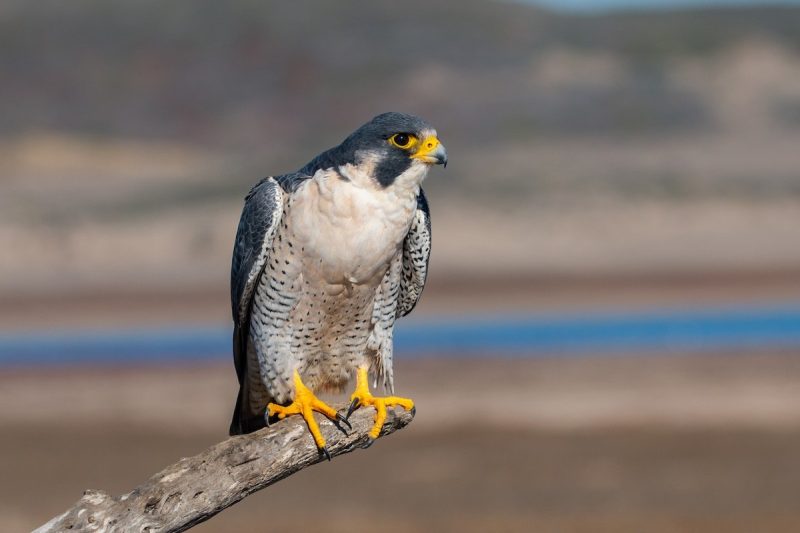
For those who watch birds in Minnesota, falcons often announce themselves through behavior around them rather than their own visibility. These encounters are often brief but unforgettable, marked by sharp wingbeats and sudden bursts of motion.
From roadside fence posts to city skyscrapers and frozen winter fields, falcons appear in places where patience and timing matter. Some arrive only during migration or harsh winters, while others are familiar seasonal companions in open country.
This guide explores five types of falcons found in Minnesota, with clear identification details and visual cues to help birders recognize each species in the field.
Different Types of Falcons Found in Minnesota
Peregrine Falcon (Falco peregrinus)

Key Identification Features
-
Medium to large falcon with long, pointed wings
-
Blue-gray upperparts and pale underparts with dark barring
-
Bold dark “helmet” and strong cheek stripes
-
Powerful, fast flight with deep wingbeats
Peregrine Falcons are the largest falcons regularly found in Minnesota and are instantly recognizable by their sharp wing shape and bold facial markings. Adults show a slate-blue back with creamy white underparts heavily barred in dark lines. In flight, the species appears sleek and muscular, with a long tail and narrow wings designed for speed rather than soaring.
In terms of size, Peregrine Falcons are noticeably larger than American Kestrels and Merlins. They typically measure around 15 to 20 inches in length with a wingspan exceeding 40 inches. Their build is strong and compact, giving them a commanding presence whether perched or airborne. Females are larger than males, a common trait among birds of prey.
Behaviorally, Peregrine Falcons are aerial hunters that rely on speed and precision. They specialize in catching other birds midair, often striking prey during steep dives known as stoops. These dives can occur over rivers, lakes, urban areas, or open countryside, making them highly adaptable hunters within Minnesota’s varied landscapes.
In Minnesota, Peregrine Falcons are found year-round in some areas but are most noticeable during migration and winter. They nest on cliffs, bridges, and tall buildings, particularly in urban centers such as Minneapolis and St. Paul. Their recovery in the state is considered a major conservation success, with stable breeding populations now established.
American Kestrel (Falco sparverius)

Key Identification Features
-
Small falcon with compact body and long tail
-
Rusty back with black spotting
-
Bold facial stripes on a pale face
-
Often seen hovering while hunting
The American Kestrel is Minnesota’s smallest falcon and one of the most colorful birds of prey in the state. Males display blue-gray wings with a rusty back and tail, while females are more uniformly brown with heavy barring. Both sexes have distinctive vertical facial stripes that make identification straightforward.
This species is significantly smaller than other falcons, measuring about 8 to 12 inches long with a wingspan of roughly 20 to 24 inches. Despite their small size, kestrels are alert, agile, and confident hunters. Their slender build and long tail help them maneuver easily while hunting over open ground.
American Kestrels are well known for their hovering behavior. They often pause midair, facing into the wind, before dropping suddenly onto prey. Their diet in Minnesota includes insects, small mammals, reptiles, and occasionally small birds, making them versatile predators across seasons.
In Minnesota, American Kestrels breed widely across open farmland, grasslands, prairies, and roadsides. They are common during spring and summer, with numbers increasing during migration as birds move through from northern regions. Some individuals remain into winter, especially in southern parts of the state where conditions are milder.
Merlin (Falco columbarius)

Key Identification Features
-
Stocky, compact falcon smaller than Peregrine
-
Dark gray or brown upperparts
-
Heavily streaked underparts
-
Fast, aggressive flight close to the ground
Merlins are compact, powerful falcons that appear dense and muscular compared to their size. Their plumage is generally darker than that of kestrels, with adults showing gray or brown upperparts and streaked underparts. Facial markings are subtle, making them less flashy but more intimidating in appearance.
They measure approximately 10 to 13 inches in length with a wingspan of about 22 to 26 inches. Although smaller than Peregrine Falcons, Merlins are noticeably bulkier than kestrels. Their short wings and strong chest give them a distinctive silhouette during fast, direct flight.
Merlins are relentless hunters that specialize in catching small birds. Unlike kestrels, they do not hover. Instead, they pursue prey in rapid chases, often flying low over open land or through tree lines. Their aggressive hunting style makes them one of the most formidable small falcons in Minnesota.
In Minnesota, Merlins are primarily seasonal visitors. They breed in northern forests and are most commonly observed during migration and winter, especially near lakes, wetlands, and urban parks. Some individuals overwinter in cities where bird prey is abundant, making them increasingly familiar winter raptors in recent years.
Prairie Falcon (Falco mexicanus)

Key Identification Features
-
Medium to large pale-colored falcon
-
Sandy brown upperparts
-
Light underparts with sparse streaking
-
Dark underwing patches visible in flight
The Prairie Falcon closely resembles the Peregrine Falcon but appears paler and more earth-toned. Its brownish upperparts and lighter underside help it blend into open landscapes. The dark patches under the wings, sometimes called “armpit marks,” are a key identification feature when seen in flight.
In size, Prairie Falcons are similar to Peregrines, measuring about 15 to 18 inches long with a broad wingspan. Their structure is slightly slimmer, and their overall appearance is less boldly patterned. This subtle coloration can make identification challenging, especially during brief sightings.
Behaviorally, Prairie Falcons hunt both birds and small mammals. They are fast, agile flyers and often hunt low over open terrain. In contrast to Peregrines, they rely less on extreme dives and more on sustained pursuit and surprise attacks.
In Minnesota, Prairie Falcons are considered rare and irregular visitors. They do not breed in the state and are most likely to appear during winter, typically in open agricultural areas or grasslands in western Minnesota. Any confirmed sighting is notable and often carefully documented by birders.
Gyrfalcon (Falco rusticolus)

Key Identification Features
-
Largest falcon in North America
-
Heavy-bodied with broad wings
-
Plumage ranges from dark gray to nearly white
-
Powerful, steady flight
The Gyrfalcon is an impressive Arctic species and the largest falcon ever recorded in Minnesota. Its plumage varies widely, ranging from dark gray individuals to striking white morphs with minimal markings. All forms share a thick, heavy appearance that sets them apart from other falcons.
Gyrfalcons can reach lengths of 19 to 25 inches with wingspans exceeding 50 inches. Their size rivals that of some hawks, and their broad wings give them a strong, deliberate flight style rather than rapid wingbeats. Females are substantially larger than males.
These falcons are powerful hunters that primarily prey on birds, including grouse and waterfowl. Their hunting style combines speed with endurance, allowing them to pursue prey over long distances in harsh conditions. They are well adapted to cold climates and open terrain.
In Minnesota, Gyrfalcons are extremely rare winter visitors, usually appearing only during especially harsh winters. Most sightings occur in open agricultural landscapes or near large bodies of water. Their presence in the state is irregular, making any encounter a memorable and significant event for observers.
How to Identify Falcons in Minnesota
Falcon identification relies on a combination of size, shape, behavior, and habitat. Compared to hawks, falcons have narrower wings, longer tails, and faster wingbeats. Their hunting style is centered on speed and aerial pursuit rather than soaring or ambush tactics.
In Minnesota, size is one of the most useful identification clues. American Kestrels are noticeably small and delicate, while Peregrine Falcons appear large and powerful with commanding flight. Merlins fall between the two, showing compact bodies and rapid, aggressive movement. Rare species such as Prairie Falcons and Gyrfalcons require close attention to plumage tone, wing shape, and overall bulk.
Habitat plays a major role in narrowing identification. Open grasslands, agricultural fields, wetlands, river corridors, and urban centers all attract falcons in different seasons. Seasonal timing is especially important in Minnesota, as several species appear only during migration or winter months.
Best Places to See Falcons in Minnesota
Falcons can be found across much of Minnesota, but certain landscapes offer higher chances of observation. Large rivers, lakeshores, and open wetlands often attract Peregrine Falcons and Merlins, especially during migration when bird prey is abundant.
Grasslands, prairies, and farmland are ideal locations for spotting American Kestrels. Fence posts, utility lines, and roadside perches frequently reveal kestrels scanning for insects and small mammals. These open habitats are particularly productive in southern and western Minnesota.
Urban areas with tall buildings and bridges also support falcon populations, especially Peregrine Falcons. Wildlife refuges, state parks, and expansive agricultural regions provide additional opportunities. Early morning and late afternoon remain the most active times for falcon hunting behavior.
Seasonal Presence of Falcons in Minnesota
Falcon activity in Minnesota varies strongly by season. American Kestrels are common during spring and summer, with some individuals remaining into winter in southern parts of the state. Their numbers increase during migration periods.
Peregrine Falcons are present year-round in limited areas but are most noticeable from fall through early spring. Merlins appear mainly during migration and winter, often moving south once harsher conditions arrive.
Prairie Falcons and Gyrfalcons do not follow predictable patterns in Minnesota and are considered rare or irregular visitors. Gyrfalcons are most likely to appear during especially cold winters, while Prairie Falcons are occasional winter wanderers. Understanding seasonal movement greatly improves identification accuracy.
Falcons vs Hawks in Minnesota
Falcons and hawks are often confused, but the differences become clear with experience. Falcons rely on speed, direct flight, and midair pursuits, while hawks typically soar, glide, and ambush prey from perches.
In Minnesota, American Kestrels are sometimes mistaken for small hawks, and Peregrine Falcons may be confused with large accipiters. Observing wing shape, flight speed, and hunting style quickly separates falcons from hawks in the field.
Falcons show sharper wing tips, faster wingbeats, and more purposeful flight paths. Hawks tend to appear broader-winged and slower, especially when soaring over open terrain.
Conservation Status of Minnesota Falcons
Most falcon species recorded in Minnesota are stable or recovering due to long-term conservation efforts. The Peregrine Falcon’s recovery following pesticide-related declines stands as one of the most successful raptor conservation stories in North America.
American Kestrel populations face localized declines in some areas, largely due to habitat loss and reduced availability of nesting cavities. Merlins remain widespread across their range and have adapted well to both forested and urban environments.
Rare visitors such as Prairie Falcons and Gyrfalcons are closely monitored. Any confirmed sighting in Minnesota contributes valuable data to long-term tracking and conservation research.
FAQs About Falcons in Minnesota
How many types of falcons live in Minnesota?
Five falcon species have been documented in Minnesota, including breeding species, seasonal migrants, and rare winter visitors.
What is the most common falcon in Minnesota?
The American Kestrel is the most widespread and commonly observed falcon in the state.
Do Peregrine Falcons live in Minnesota year-round?
Some Peregrine Falcons remain year-round, especially in urban areas, but most are more noticeable from fall through early spring.
Are falcons dangerous to humans?
Falcons are not dangerous to people and avoid direct contact. They may defend nests but pose little risk.
Where is the best place to see falcons in Minnesota?
Open grasslands, river corridors, wetlands, agricultural areas, and large cities offer the best chances for sightings.
Can falcons be seen in Minnesota cities?
Yes, Peregrine Falcons regularly hunt and nest in urban areas with tall buildings and bridges.
Are Prairie Falcons native to Minnesota?
No, Prairie Falcons are western birds and appear in Minnesota only as rare or irregular visitors.
What do falcons eat in Minnesota?
Their diet includes birds, insects, small mammals, and occasionally reptiles, depending on species and season.
When is the best time to watch falcons?
Early morning and late afternoon are the most active periods for falcon hunting.
Are falcons protected in Minnesota?
Yes, all native falcon species are protected under state and federal wildlife laws.
Final Thoughts
Minnesota supports a small but impressive variety of falcon species, each adapted to different seasons and landscapes. From the agile American Kestrel to the powerful Peregrine Falcon, these birds reflect speed, precision, and resilience.
Knowing when and where falcons appear in Minnesota enhances both identification and appreciation. Whether observed hovering over farmland, streaking along river valleys, or perched high above city streets, falcons remain some of the most captivating birds of prey in the state’s skies.