
Louisiana’s swamps, forests, and sprawling marshlands come alive after dark, and few creatures define that nighttime magic better than owls. These silent hunters slip through the shadows with incredible precision, each species adding its own mystery to the state’s rich wildlife scene. From powerful Great Horned Owls to tiny Saw-whets that appear only in winter, Louisiana offers an extraordinary mix of owl species for those willing to look and listen.
For birdwatchers, the diversity of owls in the state provides year-round opportunities. Some are permanent residents that call from deep cypress woods, while others arrive only during colder months, drifting into marshes and fields in search of food. Their unique calls, behaviors, and striking appearances make owl watching one of the most rewarding nighttime adventures.
In this guide, you’ll discover eight fascinating owls found across Louisiana, complete with identification tips, habitat insights, behaviors, and fun facts. Whether you’re exploring bayous at dusk or scanning coastal prairies in winter, this list will help you recognize each owl with confidence.
Table of Contents
Different Types of Owls Found in Louisiana
Great Horned Owl

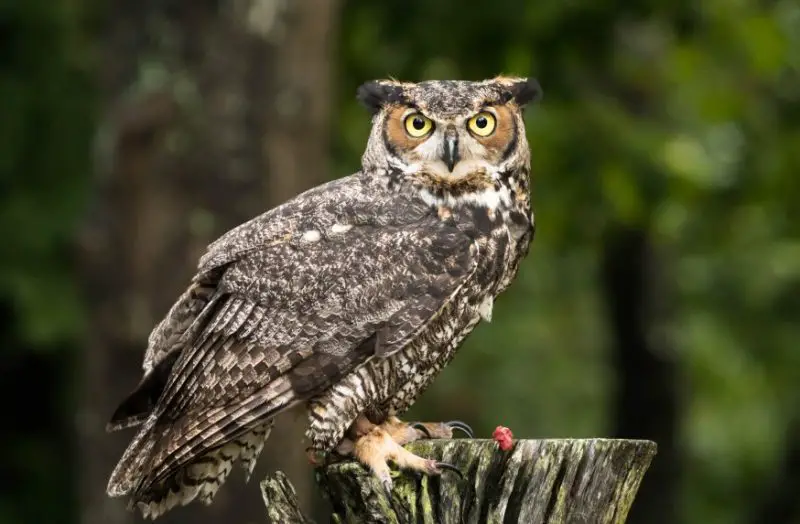
The Great Horned Owl is one of Louisiana’s most powerful and iconic nocturnal hunters. It is immediately recognized by its large ear tufts, intense yellow eyes, and deep hooting call. Its plumage is a mix of brown, gray, and buff tones that provide excellent camouflage against tree bark and forest shadows.
This species is large, measuring 18 to 25 inches tall with a wingspan that can reach up to 5 feet. Its size, combined with a broad chest and thick feathering, gives it a bulky appearance in flight. The Great Horned Owl’s strong talons allow it to take down surprisingly large prey, including rabbits, skunks, and even other birds of prey.
In Louisiana, Great Horned Owls live across wooded areas, swamps, agricultural fields, and suburban neighborhoods. They are extremely adaptable and thrive anywhere with tall trees for nesting and abundant prey. Their presence is often detected by their booming “hoo-hoo-hoo” calls echoing through nighttime forests.
A fun fact is that Great Horned Owls do not build their own nests. Instead, they take over old nests built by hawks, crows, or herons, adding only a few feathers or leaves before laying their eggs.
Eastern Screech-Owl

The Eastern Screech-Owl is a small, compact owl with two distinct color morphs—gray or reddish. Both forms blend perfectly into tree bark, making this species one of the most well-camouflaged owls in Louisiana. Its yellow eyes and small ear tufts give it a classic owl look despite its small size.
This owl measures only 6 to 10 inches long, with a wingspan of about 18 to 24 inches. It has a soft, fluttering flight and is known for its trilling or whinnying call rather than a traditional hoot. Its small stature allows it to perch quietly in tree cavities or nest boxes during the day.
Eastern Screech-Owls are common throughout Louisiana in woodlands, suburban areas, city parks, and anywhere with mature trees. They thrive in neighborhoods with backyard bird feeders—not because they eat the seeds, but because small mammals and insects gather nearby.
A fun fact is that when threatened, the Eastern Screech-Owl can flatten its body, narrow its eyes, and become almost invisible by mimicking a broken tree branch. This camouflage trick is so effective that predators often overlook it entirely.
Barred Owl

The Barred Owl is known for its soulful, echoing call that sounds like “Who cooks for you? Who cooks for you-all?” This medium-to-large owl has dark brown eyes, unlike most owls with yellow eyes, and displays striking horizontal and vertical barring across its chest and belly. Its rounded head lacks ear tufts.
Barred Owls stand about 17 to 20 inches tall with a wingspan reaching up to 4 feet. They fly silently thanks to specialized wing feathers, allowing them to approach prey without being detected. Their diet includes small mammals, amphibians, reptiles, and occasionally fish taken from shallow water.
Louisiana’s swamps, river bottoms, cypress forests, and wetlands are ideal habitats for Barred Owls. They are common statewide and especially abundant in dense, moist forests where they roost in hollows and large branches. Their call carries long distances, often giving away their location before they are seen.
A fun fact about Barred Owls is that they are strong swimmers. When pursuing prey near water, they can dive or fall into ponds and use their wings to paddle back to shore.
Barn Owl

The Barn Owl is one of the most distinctive owls in Louisiana, easily recognized by its heart-shaped white face, dark eyes, and golden-buff wings. Unlike many owls, it lacks ear tufts and has a sleek, ghostlike appearance when gliding through fields at night. Its raspy screech is unmistakable and very different from the hoots of other species.
This medium-sized owl measures 12 to 16 inches in length with a wingspan of about 3.5 feet. It has exceptionally soft feathers that allow silent flight, helping it detect even the faintest movements of rodents in grassy fields. Barn Owls are highly efficient hunters, capable of catching several mice in a single night.
In Louisiana, Barn Owls inhabit farmlands, marsh edges, prairies, pasturelands, and old barns or abandoned structures. They prefer open areas for hunting and cavities for nesting. They occur statewide but can be harder to spot due to their nocturnal habits and quiet, floating flight.
A fun fact is that Barn Owls have the most sensitive hearing of any bird tested. Their asymmetrical ear openings allow them to pinpoint prey in complete darkness, even under layers of vegetation.
Short-eared Owl

The Short-eared Owl is a slender, long-winged owl known for its mottled brown plumage and small, barely visible ear tufts. Its pale face and yellow eyes stand out against the dark outlines around its eyes, giving it a fierce yet elegant expression. This species is one of the few owls often seen actively hunting during daylight.
Short-eared Owls measure about 13 to 17 inches long with a wingspan ranging from 33 to 40 inches. Their buoyant, moth-like flight makes them easy to recognize as they glide low over open fields. They feed mostly on voles, mice, and small mammals, which they spot using both keen vision and sensitive hearing.
In Louisiana, Short-eared Owls appear mainly in winter, especially in grasslands, marsh edges, coastal prairies, and large agricultural fields. Their preference for open landscapes sets them apart from woodland owls, making coastal refuges and wide prairies some of the best places to observe them.
A fun fact about this species is that it builds ground nests rather than using tree cavities. The female creates a shallow scrape in the grass, lining it with feathers and vegetation—an unusual nesting behavior among owls.
Long-eared Owl

The Long-eared Owl is a secretive, slender owl with tall ear tufts that make its head appear long and narrow. Its facial disk is orange-buff with dark outlines, and its plumage blends perfectly with dense evergreen foliage. Because it prefers thick cover, this species is often heard more than seen.
This owl measures 13 to 16 inches long and has a wingspan of 35 to 40 inches. It flies quietly with deep, smooth wingbeats, hunting mostly at night. Long-eared Owls feed on small mammals, especially voles and mice, and occasionally small birds.
In Louisiana, Long-eared Owls are winter visitors and can be found in conifer stands, thickets, and dense woodlands near open hunting grounds. Their roosting habits make them difficult to locate, as they often hide among dense branches and use communal roosts during colder months.
A fun fact is that Long-eared Owls do not build their own nests. Instead, they reuse old hawk or crow nests, turning them into simple yet functional platforms for raising their young.
Northern Saw-whet Owl

The Northern Saw-whet Owl is a tiny, endearing owl with a round head, big yellow eyes, and no ear tufts. Its brown plumage is streaked with white, giving it a soft, fluffy appearance. Despite its small size, its sharp call—resembling the sound of a whetstone sharpening a saw—can carry surprisingly far.
This miniature owl measures only 7 to 8 inches long, making it one of the smallest owl species in North America. Its wingspan ranges from 16 to 22 inches. Northern Saw-whet Owls primarily hunt small mammals such as mice, using their remarkable night vision and silent flight to ambush prey in forested areas.
In Louisiana, this species is considered rare and appears mostly during migration or in winter. They favor dense forests, thickets, and wooded river corridors when passing through the state. Their secretive nature and small size make them extremely difficult to spot.
A fun fact is that Northern Saw-whet Owls often remain motionless when discovered, relying on their camouflage rather than fleeing. This behavior sometimes allows birdwatchers lucky close-up views—if they can find one.
Snowy Owl (rare/accidental)

The Snowy Owl is one of the most striking owls in the world, famous for its bright white plumage and piercing yellow eyes. Males tend to be nearly pure white, while females and juveniles have more dark barring. This species stands out immediately against any landscape, especially in southern regions where it appears only rarely.
Snowy Owls are large, measuring 20 to 25 inches tall with an impressive wingspan of 4.5 to 5.5 feet. Their powerful build and broad wings allow them to travel long distances during irruption years—times when food scarcity pushes them far south of their normal range. They hunt mainly during the day, searching for waterfowl, rodents, and even rabbits.
In Louisiana, Snowy Owls are accidental visitors that appear only during exceptional winters. When they do arrive, they are usually found in open areas resembling Arctic tundra, such as airports, coastal dunes, large fields, or barrier islands. These sightings are extremely rare and draw immediate attention from birdwatchers across the state.
A fun fact is that Snowy Owls can remain completely still for long periods while scanning the horizon. Their incredible eyesight allows them to detect prey even under dim Arctic light—an adaptation that remains useful when they wander south.