
With its wide variety of mushroom species, Florida is a sanctuary for mushroom connoisseurs. Among the common varieties are the vibrant red cinnabar chanterelles, delicate white puffballs, and the unique lion’s mane. However, Florida also harbors rarer treasures like the elusive honey mushrooms. Thanks to the state’s warm and humid climate, these fungi flourish, making Florida a paradise for both edible and visually stunning mushrooms.
Different Types of Mushrooms in Florida
Green-spored Parasol

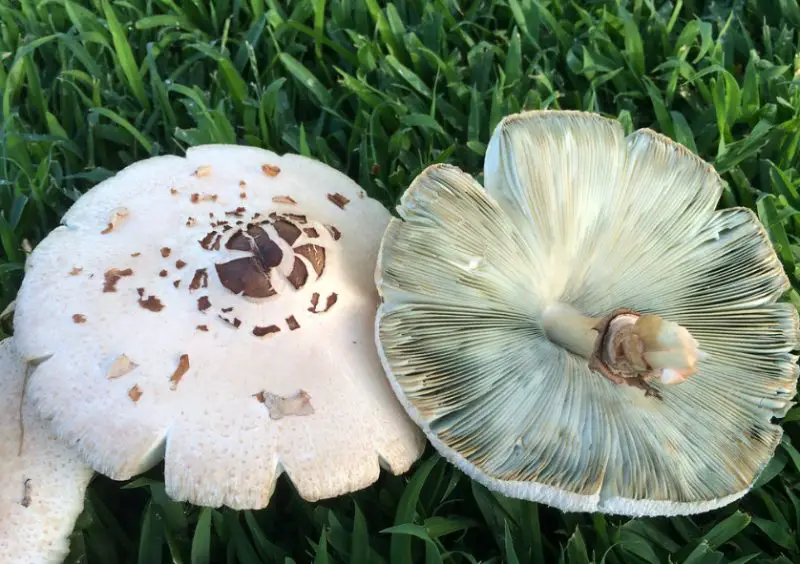
The Green-spored Parasol, Chlorophyllum molybdites, boasts caps 8-30 cm in diameter, white or off-white with irregular brown spots and warts. Its prominent gills are visible around the edges, making it the most frequently eaten poisonous mushroom in Florida. Often mistaken for edible varieties, it causes severe stomach symptoms like vomiting and diarrhea, posing risks, particularly in lawns and pastures where children and pets may encounter it.
Oyster Mushrooms

Pleurotus ostreatus, or oyster mushrooms, have fan-shaped, 2-3 cm broad display caps with thick stalks that are often white or off-white but can sometimes occasionally have a light purple or gray tint. Originally grown during World War I to help with food shortages, they are now widely consumed worldwide and may be found in Florida’s wild and on farms.
It’s interesting to note that oyster mushrooms are carnivorous; they feed on nematodes to obtain protein and nitrogen, which helps with tree rot. Furthermore, a variety of uses for its adaptable mycelium exist, such as the creation of leather-like textiles and furniture.
Honey Mushroom

Honey Mushrooms, or Armillaria mellea, feature caps 3-15 cm wide, ranging from buttery yellow to light brown, growing in large clusters resembling shelf-like structures. In Florida, they act as tree parasites, invading living hardwood and conifer trees, slowly depleting nutrients and causing eventual tree death. Due to their resemblance to poisonous varieties, it’s advised to avoid consuming them.
Shaggy Mane

The Shaggy Mane, or Coprinus comatus, boasts caps 4–8 cm wide and 6–20 cm tall, initially white and turning black as scales lift. Growing directly from the ground, they’re often found in Florida yards or fields, earning their name from their shaggy appearance. Despite their distinctive look, they resemble poisonous varieties, warranting avoidance and refraining from consumption.
Ringless Honey Mushroom

The Ringless Honey Mushroom, or Desarmillaria caespitosa, features caps 2.5-10 cm wide, light brown to pale yellow with white stalks, often growing in large clusters. In Florida, they’re often mistaken for other species like Honey Mushrooms due to their similar appearance but lack of a dark ring around the stalk. Unfortunately, they also resemble the deadly Galerina Mushroom. Parasitic to trees, they infect various species, leading to tree decline and eventual death.
Hairy Curtain Crust

The Hairy Curtain Crust, or Stereum hirsutum, presents caps 1–4 cm wide, ranging from pale yellow to brown, sometimes with green lichen or algae. Growing in crescent-shaped tiled formations on dead trees, its apt name reflects its crusty appearance with short, spiky hairs. Best left untouched, it aids in the natural decay process of dead trees, returning nutrients to the forest soil.
False Turkey-tail

False Turkey-tail, or Stereum ostrea, exhibits caps 1–7 cm wide, featuring a mix of brown and red shades in shell-shaped formations, often growing in stacked clusters. Resembling Turkey-tail Mushrooms, they are, however, inedible and can cause stomach discomfort if ingested. Unlike Turkey-tail, False Turkey-tail infects live trees, weakening them until they fall, aiding in decomposition. Caution is advised to avoid misidentification and potential health risks associated with handling or consuming this fungus.
Witch’s Butter

Witch’s Butter, or Tremella mesenterica, stands out as one of the weirdest mushrooms in Florida with its irregular, gelatinous, brain-like shape and bright lemon-yellow coloring. It defies conventional mushroom appearances, often found on dead tree limbs, particularly red alder. Remarkably, it dries during dry weather, reviving to its original state when it rains, showcasing its fascinating properties.
Mica Cap

The Mica Cap, or Coprinellus micaceus, features bell-shaped caps 1–2.5 cm wide, expanding to 5 cm, growing in dense clusters with long, thin stems. Their grayish-brown coloring and grooved caps resemble straight hair. Interestingly, this mushroom autodigests within hours of being picked, turning into an inky black liquid. Found at the base of deciduous trees in mature forests, it’s best admired through photography rather than consumption to avoid potential poisoning and messy encounters with its self-destructive nature.
Common Puffball

The Common Puffball, or Lycoperdon perlatum, ranges from 1.5-6 cm wide and 3-10 cm tall, with white to off-white coloring and spines and warts in varying shades of brown. Found in Florida gardens, yards, and forest clearings, they’re easily identified by their large size and distinctive spiky warts. Though nonpoisonous, caution is advised due to potential misidentification and the release of lung-inflaming spores upon handling, particularly risky for dogs.
Dyer’s Polypore

Dyer’s Polypore, or Phaeolus schweinitzii, exhibits caps up to 25 cm across, varying in color from yellow, green, orange, brown, to red, often adorned with concentric rings. Growing near conifer trees in Florida, it resembles irregular flat disks, sometimes emerging from tree roots. Renowned for its dye properties, caution is advised due to potential eye and skin irritation upon handling, though it should never be consumed.
Deer Mushroom

Deer Mushrooms, or Pluteus cervinus, feature caps ranging from 3–12 cm in diameter, with a typical umbrella-like shape and medium brown coloring. Found in Florida forests on rotten logs and tree stumps, they resemble the hues of a white-tailed deer, with a velvety texture akin to deer fur. Despite being nonpoisonous, they’re not typically consumed due to their bitter taste and rubbery texture.
Orange Jelly Spot

The Orange Jelly Spot, or Dacrymyces chrysospermus, forms complex groups of caps up to 6 cm wide, displaying vibrant orange-yellow coloring. Unlike typical mushrooms, it has an irregular, wavy shape resembling goop stuck to a tree. Found on dead conifer trees like pine and spruce, its jelly-like texture and bright orange appearance make it a unique find in Florida forests.
Red Chanterelle

Red Chanterelle mushrooms, scientifically known as Cantharellus cinnabarinus, exhibit distinctive features. With caps spanning 1-4 cm, they sport vibrant pink to red hues and an umbrella-like shape atop a slender stalk. Typically found in mixed forests, they’re prized for their beauty. However, caution is advised due to potential confusion with toxic varieties. Despite their delicate nature and smaller size compared to common Chanterelles, both species often coexist in their preferred habitat.
Artist’s Bracket

The Artist’s Bracket mushroom, scientifically known as Ganoderma applanatum, stands out with its distinct features. With caps ranging from 3–30 cm wide and 5–50 cm long, they grow on tree trunks, making them hard to miss. As they mature, their white color darkens to a reddish-brown. Notably, their tough, woody texture and ability to retain scratched designs on their underside make them a fascinating find in Florida’s forests.
Eastern American Jack-O’-Lantern

The Eastern American Jack-O’-Lantern mushroom, scientifically known as Omphalotus illudens, bears striking resemblance to its Halloween namesake. With caps ranging from 3-20 cm wide, their bright orange to pale yellow coloring and typical toadstool shape evoke images of carved pumpkins. Remarkably, these mushrooms glow green in the dark due to a bioluminescent chemical, attracting insects for spore dispersal. However, caution is advised as they are poisonous to humans, causing digestive discomfort if ingested.
Sulphur Tuft

Sulphur Tuft Mushrooms, scientifically known as Hypholoma fasciculare, are easily recognizable by their light yellow caps that darken to greenish hues with age. Found in clusters on fallen logs and tree stumps in Florida’s deciduous forests, they thrive where other mushrooms struggle. However, caution is warranted as they are toxic to humans, causing severe digestive issues and, in rare cases, death. Interestingly, Sulphur Tufts play a role in forestry conservation by outcompeting parasitic fungi harmful to trees.
Summer Oyster Mushroom

The Summer Oyster Mushroom, scientifically known as Pleurotus pulmonarius, is a commonly cultivated variety in Florida. With caps ranging from 5-20 cm wide, they grow in clustered shelves on tree trunks, boasting a smooth white or off-white appearance. While readily available in supermarkets and farmer’s markets, caution is advised when foraging wild specimens, as misidentification can lead to severe poisoning or even death.
Yellow Patches

Yellow Patches, scientifically known as Amanita flavoconia, are striking mushrooms with bright orange to yellow caps adorned with prominent yellow warts. Typically growing singularly, they resemble cartoonish toadstools. Though toxicity hasn’t been definitively confirmed, as part of the Amanita family, they’re assumed poisonous. It’s best to avoid handling or consuming them and instead appreciate their vibrant appearance from a safe distance.
Turkey-tail Mushroom

The Turkey-tail Mushroom, scientifically known as Trametes versicolor, boasts caps up to 8 cm long and 5 cm wide, adorned with rings of various hues ranging from black to brown and white. Its stacked growth pattern resembles roof tiles, a common sight in Florida’s mature forests. Though used in Eastern medicine and supplements, wild consumption is cautioned against due to lack of FDA approval.
Common Greenshield Lichen

Common Greenshield Lichen, or Flavoparmelia caperata, forms circular patterns with wavy edges, displaying hues from pale green to yellowish. Unlike mushrooms, it’s a lichen, comprising both fungi and algae. Thriving in diverse climates, it’s widespread in Florida, commonly found on tree bark or occasionally on rocks. Look for its distinctive rounded, pale-green growth for identification.
Blewit

Blewit, scientifically named Lepista nuda or Wood Blewit, features caps ranging from 4 to 15 cm in diameter with hues from pinkish-purple to lilac, often with a gray-brown cast. Recognizable by its long, woody stem and wide, flat caps, its prominent, straight gills extend underneath. Look for its distinctive scent, often likened to frozen orange juice concentrate, while searching forest floors amidst rotting leaf litter.
Dryad’s Saddle

Dryad’s Saddle, scientifically Cerioporus squamosus, boasts a cap up to 30 cm across and 10 cm thick, featuring brown scales atop a white or off-white surface. Growing in clusters resembling stacked tiles, it thrives near fallen trees in Florida. Despite its nonpoisonous nature, caution is advised as it resembles toxic species, emphasizing the need for expertise before consumption or handling.
Splitgill Mushroom

The Splitgill Mushroom, scientifically known as Schizophyllum commune, features small, pale white or gray caps growing in stacked clusters resembling shelves. Its unique characteristic lies in its spaced-apart gills, resembling individual threads. Thriving on decaying trees during rainy periods in Florida, it’s important to note recent research linking it to fungal lung infections, advising against wild consumption due to potential confusion with toxic species.
Chicken of the Woods

Chicken of the Woods, scientifically named Laetiporus sulphureus, features shelf-like caps up to 60 cm across, with strikingly bright yellow hues, occasionally tinged with orange or pink. Growing in stacked shelves on hardwood trees, it’s consumed in Florida and Europe. However, caution is advised as it can cause stomach upset if uncooked and may be confused with poisonous varieties. It’s safer to obtain from expert foragers rather than wild harvesting.
Crowded Parchment

Crowded Parchment, or Stereum complicatum, showcases caps about 2 cm across, clustered in irregular semicircles, circles, and crescents, with hues of brown and orange resembling crumpled paper. Commonly found on dead oak trees in Florida, it aids in decomposition. While not toxic, its proximity to harmful jelly fungus or algae warrants avoidance. Appreciate its structure through photography rather than handling.
Pear-shaped Puffball

The Pear-shaped Puffball, scientifically known as Apioperdon pyriforme, displays caps 1.5-4.5 cm wide by 2-4.5 cm tall, featuring off-white coloring with dense brown spots toward the center spreading out at the edges. Often pear-shaped but also spherical, they cluster in groups of 4-10 on rotting logs in Florida. Despite being nonpoisonous, caution is advised due to resemblance to toxic species like the Earthball mushroom, emphasizing the importance of expertise in foraging or purchasing from reputable sources.
Violet-toothed Polypore

The Violet-toothed Polypore, Trichaptum biforme, showcases caps 1-7.5 cm wide, resembling irregular semicircles akin to clamshells with shades of brown and violet, purple, or lavender rings. Typically found in Florida on decaying aspen and poplar trees, it forms stacked clusters on rotting logs. While inedible for humans, it poses a risk to pets, causing stomach problems and dehydration.
Candleflame Lichen

Candleflame Lichen, scientifically known as Candelaria concolor, is a fascinating organism in Florida, though not a mushroom. With golden yellow to yellow-green coloring and branch-like structures, it covers vast areas, including entire trees. Lichens like Candleflame thrive in diverse habitats due to a symbiotic relationship between fungi and algae, enabling them to survive in environments where both would struggle independently. Keep an eye out for this widespread lichen on tree bark across various landscapes.