

Across lawns, parks, farm fields, and roadsides in Louisiana, small mounds of loose soil often rise quietly from the ground. At first glance, these piles may look harmless, almost like the work of ordinary ants or disturbed dirt. But beneath those mounds lives one of the most notorious insects in the southern United States—the fire ant.
Many Louisiana residents are familiar with fire ants because they have experienced their painful sting at least once. A sudden burning sensation followed by itchy white pustules is something few people forget. Yet despite how common fire ants are in the region, most people know surprisingly little about how they live, how their stings work, and why they have become such a powerful presence across the southern landscape.
Fire ants are not native to Louisiana. They are invasive insects that arrived in the United States during the early twentieth century. Over the decades they spread across much of the southeastern United States, adapting remarkably well to warm climates, disturbed soils, and human-altered environments.
Today, fire ants are deeply woven into the ecological story of Louisiana. They influence agriculture, wildlife populations, public health, and even the way people manage their yards and outdoor spaces.
Yet the story behind fire ant stings goes far beyond simple discomfort. These insects possess sophisticated defensive behaviors, complex social colonies, and venom that works differently from that of bees or wasps.
Understanding fire ants means understanding how an invasive species can reshape entire ecosystems.
For Louisiana residents, learning more about these tiny insects reveals that the painful sting most people experience is only one small part of a much larger biological story unfolding just beneath their feet.
Table of Contents
- 1 Fire Ants Are an Invasive Species
- 2 Fire Ant Colonies Are Highly Organized Societies
- 3 Fire Ant Mounds Are Engineering Marvels
- 4 Fire Ant Stings Are Unique Among Insects
- 5 Fire Ants Attack as a Group
- 6 Fire Ant Venom Causes Distinctive Skin Reactions
- 7 Fire Ants Influence Louisiana Ecosystems
- 8 Floodwaters Reveal an Amazing Fire Ant Survival Strategy
- 9 Controlling Fire Ants Is Extremely Difficult
- 10 FAQs About Fire Ant Stings in Louisiana
- 10.1 Why do fire ant stings burn so much?
- 10.2 How long do fire ant sting pustules last?
- 10.3 Can fire ants sting more than once?
- 10.4 Are fire ant stings dangerous?
- 10.5 Why do fire ants swarm so quickly?
- 10.6 Where are fire ants most commonly found?
- 10.7 What attracts fire ants to certain areas?
- 10.8 Can fire ants survive floods?
- 11 Final Thoughts
Fire Ants Are an Invasive Species
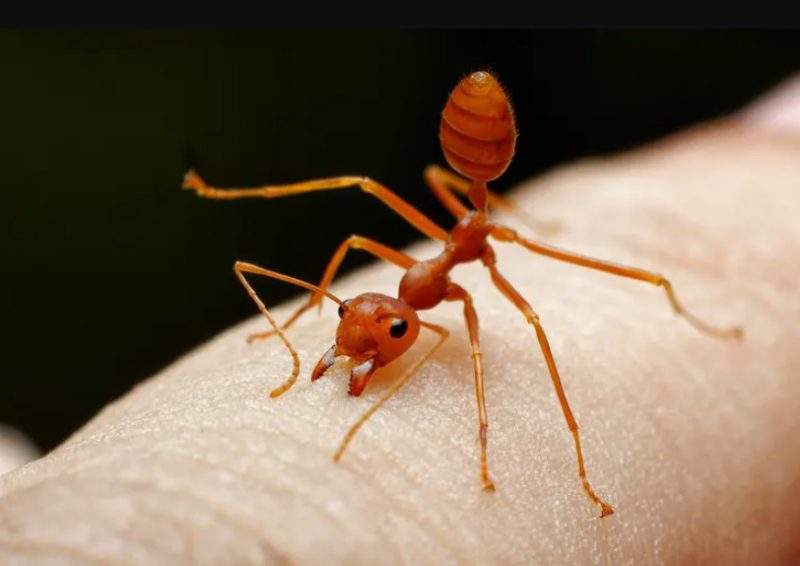
The red imported fire ant, scientifically known as Solenopsis invicta, did not evolve in North America. These ants originated in South America, particularly in regions of Brazil, Paraguay, and Argentina.
They likely arrived in the United States in the 1930s through cargo ships entering ports along the Gulf Coast. Soil used as ballast in ships is believed to have carried fire ant colonies to Alabama and surrounding areas.
Once introduced, the ants spread rapidly.
The climate of the southern United States closely resembled their native habitat, allowing them to thrive. Warm temperatures, abundant rainfall, and open soils created ideal conditions for colony expansion.
From those early port cities, fire ants spread across the Gulf states including Louisiana, Texas, Mississippi, and Florida. Over time they moved farther inland and now occupy millions of acres across the southern United States.
Their success is due in part to their aggressive nature and their ability to adapt to human landscapes such as farms, suburban lawns, and roadside areas.
Unlike many native ants that prefer undisturbed forests, fire ants flourish in areas where soil has been disturbed by construction, agriculture, or landscaping.
This adaptability helped them become one of the most dominant insect species in the region.
Fire Ant Colonies Are Highly Organized Societies
One of the most fascinating aspects of fire ants is their complex social structure.
Each mound visible above ground represents the surface entrance to an elaborate underground colony. Beneath the mound lies a network of tunnels and chambers that may extend several feet below the surface.
A single colony may contain hundreds of thousands of ants.
At the center of the colony is the queen, whose primary role is reproduction. A healthy queen can lay hundreds or even thousands of eggs per day, allowing colonies to grow rapidly.
Worker ants perform most of the colony’s daily tasks. They gather food, defend the nest, care for developing larvae, and maintain the structure of the mound.
Workers vary in size and specialize in different roles within the colony. Some workers focus on foraging while others remain near the nest to protect it.
The colony functions almost like a single organism. Individual ants communicate using chemical signals called pheromones that coordinate their activities.
These chemical messages allow thousands of ants to respond quickly when the colony is threatened.
Fire Ant Mounds Are Engineering Marvels
The visible mound of a fire ant colony serves several important purposes.
Unlike many ant species, fire ants often construct mounds without a central opening. Instead, ants enter and exit through hidden tunnels that lead beneath the mound.
This design helps regulate temperature and moisture within the colony.
The mound also acts as a solar collector. Its shape allows sunlight to warm the soil beneath, creating favorable conditions for developing larvae.
Fire ant mounds can reach heights of 18 inches or more in undisturbed areas.
However, even small mounds may house large colonies.
The underground portion of the colony often extends far beyond the visible mound, sometimes covering an area several feet wide.
This hidden structure protects the ants from predators and environmental extremes while providing space for the colony to expand.
Fire Ant Stings Are Unique Among Insects
When people think of painful insect stings, bees and wasps often come to mind. However, fire ants sting in a way that differs significantly from these insects.
A fire ant first uses its jaws to grasp the skin. Then it pivots its body and injects venom through a stinger located at the end of its abdomen.
Unlike bees, fire ants can sting multiple times.
They often form a circle around the bite area, delivering several stings in rapid succession.
This behavior explains why stepping on a fire ant mound can result in dozens of stings within seconds.
The venom contains alkaloid compounds that cause the characteristic burning sensation associated with fire ant attacks.
Within hours, small white pustules often form at the sting sites.
These pustules are sterile blisters created by the body’s reaction to the venom.
Fire Ants Attack as a Group
One reason fire ant stings can be so painful is the ants’ coordinated defensive behavior.
When a mound is disturbed, worker ants immediately release alarm pheromones. These chemical signals spread rapidly through the colony.
Within seconds, thousands of ants may rush to the surface.
Unlike many insects that sting only when directly threatened, fire ants attack aggressively to protect their colony.
This collective defense strategy overwhelms predators and discourages future disturbances.
Animals such as birds, reptiles, and mammals often learn quickly to avoid fire ant mounds after experiencing a swarm attack.
For humans, accidental encounters often occur during outdoor activities such as gardening, mowing lawns, or playing in grassy areas.
The suddenness of the attack is often what surprises people most.
Fire Ant Venom Causes Distinctive Skin Reactions
After a fire ant sting, the affected area typically goes through several stages.
Initially, a burning sensation appears almost immediately. This pain may last several minutes.
Soon afterward, a red bump develops at the sting site.
Within 24 hours, the bump often transforms into a small white pustule surrounded by redness.
These pustules are characteristic of fire ant stings and help distinguish them from other insect bites.
The pustules usually heal within several days if left undisturbed.
However, scratching or breaking the skin may lead to secondary infections.
For most people, fire ant stings remain a localized irritation.
However, some individuals experience allergic reactions that may require medical attention.
Fire Ants Influence Louisiana Ecosystems
Although often viewed as pests, fire ants play complex roles within ecosystems.
They prey on various insects, including agricultural pests, which sometimes provides benefits to farmers.
At the same time, their aggressive nature allows them to outcompete many native ant species.
This displacement can alter local insect communities.
Fire ants also affect wildlife.
Ground-nesting birds, reptiles, and small mammals may be vulnerable to fire ant attacks, particularly when young animals are unable to escape quickly.
In some cases, fire ants have been observed preying on hatchling turtles or other small wildlife.
Because of these ecological impacts, fire ants represent one of the most influential invasive species in the southeastern United States.
Floodwaters Reveal an Amazing Fire Ant Survival Strategy
Louisiana frequently experiences heavy rainfall and flooding.
During floods, fire ants demonstrate one of their most remarkable survival adaptations.
When rising water threatens a colony, worker ants quickly gather the queen, larvae, and eggs.
They link their bodies together using claws and jaws to form a floating raft.
This living raft can contain thousands of ants.
The structure repels water and allows the colony to float for days or even weeks until it reaches dry land.
Once the raft encounters solid ground, the ants quickly rebuild their colony.
This ability helps fire ants survive extreme weather events that might otherwise destroy their nests.
Controlling Fire Ants Is Extremely Difficult
Because of their large colony sizes and rapid reproduction, fire ants are difficult to control completely.
Various methods are used to manage populations.
Bait treatments containing insecticides are commonly used to reduce colony numbers.
These baits are carried back to the nest by worker ants and eventually reach the queen.
Biological control efforts have also been explored.
Researchers have introduced certain parasitic flies that target fire ants in hopes of reducing their populations.
However, completely eliminating fire ants from large regions has proven nearly impossible.
Their adaptability and reproductive capacity allow them to rebound quickly even after control efforts.
FAQs About Fire Ant Stings in Louisiana
Why do fire ant stings burn so much?
The venom injected during a sting contains alkaloids that cause a burning sensation and trigger inflammation in the skin.
How long do fire ant sting pustules last?
The pustules typically heal within several days, though itching may persist for a short time.
Can fire ants sting more than once?
Yes. Unlike bees, fire ants can sting repeatedly during an attack.
Are fire ant stings dangerous?
For most people they cause only localized irritation. However, allergic reactions can occur in some individuals.
Why do fire ants swarm so quickly?
Alarm pheromones released by worker ants trigger rapid defensive responses from the colony.
Where are fire ants most commonly found?
They often build mounds in open sunny areas such as lawns, pastures, parks, and roadside areas.
What attracts fire ants to certain areas?
They prefer loose soil, warm temperatures, and disturbed landscapes.
Can fire ants survive floods?
Yes. Colonies can form floating rafts that allow them to survive rising water.
Final Thoughts
Fire ants may be small, but their presence has reshaped landscapes across Louisiana and much of the southern United States.
Their aggressive stings, massive colonies, and remarkable survival strategies make them one of the most influential insects in the region.
While most residents encounter fire ants only when they accidentally step on a mound, these insects represent a complex ecological force operating just beneath the surface.
Understanding how fire ants live helps explain why they have spread so successfully and why managing them remains a challenge.
For those living in Louisiana, awareness and caution remain the best defenses against their painful sting.
And although they may never be welcome neighbors, fire ants remain a fascinating example of how powerful even the smallest creatures can become when nature and opportunity combine.