
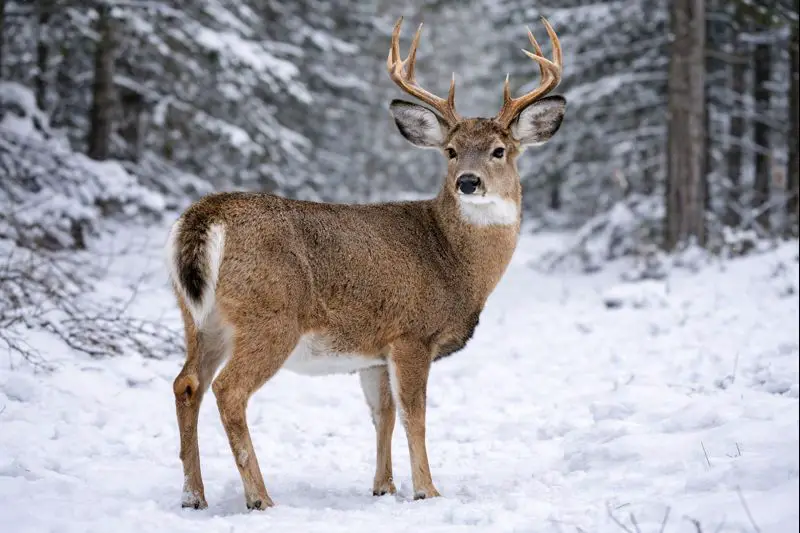
Michigan is one of the few states where two iconic North American deer species come close enough to spark a persistent question among hunters, wildlife watchers, and rural residents. White-tailed deer are everywhere, from farm fields to forest edges and suburban neighborhoods. Mule deer, while far less common, exist just west of Michigan and occasionally appear in conversations about range expansion. This overlap in geography and similarity in appearance leads many people to wonder: can white-tailed deer in Michigan breed with mule deer?
Stories circulate about deer with unusual ears, strange tail patterns, or body shapes that seem to fall somewhere between the two species. Photos are shared online. Campfire discussions repeat the idea of hybrids. The possibility feels reasonable. Both are deer. Both belong to the same genus. Both occupy parts of the Midwest.
But as with many wildlife questions, the real answer lies not in what feels plausible, but in what biology, behavior, and long-term research actually show.
Table of Contents
- 1 White-Tailed Deer Dominate Michigan’s Landscape
- 2 Mule Deer Are Not Native to Michigan
- 3 Why Mule Deer Occasionally Enter the Conversation
- 4 Genetic Compatibility Exists in Theory
- 5 Hybridization Requires Overlapping Populations
- 6 Why Hybridization Happens in Western States
- 7 Behavioral Differences Reduce Hybridization
- 8 Breeding Timing Does Not Always Align
- 9 Why Michigan Deer Sometimes Look “Different”
- 10 The Tail Confusion Factor
- 11 Ears Are an Unreliable Indicator
- 12 What Genetic Studies Show About Michigan Deer
- 13 Captive Deer and Artificial Scenarios
- 14 Disease Monitoring Strengthens Confidence
- 15 Why the Myth Persists in Michigan
- 16 The Role of Human Perception
- 17 Climate Change and Range Shifts
- 18 Why White-Tailed Deer Thrive Without Mixing
- 19 Wildlife Agencies Are Clear on This Issue
- 20 What To Do If You See an “Unusual” Deer
- 21 Why Accurate Understanding Matters
- 22 White-Tailed Deer and Michigan’s Ecosystem
- 23 FAQs About Deer Hybridization in Michigan
- 23.1 Can white-tailed deer breed with mule deer
- 23.2 Do mule deer live in Michigan
- 23.3 Are deer hybrids present in Michigan
- 23.4 Why do some deer look different
- 23.5 Can tails or ears confirm hybrids
- 23.6 Has genetic testing been done
- 23.7 Could mule deer move into Michigan
- 23.8 Should unusual deer be reported
- 24 Final Thoughts
White-Tailed Deer Dominate Michigan’s Landscape
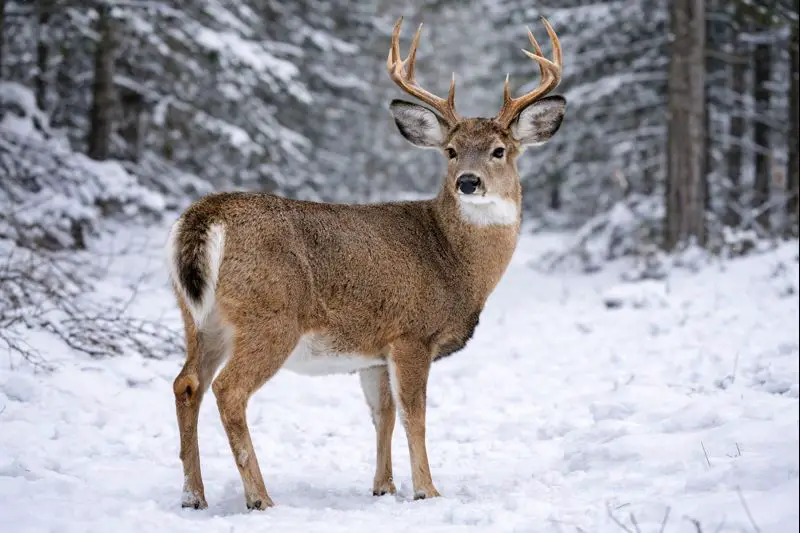
White-tailed deer (Odocoileus virginianus) are one of the most successful large mammals in Michigan. They occupy nearly every habitat type in the state, including forests, agricultural land, wetlands, and suburban areas.
Their adaptability is remarkable. They tolerate human activity, adjust diets seasonally, and reproduce efficiently. Michigan’s climate, vegetation, and land use patterns favor white-tailed deer almost everywhere.
As a result, they form dense, well-established populations across both peninsulas.
Mule Deer Are Not Native to Michigan
Mule deer (Odocoileus hemionus) are primarily a western species. Their core range includes the Great Plains westward to the Rocky Mountains and into the western states.
Michigan does not have a native, established mule deer population. The species is common in states like North Dakota, South Dakota, Wyoming, and Montana, but its eastern range stops well short of Michigan.
This geographic separation is one of the most important factors in the hybrid question.
Why Mule Deer Occasionally Enter the Conversation
Despite not being native to Michigan, mule deer often enter local discussion for a few reasons.
Hunters travel west and become familiar with mule deer. Photos of mule deer circulate online and are compared to unusual-looking white-tailed deer. Occasionally, escaped captive deer or misidentified animals fuel speculation.
In rare cases, mule deer have wandered eastward into parts of the Great Plains near the Mississippi River, but confirmed records do not place them naturally within Michigan.
Absence matters in biology.
Genetic Compatibility Exists in Theory
White-tailed deer and mule deer belong to the same genus, Odocoileus. They share a relatively recent evolutionary ancestor.
Because of this, hybridization between the two species is biologically possible. In regions where their ranges overlap in the western United States, hybrids have been genetically confirmed.
This fact is often cited to support the idea that hybridization could happen anywhere.
But biology requires opportunity, not just compatibility.
Hybridization Requires Overlapping Populations
For hybridization to occur naturally, two conditions must exist.
First, both species must be present in the same area at the same time. Second, they must encounter one another during the breeding season under conditions that allow mating.
In Michigan, the first condition is not met. Mule deer are not present as a wild population.
Without overlap, there is no opportunity.
Why Hybridization Happens in Western States
In parts of the western United States, white-tailed deer and mule deer ranges overlap naturally.
In those regions, hybrids have been documented, though they are still relatively uncommon. Even where overlap exists, the two species show strong preferences for different habitats.
Hybridization usually occurs at the edges of ranges, not in core habitat.
This pattern highlights how rare hybridization is even when conditions allow it.
Behavioral Differences Reduce Hybridization
Even where both species coexist, behavioral differences limit mating.
White-tailed deer prefer denser cover, forest edges, and mixed habitats. Mule deer favor open terrain, shrublands, and foothills.
Their movement patterns, escape behavior, and social structures differ. These differences reduce contact during breeding season.
Nature builds multiple barriers to hybridization.
Breeding Timing Does Not Always Align
Both species breed in the fall, but timing can differ slightly depending on region and environmental cues.
Even small differences in peak estrus timing reduce the chance of successful mating.
In Michigan, white-tailed deer rut timing is well established and synchronized across the population.
Without mule deer present, timing differences are irrelevant.
Why Michigan Deer Sometimes Look “Different”
Many reports of supposed hybrids stem from unusual-looking white-tailed deer.
White-tailed deer show considerable variation in size, ear length, coat color, and body shape. Nutrition, age, genetics, and health all influence appearance.
Large ears, lighter coats, or mule-like features do not indicate hybrid ancestry.
Variation within a species is often underestimated.
The Tail Confusion Factor
One of the most cited reasons for hybrid claims involves tails.
White-tailed deer have long tails with white undersides that flash when alarmed. Mule deer have shorter tails with black tips.
However, tail posture, lighting, and motion can make white-tailed deer tails appear shorter or darker in certain conditions.
In winter, thick coats and snow further obscure identifying features.
Ears Are an Unreliable Indicator
Mule deer are known for large, mule-like ears.
But ear size varies widely among white-tailed deer. Northern deer often develop larger ears relative to body size, especially in colder climates.
This overlap in appearance creates confusion.
Visual traits alone are unreliable for species identification.
What Genetic Studies Show About Michigan Deer
Genetic testing of Michigan’s deer population shows overwhelmingly pure white-tailed deer ancestry.
Wildlife agencies regularly test deer for disease and population monitoring. If mule deer genes were present, they would be detected.
No evidence supports the existence of mule deer or mule deer hybrids in Michigan’s wild populations.
Science leaves little room for ambiguity.
Captive Deer and Artificial Scenarios
In rare cases, hybridization has occurred in captive settings where humans artificially bring species together.
These scenarios do not reflect natural conditions and are tightly controlled.
Michigan law strictly regulates captive cervids due to disease concerns, further reducing any possibility of cross-species mixing.
Captivity does not represent wild ecology.
Disease Monitoring Strengthens Confidence
Michigan conducts extensive monitoring for chronic wasting disease and other illnesses.
This surveillance includes genetic sampling across large numbers of deer.
The absence of mule deer genetics across years of testing strongly supports the conclusion that hybridization is not occurring.
Data accumulation matters.
Why the Myth Persists in Michigan
The hybrid myth persists because it feels logical.
People know hybrids exist elsewhere. They see unusual deer. They assume expansion or mixing.
Add social media and repeated storytelling, and speculation becomes belief.
But belief does not equal evidence.
The Role of Human Perception
Humans are pattern-seeking.
When we expect to see something unusual, we interpret ambiguous information accordingly. A large deer becomes a hybrid. A different gait becomes proof.
Memory reinforces the story.
This is not deception. It is psychology.
Climate Change and Range Shifts
Some people suggest climate change could bring mule deer into Michigan.
While climate affects wildlife distributions, habitat structure, geography, and migration corridors matter more.
The Great Plains, rivers, and land use patterns still form strong barriers.
Natural colonization into Michigan remains extremely unlikely.
Why White-Tailed Deer Thrive Without Mixing
White-tailed deer are already perfectly adapted to Michigan.
They do not need hybrid traits to survive. Their reproductive success, dietary flexibility, and behavioral adaptability are unmatched.
Hybridization offers no clear advantage in this environment.
Evolution favors what already works.
Wildlife Agencies Are Clear on This Issue
Michigan wildlife officials consistently state that mule deer do not exist as a wild species in the state.
They confirm that hybridization with mule deer is not occurring.
When agencies speak this clearly, it reflects strong evidence.
What To Do If You See an “Unusual” Deer
If you encounter a deer that looks unusual, document it calmly.
Photographs, location, and behavior can help wildlife biologists understand variation.
Avoid assuming hybrid ancestry. Most unusual features have simple explanations.
Let science handle identification.
Why Accurate Understanding Matters
Belief in hybrids can influence hunting decisions, management attitudes, and fear about disease.
Accurate understanding supports responsible wildlife management.
Misinformation creates unnecessary concern.
White-Tailed Deer and Michigan’s Ecosystem
White-tailed deer shape Michigan’s forests, agriculture, and predator dynamics.
Their population trends influence vegetation, bird habitats, and human-wildlife conflict.
Understanding what species are actually present helps manage those impacts effectively.
FAQs About Deer Hybridization in Michigan
Can white-tailed deer breed with mule deer
Yes, biologically, but only where both species coexist.
Do mule deer live in Michigan
No. There is no wild mule deer population in the state.
Are deer hybrids present in Michigan
No evidence supports this.
Why do some deer look different
Natural variation, age, nutrition, and health.
Can tails or ears confirm hybrids
No. Appearance alone is unreliable.
Has genetic testing been done
Yes. Results show pure white-tailed deer.
Could mule deer move into Michigan
Natural colonization is extremely unlikely.
Should unusual deer be reported
Yes, but without assuming hybrid status.
Final Thoughts
The idea that white-tailed deer in Michigan are breeding with mule deer is understandable, but it does not match reality. While hybridization is possible where both species overlap, Michigan does not provide that opportunity.
What people are seeing are white-tailed deer expressing natural variation within a highly adaptable species. Mule deer remain a western presence, separated by geography and ecology.
In Michigan’s forests and fields, deer are not blending species. They are thriving exactly as they are.