
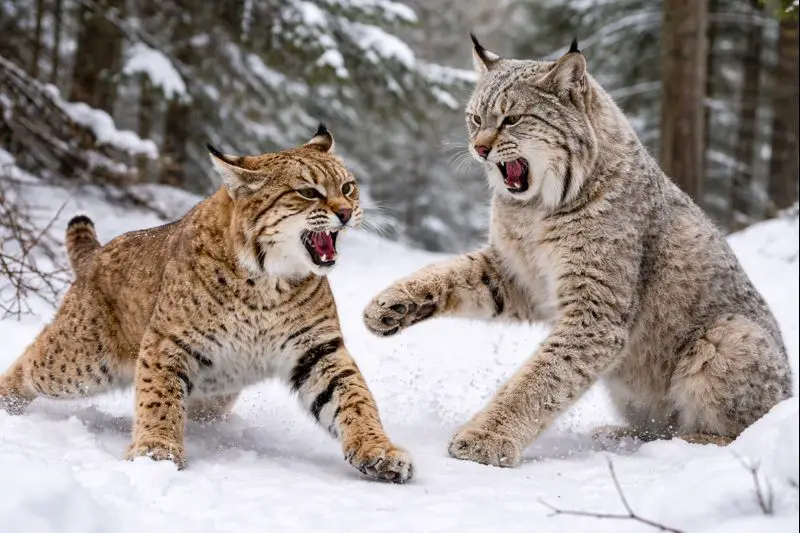
Montana’s forests and mountain ranges are some of the wildest remaining landscapes in the lower forty-eight states. They are also one of the few places where two similar looking wild cats share overlapping territory. Bobcats roam widely across valleys, foothills, and open forests. Canada lynx inhabit colder, higher-elevation forests tied closely to snow and prey cycles. Where these two species meet, a persistent question keeps resurfacing among hunters, hikers, and wildlife observers: are bobcats in Montana interbreeding with Canada lynx?
Photos of cats with tufted ears but shorter tails. Reports of animals that look too large to be bobcats yet too small to be lynx. Stories passed between neighbors and shared online. The idea of hybrid cats feels plausible, especially in a state known for wildlife overlap. But as with many wildlife myths, the truth is shaped by biology, behavior, and ecology rather than appearance alone.
To understand whether bobcats and Canada lynx interbreed in Montana, it is necessary to look carefully at genetics, habitat use, mating behavior, and what scientific research actually shows.
Table of Contents
- 1 Montana Is One of the Few Overlap Zones in the Lower 48
- 2 Bobcats and Canada Lynx Are Closely Related but Distinct
- 3 Genetic Compatibility Does Exist in Theory
- 4 Hybridization Is Extremely Rare in the Wild
- 5 Behavioral Differences Strongly Limit Interbreeding
- 6 Mating Timing Rarely Aligns Perfectly
- 7 Territorial Behavior Creates Additional Barriers
- 8 Why Snow Is a Major Separating Force
- 9 Where Overlap Is Most Likely to Occur
- 10 What Confirmed Hybrids Actually Look Like
- 11 Why Montana Sightings Fuel Confusion
- 12 Juvenile Lynx Are Often Misidentified
- 13 Bobcat Size Variation Adds to the Myth
- 14 What Genetic Studies Show
- 15 Why Hybrids Do Not Establish Populations
- 16 Canada Lynx Are Protected in Montana
- 17 Bobcats Are Abundant and Well Studied
- 18 Why the Hybrid Idea Persists
- 19 Social Media Amplifies Rare or Ambiguous Cases
- 20 How Wildlife Experts View the Question
- 21 Why Understanding the Difference Matters
- 22 What To Do If You See an Unusual Cat
- 23 Living With Both Species in Montana
- 24 Why Montana Remains a Special Case
- 25 FAQs About Bobcats and Canada Lynx in Montana
- 25.1 Can bobcats and Canada lynx interbreed
- 25.2 Are hybrids common in Montana
- 25.3 Can hybrids be identified by appearance
- 25.4 Why do some cats look like both species
- 25.5 Are lynx protected in Montana
- 25.6 Do bobcats threaten lynx populations
- 25.7 Should sightings be reported
- 25.8 Does climate change affect overlap
- 26 Final Thoughts
Montana Is One of the Few Overlap Zones in the Lower 48
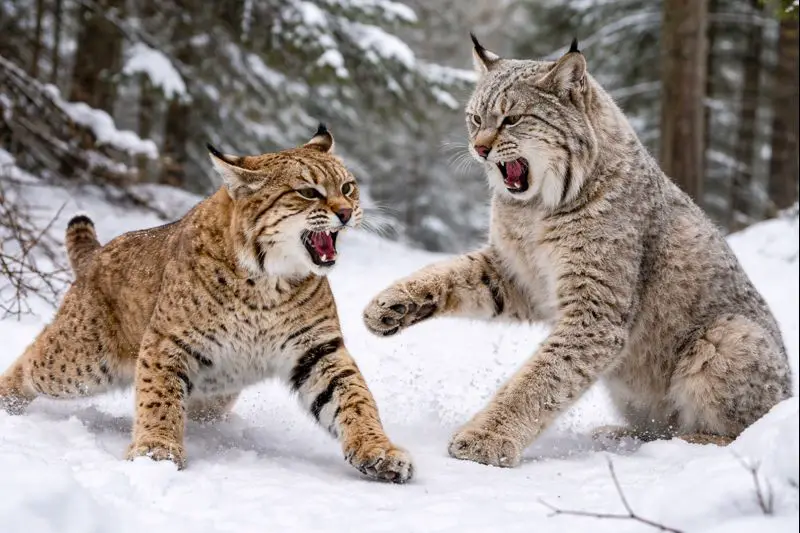
Montana sits at a biological crossroads for wild cats. Bobcats are widespread throughout the state, from lower elevation forests to brushy river bottoms and even semi-arid landscapes. Canada lynx, by contrast, are restricted to colder, high-elevation forests with deep snow and dense cover.
This overlap is limited but real. Parts of western and north-central Montana provide suitable habitat for both species, particularly during certain seasons. This geographic intersection is the reason the hybrid question arises here more than in many other states.
Overlap, however, does not automatically lead to interbreeding.
Bobcats and Canada Lynx Are Closely Related but Distinct
Bobcats (Lynx rufus) and Canada lynx (Lynx canadensis) belong to the same genus. They share a relatively recent evolutionary ancestor compared to many other wild cats. This genetic closeness is what makes the idea of interbreeding feel possible.
Despite this relationship, they are distinct species with different adaptations. Bobcats evolved for versatility across many habitats. Canada lynx evolved specifically for cold, snowy environments and a narrow prey base.
That specialization matters.
Genetic Compatibility Does Exist in Theory
From a purely biological standpoint, bobcats and Canada lynx can interbreed. They have compatible chromosome numbers, and hybridization has been documented in very limited cases in North America.
This fact is important. Unlike foxes and dogs, which are genetically incompatible, bobcats and lynx do not face an absolute genetic barrier.
However, theoretical possibility does not translate into common occurrence.
Hybridization Is Extremely Rare in the Wild
While hybridization between bobcats and Canada lynx is possible, confirmed cases are exceptionally rare.
Only a handful of genetically verified hybrids have ever been documented, and most come from Canada rather than the United States. Even in those cases, hybrids were isolated individuals, not members of a stable or expanding population.
In Montana, no evidence suggests that hybridization occurs frequently or at a level that would influence populations.
Behavioral Differences Strongly Limit Interbreeding
Behavior is one of the strongest barriers preventing interbreeding in Montana.
Bobcats and Canada lynx use different hunting strategies, occupy different terrain, and respond differently to snow conditions. Bobcats avoid deep snow. Lynx are adapted to move efficiently on snow using large, padded feet.
During winter, lynx occupy habitats where bobcats struggle to survive. During summer, bobcats expand into areas lynx may pass through but do not rely on.
These seasonal separations reduce prolonged contact during mating periods.
Mating Timing Rarely Aligns Perfectly
Both species breed in late winter, but timing is not identical.
Bobcat breeding seasons are longer and more flexible. Canada lynx breeding is closely tied to prey availability, particularly snowshoe hare cycles.
Even small differences in estrus timing reduce opportunities for successful mating.
In the wild, timing matters as much as proximity.
Territorial Behavior Creates Additional Barriers
Both bobcats and lynx are solitary and territorial.
They avoid one another whenever possible. Encounters between the two species are more likely to involve avoidance or competition rather than courtship.
Unlike social species that tolerate prolonged contact, solitary cats do not linger together without purpose.
This behavior further reduces hybridization likelihood.
Why Snow Is a Major Separating Force
Snow depth plays a critical role in Montana.
Canada lynx are specialists of deep snow environments. Their large feet act like snowshoes, allowing them to hunt efficiently where other predators struggle.
Bobcats sink into deep snow and lose mobility. As a result, bobcats retreat to lower elevations or south-facing slopes during harsh winters.
This snow-based separation is one of the strongest ecological barriers between the two species.
Where Overlap Is Most Likely to Occur
Potential overlap occurs mainly during mild winters or transitional seasons.
Spring and early summer may bring both species into mid-elevation forests. Juvenile dispersal can also increase temporary overlap.
However, these overlaps are brief. They do not provide the prolonged contact typically required for mating.
Short encounters do not favor hybridization.
What Confirmed Hybrids Actually Look Like
Confirmed bobcat-lynx hybrids do not consistently match popular expectations.
They often display intermediate traits that are difficult to identify without close examination. Even trained biologists cannot reliably identify hybrids by appearance alone.
Ear tufts, tail length, and body size vary widely within both species.
This makes visual identification unreliable.
Why Montana Sightings Fuel Confusion
Montana’s environment exaggerates appearance.
Winter coats are thicker. Animals appear larger. Snow obscures tails. Low light conditions distort perception.
A large bobcat in winter can resemble a lynx. A small lynx seen briefly can resemble a bobcat.
Once the idea of hybrids exists, ambiguous sightings reinforce belief.
Juvenile Lynx Are Often Misidentified
Young lynx are frequently mistaken for bobcats.
They are smaller than adult lynx but already have large feet and ear tufts. Their tails may not be clearly visible in brush or snow.
In Montana, where lynx populations are present but sparse, people unfamiliar with juvenile lynx may assume hybrid ancestry.
This misidentification accounts for many reports.
Bobcat Size Variation Adds to the Myth
Bobcats vary significantly in size across Montana.
Northern and high-elevation bobcats are often larger than those in southern regions. Males can appear especially robust during winter.
Size overlap between large bobcats and small lynx creates visual ambiguity.
Ambiguity fuels speculation.
What Genetic Studies Show
Genetic research conducted in Montana and surrounding regions shows that bobcats and Canada lynx remain genetically distinct.
Hybridization events, when they occur, do not persist across generations. There is no evidence of stable hybrid populations.
Wildlife agencies consistently report that the vast majority of animals tested show pure species ancestry.
Science does not support widespread mixing.
Why Hybrids Do Not Establish Populations
Even when hybrids are born, survival and reproduction are uncertain.
Hybrids may lack the specialized adaptations required to thrive in either parent species’ niche. They may struggle with hunting efficiency, snow travel, or territory defense.
Natural selection tends to eliminate poorly adapted combinations.
This prevents hybrid lineages from expanding.
Canada Lynx Are Protected in Montana
Canada lynx are listed under the Endangered Species Act in the contiguous United States.
This protection has led to careful monitoring and genetic testing of lynx populations in Montana.
If hybridization were occurring at meaningful levels, it would be detected through conservation research.
No such pattern has emerged.
Bobcats Are Abundant and Well Studied
Bobcats are common and widely studied in Montana.
Their population trends, movements, and genetics are well documented. There is no evidence that bobcats show widespread lynx ancestry.
This further supports the conclusion that hybridization is not shaping bobcat populations.
Why the Hybrid Idea Persists
Hybrid stories persist because they offer a simple explanation for unfamiliar sightings.
They feel dramatic. They fit the narrative of wildness returning or changing.
In Montana, where wildlife encounters are common, people expect complexity.
But expectation does not equal evidence.
Social Media Amplifies Rare or Ambiguous Cases
Photos and videos shared online often lack context.
A cat photographed without scale appears larger. Night vision exaggerates features. Snow hides key identifying traits.
Once shared, these images are interpreted through existing beliefs.
Speculation spreads faster than correction.
How Wildlife Experts View the Question
Wildlife biologists in Montana acknowledge that bobcat-lynx hybridization is biologically possible but extremely rare.
They emphasize that it is not a significant ecological issue and does not affect population management.
Experts focus on habitat protection and species conservation rather than hybrid concerns.
Why Understanding the Difference Matters
Misidentifying lynx as bobcats can have legal consequences.
Because lynx are protected, accurate identification is critical for hunters, trappers, and landowners.
Education reduces accidental harm and supports conservation goals.
What To Do If You See an Unusual Cat
If you encounter a wild cat that looks unusual, document it without assuming hybrid status.
Note size, tail length, ear tufts, habitat, and snow conditions. Photographs help, but distance and safety matter more.
Report sightings to wildlife authorities when appropriate.
Let science handle identification.
Living With Both Species in Montana
Bobcats and Canada lynx both play important ecological roles.
They regulate prey populations, influence predator dynamics, and reflect ecosystem health.
Their coexistence in Montana is a sign of ecological complexity, not genetic blending.
Why Montana Remains a Special Case
Few states support both species.
Montana’s size, elevation range, and climate allow overlap without forcing interaction.
This balance limits hybridization while supporting biodiversity.
FAQs About Bobcats and Canada Lynx in Montana
Can bobcats and Canada lynx interbreed
Yes, but it is extremely rare.
Are hybrids common in Montana
No. There is no evidence of widespread hybridization.
Can hybrids be identified by appearance
No. Genetic testing is required.
Why do some cats look like both species
Natural variation, winter coats, and misidentification.
Are lynx protected in Montana
Yes. They are federally protected.
Do bobcats threaten lynx populations
No. Habitat and climate are more important factors.
Should sightings be reported
Unusual or confirmed lynx sightings should be reported.
Does climate change affect overlap
Changing snow conditions may influence future interactions.
Final Thoughts
The idea that bobcats in Montana are interbreeding with Canada lynx is understandable but largely unsupported by evidence. While hybridization is biologically possible, it remains an exceptionally rare event with no meaningful impact on populations.
What people are seeing are bobcats and lynx sharing a complex landscape shaped by snow, elevation, and prey. Their similarities invite confusion. Their differences keep them separate.
In Montana’s wild spaces, these two cats coexist not by blending, but by occupying different niches. Nature draws clearer boundaries than rumor ever could.