
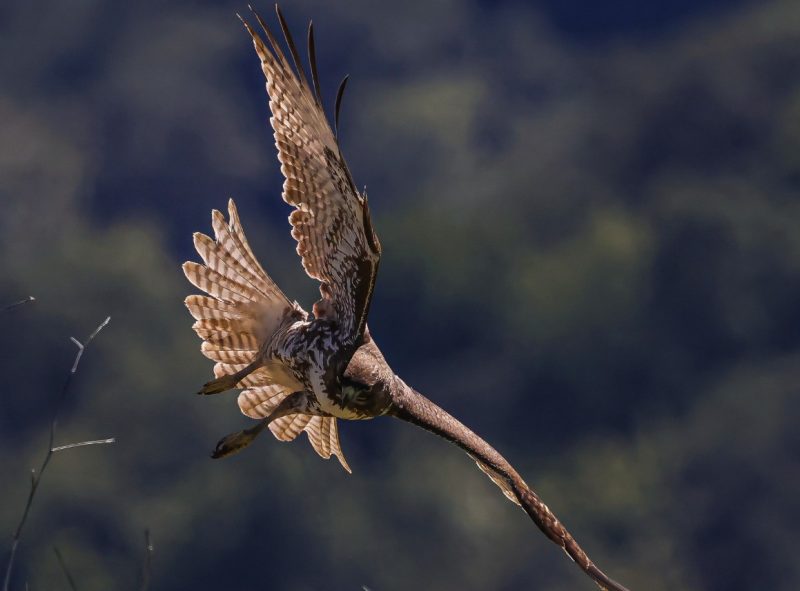
Hawks are part of the everyday sky in California. They circle above highways, perch on power poles, glide along ridgelines, and scan open fields with quiet intensity. To most observers, a hawk dive looks straightforward. The bird spots prey, folds its wings, drops quickly, and strikes.
But that familiar image hides a much deeper reality.
The hidden fact is this: hawks in California do not dive to maximize speed. They dive to preserve control, visual clarity, and decision-making until the final fraction of a second. In many cases, they intentionally slow their descent just before capture, even when gravity would allow them to fall faster.
This behavior runs counter to how people imagine aerial predators. Yet it explains why hawks remain such successful hunters across California’s extraordinarily varied landscapes.
Table of Contents
- 1 Hawk Dives Are Precision Maneuvers, Not Free Falls
- 2 Vision Sets the Upper Speed Limit
- 3 California’s Terrain Forces Behavioral Flexibility
- 4 Hawks Use Slowing as a Tactical Advantage
- 5 Talon Placement Matters More Than Impact Force
- 6 Juvenile Hawks Reveal the Learning Curve
- 7 Wind and Thermals Shape Every Dive
- 8 Hawks Rarely Dive Straight Down
- 9 Urban Hawks Have Shortened Dive Profiles
- 10 Prey Behavior Directly Influences Dive Outcome
- 11 Hawks Abort Dives More Often Than People Realize
- 12 Seasonal Conditions Affect Risk Tolerance
- 13 Why This Behavior Is Easy to Miss
- 14 California Hawks Share This Trait Across Species
- 15 Why Control Won the Evolutionary Race
- 16 What This Changes for Observers
- 17 FAQs about A Hidden Fact About Hawk Dive Behavior in California
- 17.1 Do hawks always dive at maximum speed?
- 17.2 Why don’t hawks dive as fast as falcons?
- 17.3 Can hawks slow down during a dive?
- 17.4 Does prey behavior affect how hawks dive?
- 17.5 Do hawks dive differently in urban California areas?
- 17.6 Are hawk dives instinctive or learned?
- 17.7 Why do juvenile hawks miss prey more often?
- 17.8 Do wind and thermals affect hawk dives?
- 17.9 How often do hawks abort dives?
- 17.10 What is the biggest misconception about hawk dives?
- 18 Final Thoughts
Hawk Dives Are Precision Maneuvers, Not Free Falls
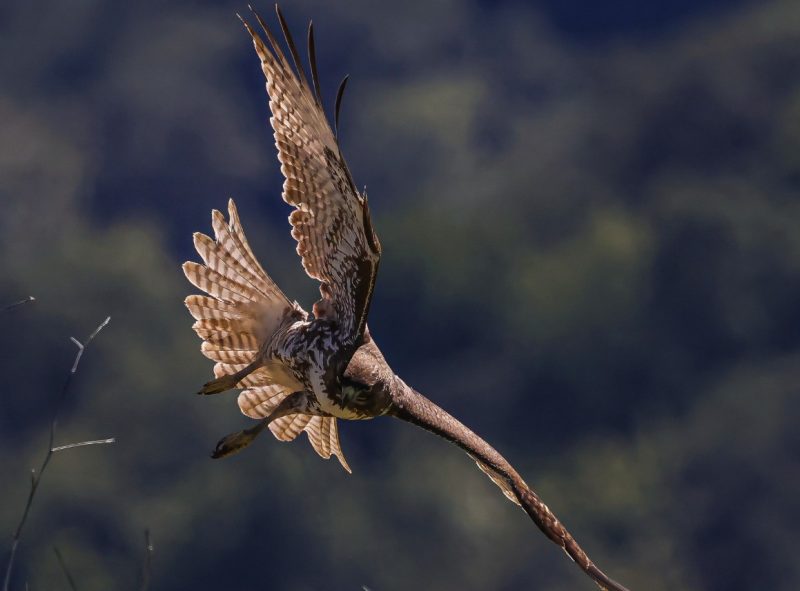
A hawk dive is often mistaken for a simple act of gravity. From the ground, it looks like a bird folding its wings and letting itself fall. In reality, nothing about a hawk’s dive is passive.
The moment a hawk commits to a descent, its entire body becomes an active control system. Wing angles change by degrees, not inches. Tail feathers fan and tighten repeatedly. Individual flight feathers flex to alter airflow. Even the position of the head shifts to stabilize vision. These adjustments happen continuously, sometimes dozens of times in a single dive.
Rather than surrendering to gravity, hawks negotiate with it.
This negotiation allows them to regulate speed, preserve lift, and maintain spatial awareness all the way to the strike. A hawk that simply drops would lose the ability to correct its path. One that controls the descent retains options.
In California, where hunting environments can shift from open farmland to cluttered suburban edges within minutes, that control is not optional. A dive that is too fast leaves no margin for error. A dive that is too slow gives prey time to disappear. Hawks survive by operating inside that narrow window where speed and precision overlap.
Vision Sets the Upper Speed Limit
Hawks are famous for their eyesight, but even exceptional vision has limits.
At high speeds, airflow around the head becomes turbulent. Tiny shifts in pressure and vibration can destabilize the eyes, reducing visual clarity. At the same time, rapid image motion causes the visual field to blur. Fine details, such as the twitch of a rodent’s tail or the sudden wingbeat of a bird, become harder to track.
This creates a hard biological ceiling on how fast a hawk can dive while still seeing clearly.
The hidden adaptation is that hawks cap their own speed. As they descend, they often partially spread their wings or adjust feather spacing, increasing drag and smoothing airflow around the eyes. This deceleration is subtle, often invisible to observers, but it dramatically improves targeting accuracy.
In California’s bright, high-contrast environments—where shadows, vegetation, and terrain create visual noise—clarity matters more than velocity. A slightly slower dive that keeps prey sharply in focus is far more effective than a faster dive that blurs the target at the critical moment.
California’s Terrain Forces Behavioral Flexibility
California is not a single hunting landscape. It is a patchwork of environments that demand different dive strategies.
In the Central Valley, hawks hunt over wide, open ground. Prey can be seen from long distances, allowing hawks to initiate longer, shallower dives. These extended descents give them time to adjust trajectory mid-dive as prey changes direction.
In coastal scrub and chaparral, visibility drops sharply. Vegetation is dense and uneven. Hawks respond with shorter, steeper dives that are more likely to be aborted if prey reaches cover.
In foothills and mountainous regions, uneven terrain creates unpredictable updrafts. Hawks approach at angles that minimize turbulence, often curving their dives to maintain lift and stability.
In suburban California, additional hazards appear. Power lines, vehicles, fences, and buildings all limit dive paths. Here, hawks shorten their dives and rely on surprise rather than altitude.
The same hawk species may use dramatically different dive profiles depending on where it hunts. Flexibility is the trait that allows them to thrive across the state.
Hawks Use Slowing as a Tactical Advantage
One of the least noticed aspects of hawk dives is intentional deceleration near the end of the descent.
As prey becomes aware of danger, it often reacts too soon. Some animals freeze. Others bolt in predictable directions. By slowing slightly, hawks delay the moment of commitment, forcing prey to make a decision without fully understanding the threat.
This hesitation increases capture success.
The prey moves first. The hawk responds second.
In this way, the dive becomes less about speed and more about manipulation. The hawk controls not only its own movement, but the prey’s response.
Talon Placement Matters More Than Impact Force
Another common misunderstanding is that hawks kill prey through sheer impact.
In reality, hawks rely on precise talon placement. Their talons are designed to close rapidly and lock onto vital areas, not to strike like blunt weapons. A successful capture depends on accuracy measured in centimeters.
If a hawk were diving at maximum speed, talon placement would become erratic. The risk of overshooting, glancing contact, or self-injury would increase dramatically.
By moderating speed, hawks ensure their talons arrive exactly where intended. This precision is especially important when hunting agile prey such as ground squirrels, rabbits, or birds common across California.
Control protects the hawk as much as it captures the prey.
Juvenile Hawks Reveal the Learning Curve
Young hawks make the hidden complexity of diving behavior obvious.
Juveniles often dive too aggressively. They descend too steeply, misjudge timing, or fail to adjust speed near the end. Many overshoot prey entirely or collide awkwardly with vegetation.
Their success rate is low.
Over time, repeated failure teaches restraint. Juveniles learn when to slow, when to abort, and when to commit fully. They learn how air movement affects control. They learn how prey reacts at different distances.
California’s long hunting seasons provide extended opportunities for this learning process. What looks instinctive in adult hawks is often the result of months or years of refinement.
Wind and Thermals Shape Every Dive
California’s air is rarely still.
Coastal winds, inland thermals, and mountain updrafts constantly reshape the atmosphere. Hawks are acutely sensitive to these patterns. They feel subtle changes in lift and pressure through their wings and feathers.
Before diving, hawks often wait for favorable conditions. Entering a dive at the wrong angle can destabilize flight or distort vision. Hawks adjust their approach to align with airflow that supports controlled descent.
They use wind to stabilize, not to accelerate.
This environmental awareness is invisible to ground observers but central to hunting success.
Hawks Rarely Dive Straight Down
True vertical dives are inefficient and risky.
Most hawk dives follow curved or angled paths that preserve lift and allow mid-course correction. These trajectories keep prey centered in the hawk’s binocular field of view and reduce the chance of losing control.
In California’s cluttered landscapes, angled dives also minimize collision risk. Straight down looks dramatic, but angled approaches win hunts.
Efficiency beats spectacle.
Urban Hawks Have Shortened Dive Profiles
In cities and suburbs, hawks adjust again.
High-altitude dives increase the chance of losing prey among buildings or striking obstacles. Urban hawks often hunt from lower perches, using surprise rather than speed.
Their dives are shorter, quieter, and less visible, but just as effective.
Adaptation keeps them alive in human-dominated spaces.
Prey Behavior Directly Influences Dive Outcome
Hawks do not commit blindly.
If prey freezes, hawks slow to avoid overshooting. If prey bolts unpredictably, hawks may abort rather than risk injury. If prey enters cover, the dive ends.
In California, where prey species vary widely, this responsiveness is essential. A dive is not a fixed script. It is a real-time exchange between predator and prey.
Hawks Abort Dives More Often Than People Realize
Aborted dives are common.
If wind shifts, prey behavior changes, or human disturbance increases, hawks disengage mid-dive and pull up smoothly. This ability to abort safely requires precise motor control and spatial awareness.
Every dive includes an exit plan.
Aborting is not failure. It is strategy.
Seasonal Conditions Affect Risk Tolerance
Season shapes behavior.
In winter, prey is scarce and alert. Hawks become conservative, slowing dives and aborting more frequently to conserve energy and avoid injury. In spring and summer, abundant prey allows more frequent attempts and greater experimentation.
Dive behavior reflects survival priorities.
Why This Behavior Is Easy to Miss
From the ground, a hawk dive lasts only seconds.
Subtle speed changes, wing adjustments, and deceleration are difficult to see without slow-motion footage. Because people expect speed, they overlook control.
The hidden fact hides in plain sight.
Whether hunting rodents, birds, or reptiles, hawks across California exhibit the same core principle.
Species differ in size and prey preference, but the strategy remains consistent.
Clarity beats speed. Control beats force.
Why Control Won the Evolutionary Race
Over time, hawks that relied solely on speed failed. They missed prey, suffered injuries, or lost visual tracking.
Hawks that balanced speed with control survived and reproduced.
Evolution favored restraint.
What This Changes for Observers
Once you notice the deceleration, hawk dives look different.
You see hesitation where you expected aggression. Calculation where you expected instinct. Decision where you expected reflex.
The dive becomes not a fall—but a choice.
FAQs about A Hidden Fact About Hawk Dive Behavior in California
Do hawks always dive at maximum speed?
No. Hawks often control and even slow their dives to maintain visual clarity and precision.
Why don’t hawks dive as fast as falcons?
Hawks prioritize control and accuracy, while falcons rely more on extreme speed.
Can hawks slow down during a dive?
Yes. Hawks adjust wing angle and tail spread to regulate speed, especially near prey.
Does prey behavior affect how hawks dive?
Absolutely. Hawks change dive speed or abort entirely based on how prey reacts.
Do hawks dive differently in urban California areas?
Yes. Urban hawks use shorter, more controlled dives to avoid obstacles and confusion.
Are hawk dives instinctive or learned?
Both. Basic diving is instinctive, but precise control improves with experience.
Why do juvenile hawks miss prey more often?
Young hawks often dive too fast or misjudge angles until they learn speed control.
Do wind and thermals affect hawk dives?
Yes. Hawks wait for favorable air conditions to maintain stability and vision.
How often do hawks abort dives?
Very often. Aborting is not failure, but a strategic choice to avoid risk.
What is the biggest misconception about hawk dives?
That speed alone determines success. Control and timing matter more.
Final Thoughts
The hidden fact about hawk dive behavior in California is not how fast hawks fall.
It is how deliberately they choose not to.
Hawks succeed because they manage speed, preserve vision, and strike with precision rather than force. Their dives are not acts of recklessness, but carefully controlled maneuvers shaped by California’s landscapes, winds, and prey.
Once you understand this, hawks stop looking like simple predators.
They start looking like aerial tacticians—masters of restraint in a world that rewards control over chaos.