
Red flashes on a bird’s wings often appear for only a second, usually when the bird lifts off or shifts position. In California, these brief moments of color can be the key to identifying species that otherwise look dark, muted, or ordinary at rest.
Unlike overall body color, red wing patches serve clear functions. They act as territorial signals, courtship displays, and visual cues during flight. Some species reveal red boldly, while others show it only in motion, making careful observation essential.
California’s varied landscapes—from wetlands and deserts to mountain forests and coastal parks—create opportunities to see both resident species and rare wanderers. Paying attention to wing movement rather than plumage alone often turns a passing glimpse into a confirmed identification.
Table of Contents
- 1 Types of Birds With Red Wing Patches in California
- 2 Tips for Observing Birds With Red Wing Patches in California
- 3 FAQs About Birds With Red Wing Patches in California
- 3.1 Why do some birds show red only on their wings?
- 3.2 Are red wing patches related to diet?
- 3.3 Which species has the most obvious red wing patch?
- 3.4 Are rare red-winged birds usually migrants?
- 3.5 Can females show red wing patches?
- 3.6 Do juveniles have red wing patches?
- 3.7 Where are rare sightings most likely to occur?
- 4 Final Thoughts
Types of Birds With Red Wing Patches in California
Red-winged Blackbird

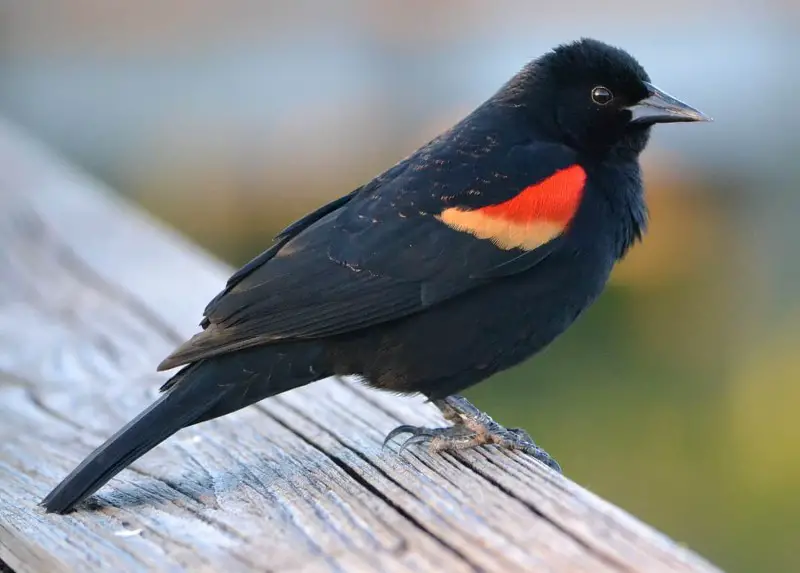
The red wing patch of the Red-winged Blackbird is one of the most recognizable field marks in North America. Males appear mostly black at rest, but when they fly or display, bright red shoulder patches edged in yellow flash boldly. Adults measure about 7–9 inches long with a stocky, confident build.
Behavior is loud and assertive. Males perch high on reeds or fences, spreading their wings and calling loudly to defend territory. The red patches play a central role in these displays, signaling dominance to rivals and attracting mates.
Wetlands define much of its presence in California, including marshes, ponds, agricultural ditches, and flooded fields. Outside the breeding season, large flocks also spill into open farmland and grasslands.
A fun fact is that the red wing patch is not always visible. Males can partially conceal it by adjusting their feathers, revealing the color only when needed.
Tricolored Blackbird

At a glance, the Tricolored Blackbird resembles a Red-winged Blackbird, but closer inspection reveals deeper red shoulder patches bordered by crisp white rather than yellow. Slightly smaller and sleeker, adults average about 7 inches long.
This species is intensely social. During breeding season, thousands of birds may nest together in dense colonies, filling wetlands with constant sound and movement. Wing displays are frequent as individuals jostle for space and mates.
Almost the entire global population depends on habitats in California, especially freshwater marshes and agricultural fields like alfalfa and grain crops. This narrow range makes the species especially vulnerable to habitat changes.
A notable fact is its conservation status. Tricolored Blackbirds are declining rapidly, and California plays a critical role in their survival.
Yellow-headed Blackbird
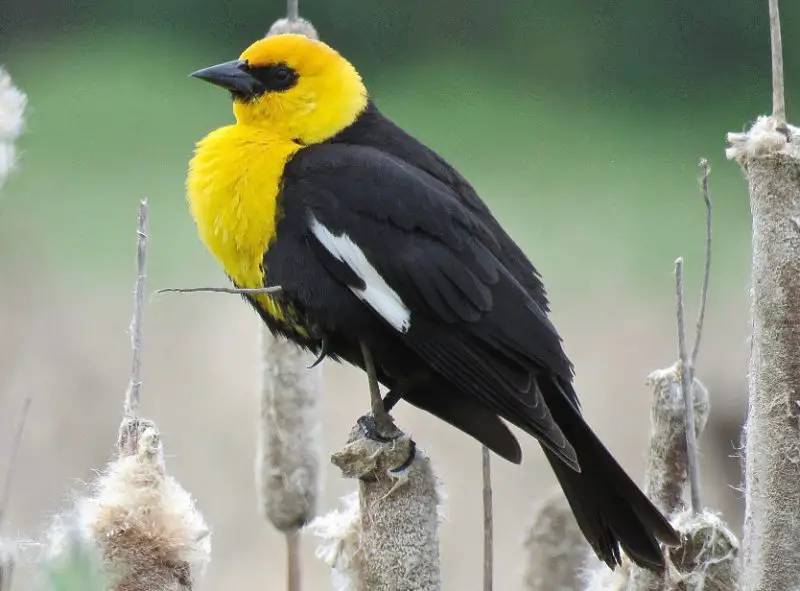
The Yellow-headed Blackbird looks dramatic even from a distance, with a bright yellow head and chest contrasting sharply against black wings and body. When the wings open, red shoulder patches edged with yellow become visible, adding another layer of color. Adults are about 9–10 inches long.
Their behavior is bold and often aggressive. Males defend nesting areas with loud, harsh calls and exaggerated wing displays, frequently chasing away intruders much larger than themselves.
Breeding populations occur seasonally in California, favoring large freshwater marshes with tall reeds. Outside nesting season, they move into open fields and agricultural areas, often forming mixed flocks with other blackbirds.
An interesting detail is their voice. Unlike the musical songs of many birds, the Yellow-headed Blackbird produces a raspy, mechanical call that matches its intense appearance.
Northern Flicker
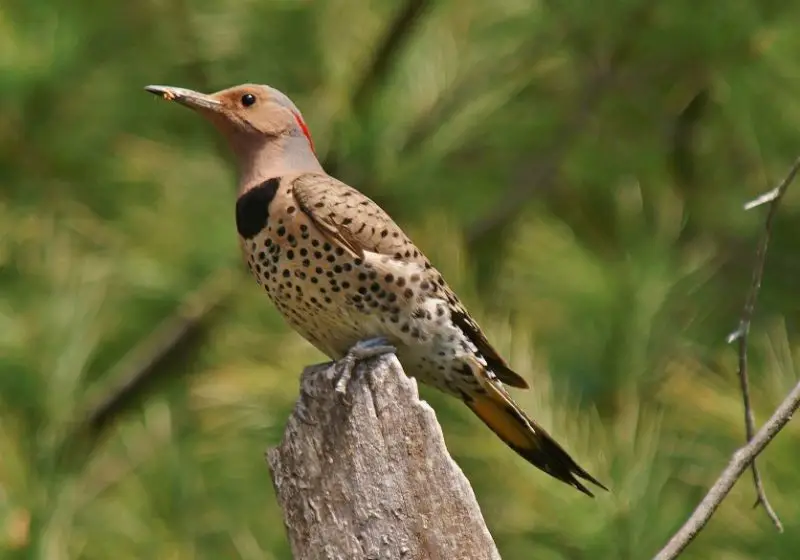
The Northern Flicker stands apart from most woodpeckers due to its ground-feeding habits and large size, reaching about 11–12 inches long. In California’s red-shafted form, flashes of red appear along the wing linings and tail shafts during flight.
Unlike tree-bound woodpeckers, flickers spend much of their time on the ground searching for ants and beetles. Their flight is undulating, with repeated wingbeats followed by short glides that highlight the red coloration.
Open woodlands, parks, forest edges, and suburban areas support the species in California, where it is widespread year-round in many regions.
A fun fact is that ants make up a major portion of the flicker’s diet. Their long, sticky tongue is specially adapted for extracting insects from the soil.
Red Crossbill

Male Red Crossbills show varying shades of red across the body and wings, sometimes appearing brick-red, orange, or pinkish depending on diet. Their most distinctive feature is the crossed bill tips, visible even at a distance. Adults measure around 5–6 inches long.
Feeding behavior is highly specialized. Crossbills pry seeds from conifer cones by twisting their unique bills sideways, a skill few other birds possess. This allows them to exploit food sources year-round.
Conifer forests define where the species appears in California, especially in mountainous regions dominated by pine, spruce, or fir. Movements are irregular and depend heavily on cone availability.
One fascinating detail is that Red Crossbills may breed at almost any time of year if food is abundant, even in winter, defying typical seasonal patterns.
Vermilion Flycatcher

A flash of intense red is usually the first clue when a male Vermilion Flycatcher appears. The crimson body contrasts sharply with dark wings and tail, and under strong sunlight the red can take on a pinkish tone. This small flycatcher measures only about 5–6 inches long.
Rather than staying hidden, the species favors exposed perches. From fence lines or low branches, it launches sudden aerial sallies to catch flying insects, then returns to the same spot with precise timing.
Southern deserts and open riparian areas host most records in California, particularly in winter. Golf courses, wetlands, and agricultural edges sometimes attract individuals that linger for weeks.
A fun fact is that Vermilion Flycatchers often wag their tails while perched, a subtle behavior that helps observers pick them out even before the color becomes obvious.
Western Tanager

The Western Tanager shows its brightest red on the head and upper body, while the wings remain dark, creating strong contrast during flight. When moving between trees, the red stands out vividly against green foliage. Adults are medium-sized songbirds, around 7 inches long.
Feeding activity is steady and methodical. Tanagers glean insects from leaves during breeding season and switch to fruits and berries when available. Their movements are purposeful rather than frantic.
Coniferous and mixed forests define much of the species’ range in California, especially in mountainous regions during summer. Migration brings them into lower elevations, parks, and wooded neighborhoods.
An interesting detail is that the red coloration develops from yellow pigments transformed in the body, meaning the bird’s diet directly influences how intense the red appears.
Scarlet Tanager

A true Scarlet Tanager in California is unforgettable. Males display deep scarlet bodies paired with jet-black wings, creating one of the most dramatic color contrasts of any North American bird. Adults measure about 7 inches long.
Despite their striking appearance, these birds behave quietly. They forage high in the canopy, often remaining hidden while moving slowly among leaves in search of insects.
Only a handful of records exist in California, usually involving single birds during migration. Woodland edges, riparian corridors, or urban parks sometimes host brief stopovers.
A remarkable fact is that Scarlet Tanagers migrate at night, which helps explain how such an eastern species occasionally appears far west of its normal range.
Red-breasted Sapsucker
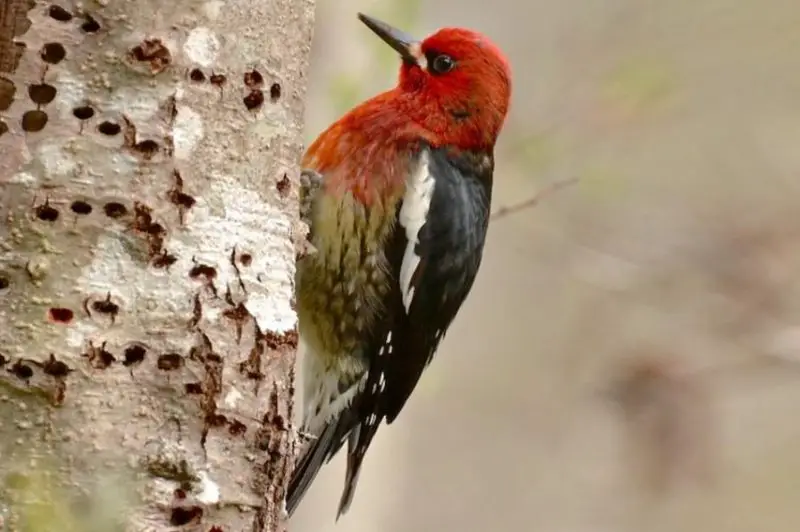
The Red-breasted Sapsucker shows rich red coloration across the head and chest, with the color sometimes extending toward the shoulder area. Black-and-white wing patterning provides contrast, especially noticeable in flight. Adults are about 8–9 inches long.
This woodpecker feeds differently from most of its relatives. It drills neat rows of sap wells in trees, returning repeatedly to feed on sap and insects attracted to it.
Forests and wooded parks support populations in California, particularly along the coast and in mountainous regions. The species favors mature trees where sap flow is reliable.
A fun fact is that sapsucker wells benefit other wildlife. Hummingbirds and insects often rely on these sap sources created by the bird’s feeding habits.
Red-naped Sapsucker
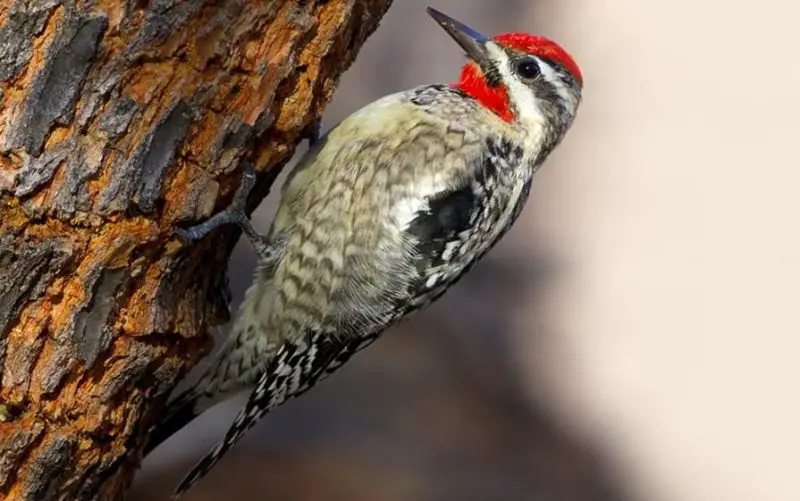
The defining feature of the Red-naped Sapsucker is the red patch on the back of the neck, visible even when the bird is clinging to tree trunks. Black-and-white wings add contrast, becoming more apparent when the bird flies. Adults measure roughly 8 inches long.
Movement tends to be vertical and deliberate. This species climbs trunks and branches, pausing frequently to drill or inspect sap wells.
Breeding occurs mainly in montane forests in California, with seasonal movements bringing individuals into foothills and lower elevations. Mixed woodlands and forest edges are common stopover sites.
An interesting note is that Red-naped and Red-breasted Sapsuckers can hybridize where their ranges overlap, producing birds with mixed red patterns that challenge identification.
Painted Redstart
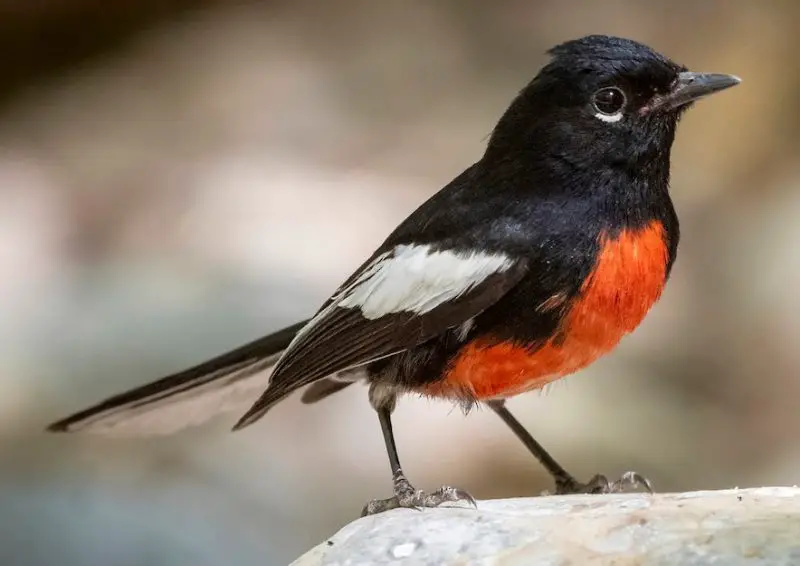
Few birds show wing patches as boldly as the Painted Redstart. Its black body is sharply contrasted by large white wing panels that flash dramatically during flight or wing-flicking displays. Adults are small, measuring about 5–6 inches long, but their visual impact is outsized.
Movement is central to how this bird hunts. Painted Redstarts frequently spread and flick their wings while foraging, startling insects into motion before chasing them. This constant wing flashing makes the white patches impossible to miss.
Records in California are exceptionally rare and usually involve single birds appearing during migration. When they do occur, sightings tend to come from riparian corridors, wooded canyons, or park-like habitats with dense foliage.
A fun fact is that this wing-flashing behavior is intentional hunting strategy, not just display. The bird actively uses contrast and motion to manipulate prey behavior.
Hepatic Tanager

The Hepatic Tanager carries a deep brick-red tone across most of its body, paired with darker, more subdued wings. Compared to brighter tanagers, the color appears richer and earthier rather than scarlet. Adults average around 7 inches in length.
Rather than constant motion, this species forages calmly through tree canopies. Insects are taken from leaves and branches, supplemented by fruits when available. Its pace is unhurried and deliberate.
Occurrences in California are scarce and mostly limited to the southeastern deserts and montane regions, often during breeding season wanderings. Pine-oak woodlands and forested slopes provide suitable conditions.
An interesting detail is that Hepatic Tanagers show noticeable color variation by region, which can make identification challenging when individuals appear far outside their typical range.
Red-headed Woodpecker
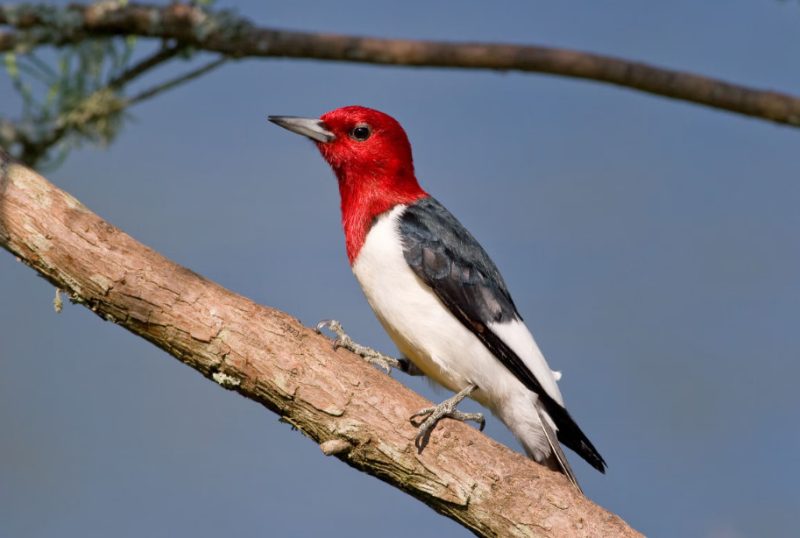
The Red-headed Woodpecker is instantly recognizable by its entirely crimson head set against bold black-and-white wings. In flight, the contrast is striking, with large white wing panels flashing between black sections. Adults are medium-sized woodpeckers, measuring about 9 inches long.
Unlike many woodpeckers, this species often catches insects in midair. It also stores food, wedging nuts and seeds into bark crevices for later use. Its behavior is confident and sometimes aggressive toward other birds.
Sightings in California are unusual and typically involve wandering individuals rather than established populations. Open woodlands, groves, and parklands are the most likely places where one might appear.
A remarkable fact is that Red-headed Woodpeckers rely heavily on acorns and mast crops. Their populations fluctuate with oak productivity, which partly explains their irregular appearances far from core range.
Tips for Observing Birds With Red Wing Patches in California
Watch for movement, not stillness. Red wing patches are most visible during takeoff, landing, wing flicking, or territorial displays. Perched birds may hide color entirely.
Choose habitats strategically. Marshes and agricultural edges favor blackbirds, forests support tanagers and sapsuckers, while desert riparian zones increase chances for rare flycatchers.
Season matters. Breeding season brings stronger color and more frequent displays, while migration can produce unexpected vagrants far outside their usual range.
Keep distance and stay patient. Many red-patched species are sensitive to disturbance, and repeated flushing may cause them to conceal color or leave the area entirely.
FAQs About Birds With Red Wing Patches in California
Why do some birds show red only on their wings?
Wing patches act as signals during flight or display, allowing birds to communicate without being constantly visible to predators.
In many species, yes. Carotenoid pigments from insects or plant material influence red coloration intensity.
Which species has the most obvious red wing patch?
The Red-winged Blackbird shows the most dramatic and consistent red shoulder patches.
Are rare red-winged birds usually migrants?
Most are. Vagrants like Scarlet Tanager or Painted Redstart typically appear during migration periods.
Can females show red wing patches?
In some species, females show reduced or muted red, while in others the color is absent or very subtle.
Do juveniles have red wing patches?
Juveniles often lack strong red coloration, developing it later as they mature.
Where are rare sightings most likely to occur?
Riparian corridors, urban parks, and isolated wetlands often attract wandering individuals.
Final Thoughts
Red wing patches add an element of surprise to birdwatching in California. Often hidden until the perfect moment, these flashes of color reward observers who focus on movement rather than stillness.
From common blackbirds defending wetlands to rare tanagers appearing briefly during migration, each species tells a story shaped by habitat, season, and behavior. Learning to recognize wing signals transforms quick sightings into confident identifications.