
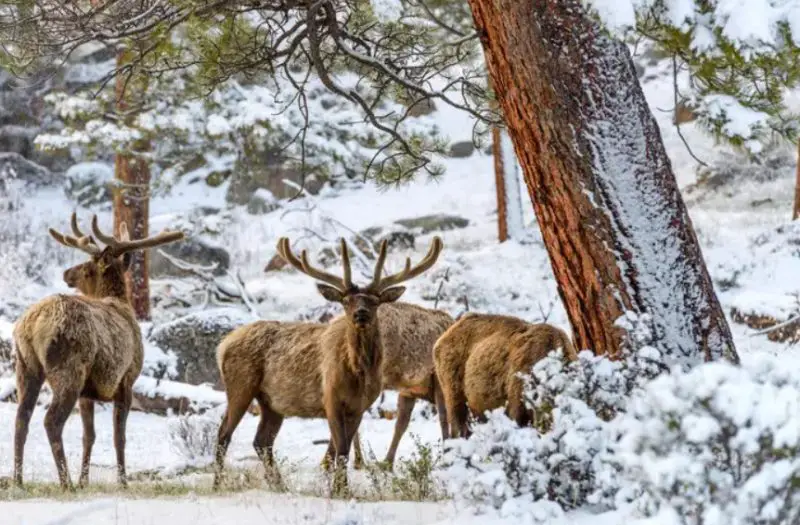
January is when Colorado’s winter truly takes control of the landscape. Snowpack deepens, daylight is short, and temperatures settle into patterns that shape wildlife behavior for weeks at a time. For elk, January snowpack is not just background scenery. It is one of the strongest forces determining where they move, how visible they are, and how often people encounter them.
Every winter, questions surface across the state. Why are elk suddenly everywhere in one valley and gone from another? Why are herds showing up near roads, ranches, and towns more often in January? Why do sightings spike after storms and then disappear again?
The answers are written in the snow.
Table of Contents
- 1 Why January matters more than any other winter month
- 2 Snow depth changes everything about elk movement
- 3 Snow quality matters as much as snow depth
- 4 Elevation shifts define January elk sightings
- 5 South-facing slopes become critical habitat
- 6 Snowpack compresses elk into visible zones
- 7 Why elk appear near roads more often in January
- 8 Wind interacts with snowpack to shape elk behavior
- 9 Thermal cover becomes non-negotiable
- 10 Feeding windows shrink as snowpack deepens
- 11 Forage availability drives visibility
- 12 Agricultural edges attract elk in January
- 13 Predation pressure shifts with snowpack
- 14 How January snowpack affects herd grouping
- 15 Bulls, cows, and calves respond differently
- 16 Why some areas seem empty in January
- 17 Snowpack timing matters as much as amount
- 18 Human activity influences January elk patterns
- 19 Why trail cameras explode with activity in January
- 20 January snowpack and vehicle collisions
- 21 Long-term snowpack trends are reshaping elk behavior
- 22 What wildlife managers watch in January
- 23 How observers can better predict January sightings
- 24 This is not random movement
- 25 Why patience matters in January
- 26 What January snowpack means going forward
- 27 Final thoughts
Why January matters more than any other winter month

Early winter is flexible for elk. Late winter is survival-focused. January sits at the tipping point between the two.
By January, elk have already burned through much of the fat they built in fall. Bulls are recovering from the rut. Cows are entering early pregnancy. Calves are still growing and less efficient at conserving energy.
At this stage, snowpack becomes the deciding factor. Not just how much snow falls, but how it accumulates, compacts, melts, refreezes, and interacts with terrain.
January snowpack determines whether elk can afford to stay where they are—or whether they must move.
Snow depth changes everything about elk movement
Elk are large, powerful animals, but snow quickly limits their mobility.
When snow is shallow, elk can paw through it to reach grass, shrubs, and forbs. When snow deepens beyond knee height, every step costs energy. Travel slows. Feeding efficiency drops. Calorie loss accelerates.
In Colorado, January snowpack often crosses that threshold, especially at mid to high elevations.
Once that happens, elk respond predictably. They reduce movement in place or relocate to areas where snow is easier to manage.
This is why January sightings often cluster rather than spread evenly across the landscape.
Snow quality matters as much as snow depth
People often talk about snow depth, but elk respond just as strongly to snow quality.
Powder snow is easier to move through than dense, wet snow. Crusted snow is often the worst of all. A hard crust supports a predator’s weight but breaks under an elk, forcing them to punch through with every step.
In January, Colorado frequently experiences freeze-thaw cycles that create layered snowpack. Elk feel this immediately.
When snow becomes crusted or wind-packed, elk abandon otherwise suitable habitat. Sightings drop abruptly in those areas and spike elsewhere.
This explains why herds seem to “vanish” overnight after certain storms.
Elevation shifts define January elk sightings
As January snowpack builds, elk gradually drop in elevation.
High-elevation summer range becomes energetically expensive. Mid-elevation zones hold elk temporarily, but once snow stacks up there too, movement continues downslope.
Lower elevations offer several advantages in January:
-
Shallower snow
-
More exposed forage
-
Reduced wind
-
Better thermal cover
As a result, elk sightings increase in foothills, valleys, and winter range earlier and more consistently than in December.
This downslope movement is one of the clearest January patterns across Colorado.
South-facing slopes become critical habitat
January sun angle plays a major role in elk distribution.
South-facing slopes receive more solar radiation, which melts snow faster and exposes forage sooner. Even a few inches less snow can make the difference between usable and unusable ground.
Elk concentrate heavily on these slopes in January. Sightings often spike along south-facing hillsides, benches, and open forests while north-facing slopes appear empty.
For observers, this can feel dramatic. In reality, elk are simply following microclimates created by snowpack and sun exposure.
Snowpack compresses elk into visible zones
January snowpack does not spread elk evenly. It compresses them.
As snow eliminates marginal habitat, elk are forced into fewer suitable areas. These areas may include:
-
Valley bottoms
-
River corridors
-
Foothill benches
-
Agricultural edges
-
Low-elevation public land
This compression increases sighting frequency. People are not seeing more elk overall. They are seeing more elk in fewer places.
This is why January often produces large, memorable herds near towns and roads.
Why elk appear near roads more often in January
Road sightings increase dramatically in January, and snowpack is the main reason.
Plowed roads create linear snow-free corridors. Adjacent shoulders often have shallower snow. Salt runoff and disturbed soil can expose vegetation.
Elk quickly learn this.
They do not use roads casually, but they do cross them more often when snow forces movement between feeding and bedding areas.
January snowpack narrows safe travel routes, making road crossings more predictable—and more dangerous.
Wind interacts with snowpack to shape elk behavior
Snow alone does not tell the full story. Wind amplifies its effects.
Wind scours ridges, piles snow into drifts, and strips heat from exposed terrain. In January, strong winds can make moderate snowpack function like deep snow.
Elk avoid wind-exposed areas aggressively during this month. They seek timber, terrain breaks, and leeward slopes where snow is shallower and conditions are calmer.
Sightings therefore increase in sheltered zones while windy ridgelines appear deserted.
Thermal cover becomes non-negotiable
By January, elk are no longer choosing comfort. They are choosing survival.
Thermal cover—dense trees, broken terrain, and sheltered basins—reduces heat loss and conserves energy. Snowpack magnifies the value of this cover.
Elk may feed briefly in open areas, but they retreat quickly to shelter. Observers often catch elk moving in short windows between bedding and feeding sites.
This creates the impression of sudden appearances and disappearances that characterize January sightings.
Feeding windows shrink as snowpack deepens
January snowpack compresses time as well as space.
Elk feed in shorter, more focused bouts. Instead of long feeding periods spread across the night, they concentrate activity during brief windows when conditions are favorable.
These windows often occur:
-
Midday when temperatures rise slightly
-
After storms when snow settles
-
During calm periods between wind events
This timing explains why January sightings often occur outside the traditional dawn and dusk pattern.
Forage availability drives visibility
Snowpack determines not only where elk go, but how visible they are when they get there.
When forage is buried, elk spend more time searching. When forage is exposed, they feed efficiently and rest sooner.
January snowpack often exposes forage unevenly. Patches of windblown grass or sun-melted slopes attract heavy use.
Elk congregate on these patches, increasing sighting frequency in very specific locations.
Agricultural edges attract elk in January
In many parts of Colorado, lower-elevation agriculture becomes a magnet in January.
Hay fields, pastures, and crop residue offer accessible calories when snow limits natural forage. Elk are drawn to these areas as snowpack builds elsewhere.
This increases sightings near ranches and communities, sometimes leading to conflict.
From the elk’s perspective, it is simple math. Energy gained versus energy spent.
Predation pressure shifts with snowpack
Predators adapt quickly to snow conditions.
In deep or crusted snow, predators may gain an advantage over elk, especially calves. In other conditions, elk can use open terrain to detect threats earlier.
January snowpack alters this balance. Elk may move to areas where snow conditions reduce ambush risk, even if those areas are closer to people.
This predator-avoidance behavior influences where sightings occur.
How January snowpack affects herd grouping
Elk herd structure changes in January.
As snowpack deepens, elk form larger groups. Grouping reduces individual energy loss and improves predator detection.
Larger groups are easier to spot. This is another reason January produces more noticeable sightings even if overall numbers remain constant.
Large herds near roads or valleys often reflect snow-driven grouping rather than population growth.
Bulls, cows, and calves respond differently
Not all elk respond to snowpack in the same way.
Cows and calves are more sensitive to energy loss. They tend to move earlier and farther downslope. Bulls, especially mature ones, may hold higher ground slightly longer.
By January, however, most groups converge in similar zones as snowpack becomes unavoidable.
This convergence increases mixed-group sightings and large herd encounters.
Why some areas seem empty in January
When snowpack crosses certain thresholds, elk abandon entire regions.
Observers returning to familiar high-country spots often find them empty. Tracks disappear. Cameras go quiet.
This does not mean elk numbers are down. It means snowpack has made those areas inefficient.
Elk have shifted, sometimes miles away, to lower elevations or different aspects.
Snowpack timing matters as much as amount
An early heavy snowpack pushes elk sooner. A late snowpack delays movement.
January snowpack that arrives suddenly can trigger abrupt migrations. Gradual accumulation allows elk to adjust more slowly.
This year-to-year variability explains why January sightings feel unpredictable even to experienced observers.
The snow’s story changes every winter.
Human activity influences January elk patterns
January snowpack concentrates people as well as elk.
Plowed roads, packed trails, and winter recreation zones funnel human movement. Elk respond by avoiding heavily trafficked areas and favoring quieter zones.
Sometimes those quiet zones are near towns or private land, increasing sightings where people least expect them.
Elk choose disturbance they can predict over disturbance they cannot.
Why trail cameras explode with activity in January
Trail cameras often record dramatic increases in January.
This is not because elk suddenly move more. It is because their movement becomes concentrated.
Cameras placed along migration routes, fence gaps, and valley corridors capture repeated use as snowpack funnels elk through limited paths.
January snowpack turns the landscape into a series of bottlenecks.
January snowpack and vehicle collisions
As elk move downslope and concentrate near roads, collision risk rises.
Snowbanks reduce escape routes. Plowed shoulders attract feeding. Reduced daylight and glare from snow complicate visibility.
January is one of the most dangerous months for elk-vehicle encounters in Colorado.
This risk often peaks just after storms when elk resume movement during calm periods.
Long-term snowpack trends are reshaping elk behavior
While each January is unique, broader trends matter.
More variable winters, with alternating heavy snow and dry periods, create inconsistent snowpack. Elk must adapt repeatedly within a single season.
This favors flexibility over tradition.
As a result, historical patterns become less reliable predictors of January sightings.
What wildlife managers watch in January
January snowpack provides critical data for wildlife managers.
They monitor:
-
Distribution across winter range
-
Group size and composition
-
Calf survival indicators
-
Movement timing
-
Conflict reports
These observations help predict herd health and inform management decisions later in the year.
January is not just a snapshot. It is a preview of spring outcomes.
How observers can better predict January sightings
Understanding snowpack improves prediction.
Look for:
-
Recent storms followed by calm weather
-
South-facing slopes with partial melt
-
Valley bottoms with exposed forage
-
Wind-protected timber edges
-
Travel corridors between feeding and bedding areas
These are the places January elk sightings concentrate.
This is not random movement
Elk behavior in January often appears chaotic. It is not.
Every movement reflects energy conservation, risk management, and snowpack response.
What changes year to year is where those conditions align.
Snowpack is the map elk follow.
Why patience matters in January
January elk sightings come in waves.
Days of nothing may be followed by sudden, dramatic encounters. This reflects compressed movement rather than absence.
Understanding this helps reduce frustration and misinterpretation.
Elk are there. They are just waiting for the right conditions.
What January snowpack means going forward
As climate variability increases, January snowpack will likely become more unpredictable.
Elk will continue to adapt quickly. Sightings will cluster, disperse, and reappear in new patterns.
People who understand snowpack dynamics will make sense of what they see. Those who rely on old calendars may struggle.
Final thoughts
January snowpack is the single most important factor shaping elk sightings in Colorado during midwinter.
It determines where elk can move, where they can feed, and where they can survive with minimal energy loss. It compresses herds, shifts elevation use, and brings elk into closer contact with people.
When elk appear unexpectedly in January, the explanation is almost always underfoot.
The snow is telling them where to go—and they are listening.