
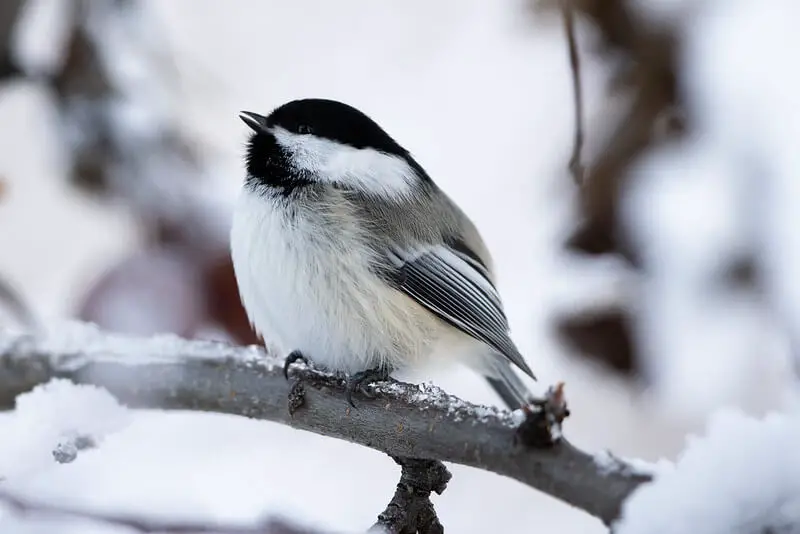
Winter in Vermont is not gentle. Temperatures regularly plunge well below freezing. Snow piles up for months. Daylight shrinks. Food becomes scarce, unpredictable, and often frozen solid. For many birds, these conditions are simply too harsh to endure, which is why migration has become the dominant survival strategy.
Yet one small bird remains.
The black-capped chickadee does not flee south when Vermont locks into winter. Instead, it stays. It sings. It flits through snow-covered forests and suburban yards alike. It survives nights that dip far below zero and mornings that arrive coated in frost.
This is not accidental. The black-capped chickadee is one of the most cold-adapted songbirds in North America. Its survival depends on a finely tuned system of insulation, metabolism, memory, behavior, and physiology that works together with remarkable efficiency.
Understanding how this tiny bird survives extreme cold reveals one of nature’s most impressive cold-weather survival strategies.
Table of Contents
- 1 Small Size, Big Problem
- 2 Feathers as a Precision Insulation System
- 3 A Metabolism Built for Burning Fuel
- 4 Fat as Overnight Insurance
- 5 Food Caching and a Seasonal Memory Boost
- 6 Diet Flexibility in Frozen Landscapes
- 7 Countercurrent Heat Exchange in Legs and Feet
- 8 Roosting Smart: Where Nights Are Won or Lost
- 9 Communal Roosting and Shared Warmth
- 10 Torpor: Lowering the Thermostat to Survive
- 11 Reduced Activity and Energy Discipline
- 12 Flocking Behavior Increases Survival Odds
- 13 Snow Is Not Always the Enemy
- 14 Experience Matters More Than Strength
- 15 Why Chickadees Do Not Migrate
- 16 Vermont’s Forests Are Ideal Chickadee Habitat
- 17 Human Landscapes as Supplemental Support
- 18 Climate Change and Winter Survival
- 19 Why Chickadees Symbolize Winter Resilience
- 20 FAQs about Why Black-Capped Chickadees Can Survive Extreme Cold in Vermont
- 20.1 Why can black-capped chickadees survive extreme cold in Vermont?
- 20.2 How do black-capped chickadees stay warm during freezing Vermont winters?
- 20.3 How do chickadees find food in winter when Vermont is frozen?
- 20.4 How do black-capped chickadees survive cold winter nights?
- 20.5 Why don’t black-capped chickadees migrate south?
- 20.6 Does snow help or harm chickadees in winter?
- 20.7 Are young chickadees as good at surviving winter as adults?
- 20.8 Do human bird feeders help chickadees survive Vermont winters?
- 21 Final Thoughts
Small Size, Big Problem
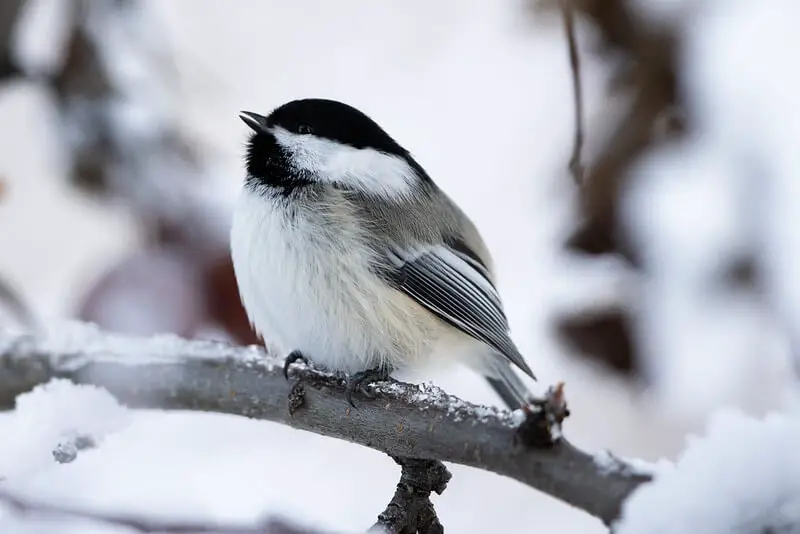
At first glance, the chickadee seems poorly suited for Vermont winters.
It weighs less than half an ounce. Its small body has a high surface-area-to-volume ratio, meaning it loses heat rapidly. Unlike large birds or mammals, it cannot rely on sheer mass to retain warmth.
From a physics standpoint, a chickadee should freeze.
Yet it doesn’t.
The reason lies in how the species compensates for size with specialization. Every part of the chickadee’s biology works toward one goal in winter: conserving heat while maintaining enough energy to survive.
Feathers as a Precision Insulation System
Feathers are the chickadee’s first and most important defense against cold.
In winter, chickadees fluff their feathers dramatically, trapping layers of air close to the body. This trapped air acts as insulation, slowing heat loss to the surrounding environment.
Beneath the visible contour feathers lies a dense layer of down. This down is exceptionally effective at retaining body heat, especially during still, cold nights.
Chickadees actively regulate feather position. When wind increases or temperatures drop further, feathers loosen to trap more air. When conditions improve, feathers compress to allow mobility.
This dynamic insulation system works continuously, adapting minute by minute.
A Metabolism Built for Burning Fuel
Insulation alone is not enough.
Chickadees survive Vermont winters by maintaining an extremely high metabolic rate. They burn calories rapidly, converting food directly into heat.
During winter days, chickadees spend most of their waking hours foraging. They must. A chickadee can lose a significant portion of its body weight overnight just staying warm.
To compensate, it eats almost constantly during daylight, often consuming up to half its body weight in food each day.
This relentless feeding is not hunger. It is survival math.
Fat as Overnight Insurance
Chickadees do not rely solely on immediate food intake.
As day fades, they carry small but critical fat reserves. These fat deposits serve as overnight fuel, allowing the bird to maintain body temperature through long, dark Vermont nights.
The balance is delicate. Too little fat increases starvation risk. Too much fat slows flight and increases vulnerability to predators.
Chickadees adjust fat levels daily based on weather forecasts their bodies instinctively recognize. Colder nights mean slightly heavier fat storage by dusk.
This daily recalibration is one of their most refined survival traits.
Food Caching and a Seasonal Memory Boost
One of the chickadee’s most extraordinary adaptations is food caching.
Throughout autumn and winter, chickadees hide seeds and insect fragments in bark crevices, under lichens, in pine needles, and within tree cracks. A single bird may cache thousands of food items.
What makes this remarkable is memory.
Chickadees remember the locations of their caches for weeks or even months. During winter, when fresh food is scarce or storms limit movement, these hidden reserves become lifesaving.
Even more impressive, chickadees experience seasonal changes in brain structure. The hippocampus, a region associated with spatial memory, physically enlarges in fall to support caching behavior, then shrinks again in spring.
Few animals demonstrate such direct seasonal brain plasticity.
Diet Flexibility in Frozen Landscapes
Chickadees are not picky eaters.
In summer, they rely heavily on insects. In winter, they shift to seeds, berries, dormant insects hidden under bark, and cached food.
They are skilled bark foragers, inspecting tree trunks and branches inch by inch for overwintering larvae and insect eggs. Even in deep winter, these protein-rich foods remain available to birds that know where to look.
This dietary flexibility ensures chickadees are never tied to a single food source that might disappear.
Countercurrent Heat Exchange in Legs and Feet
A chickadee standing on snow or ice appears to defy logic.
Its bare legs and feet should bleed heat rapidly. Instead, they lose surprisingly little warmth thanks to countercurrent heat exchange.
Warm blood traveling from the body passes close to cold blood returning from the feet. Heat transfers internally, cooling outgoing blood before it reaches the extremities.
As a result, feet remain just above freezing, preventing tissue damage while minimizing heat loss.
This allows chickadees to perch on icy branches without draining critical energy reserves.
Roosting Smart: Where Nights Are Won or Lost
Daytime survival matters, but nights are the real test.
Chickadees do not sleep exposed to the elements. They select sheltered roosting sites that dramatically reduce heat loss.
Tree cavities are preferred. Old woodpecker holes, natural knots, and rotting trunks provide wind protection and slightly warmer microclimates.
In the absence of cavities, chickadees use dense conifers, brush piles, or even human structures such as birdhouses.
Choosing the right roost can mean the difference between life and death during extreme cold snaps.
Although chickadees are often seen alone or in small flocks, winter nights sometimes bring communal roosting.
Multiple birds may crowd into a single cavity, pressing bodies together to reduce exposed surface area. Shared body heat lowers individual energy expenditure.
This behavior is most common during severe cold, when energy savings are critical.
Not all nights require communal roosting, but when conditions demand it, chickadees adapt.
Torpor: Lowering the Thermostat to Survive
One of the chickadee’s most powerful winter tools is torpor.
During torpor, the bird temporarily lowers its body temperature and metabolic rate overnight. This reduces energy consumption dramatically.
Instead of maintaining normal daytime body temperature, the chickadee allows itself to cool slightly, conserving precious calories.
In the morning, it must rewarm quickly by feeding and shivering. This makes torpor risky. If food is unavailable or conditions worsen unexpectedly, recovery may fail.
Used carefully, however, torpor saves enough energy to survive nights that would otherwise be lethal.
Reduced Activity and Energy Discipline
Chickadees are energetic birds, but winter forces discipline.
They reduce unnecessary flights, limit territorial aggression, and conserve energy whenever possible. Singing becomes rare. Courtship disappears entirely.
Movements are purposeful. Short hops replace long flights. Foraging is efficient and focused.
This behavioral restraint ensures energy is spent only where it produces survival value.
Flocking Behavior Increases Survival Odds
In winter, chickadees often join mixed-species flocks with nuthatches, woodpeckers, and other small birds.
These flocks provide multiple advantages. More eyes mean earlier predator detection. Group movement improves foraging efficiency. Alarm calls travel quickly.
Within these flocks, chickadees play a key role as sentinels, often initiating warning calls.
Social cooperation increases survival for everyone involved.
Snow Is Not Always the Enemy
Snow creates challenges, but it also offers benefits.
A deep snowpack insulates the ground, protecting dormant insects and seeds beneath. It reduces temperature swings near the surface.
Chickadees exploit snow edges, fallen logs, and tree bases where food remains accessible.
Rather than avoiding snow entirely, they navigate it strategically.
Experience Matters More Than Strength
Not all chickadees survive Vermont winters.
Juvenile birds face the highest mortality rates during their first winter. They lack experience, knowledge of food locations, and familiarity with safe roosts.
Adults that survive multiple winters become highly efficient. They know which trees harbor food, which cavities stay warmest, and when to adjust behavior.
Winter survival is learned as much as it is inherited.
Why Chickadees Do Not Migrate
Migration is not automatically safer.
Long-distance travel exposes birds to storms, predators, exhaustion, and habitat loss. For chickadees, staying put avoids these risks.
Their adaptations make winter survival more predictable than migration.
For this species, cold is manageable. Distance is dangerous.
Vermont’s Forests Are Ideal Chickadee Habitat
Vermont’s mixed forests provide everything chickadees need.
Deciduous trees host insects. Conifers offer winter shelter. Deadwood creates cavities. Shrubs provide seeds.
Even managed forests and suburban landscapes can support chickadees when structural diversity remains intact.
Habitat complexity is more important than climate alone.
Human Landscapes as Supplemental Support
Bird feeders, nest boxes, and native plantings can improve winter survival.
Supplemental food reduces starvation risk during extreme cold or storms. Nest boxes provide additional roosting options.
However, chickadees do not depend entirely on humans. Their survival system functions even in remote forests.
Human support helps, but nature built the foundation.
Climate Change and Winter Survival
Warmer winters may seem beneficial, but they introduce new risks.
Freeze-thaw cycles create ice crusts that block food. Warmer spells may disrupt insect dormancy. Sudden cold snaps following mild weather can catch birds unprepared.
Chickadees remain adaptable, but rapid climate shifts test even the best survival systems.
Why Chickadees Symbolize Winter Resilience
The black-capped chickadee is not merely enduring Vermont winters. It is thriving within them.
Its cheerful calls echo through frozen forests. Its presence signals balance, adaptation, and persistence.
Small as it is, the chickadee represents one of the most refined cold-weather survival strategies in the animal world.
FAQs about Why Black-Capped Chickadees Can Survive Extreme Cold in Vermont
Why can black-capped chickadees survive extreme cold in Vermont?
They use dense feather insulation, high metabolism, food caching, and energy-saving behaviors to stay warm.
How do black-capped chickadees stay warm during freezing Vermont winters?
They fluff feathers to trap air, burn calories rapidly, and reduce heat loss through their legs and feet.
How do chickadees find food in winter when Vermont is frozen?
They eat seeds, berries, dormant insects under bark, and rely heavily on cached food stored earlier.
How do black-capped chickadees survive cold winter nights?
They roost in tree cavities, sometimes share shelter, and use short-term torpor to conserve energy.
Why don’t black-capped chickadees migrate south?
Their cold-weather adaptations make staying safer and more reliable than long-distance migration.
Does snow help or harm chickadees in winter?
Snow can help by insulating the ground and protecting food sources, despite limiting visibility.
Are young chickadees as good at surviving winter as adults?
No. Juveniles face higher mortality because they lack experience finding food and safe roosts.
Do human bird feeders help chickadees survive Vermont winters?
Yes. Feeders and nest boxes can improve survival, especially during extreme cold or storms.
Final Thoughts
Black-capped chickadees survive extreme cold in Vermont because evolution equipped them with everything they need.
They insulate with feathers, burn fuel efficiently, store food, remember thousands of locations, share warmth, lower metabolism when necessary, and choose shelter with precision.
Winter does not defeat them. It shapes them.
In the quiet of Vermont’s frozen woods, the chickadee’s survival is a reminder that resilience does not always come from size or strength. Sometimes, it comes from strategy, memory, and the ability to adapt to cold without leaving home.