
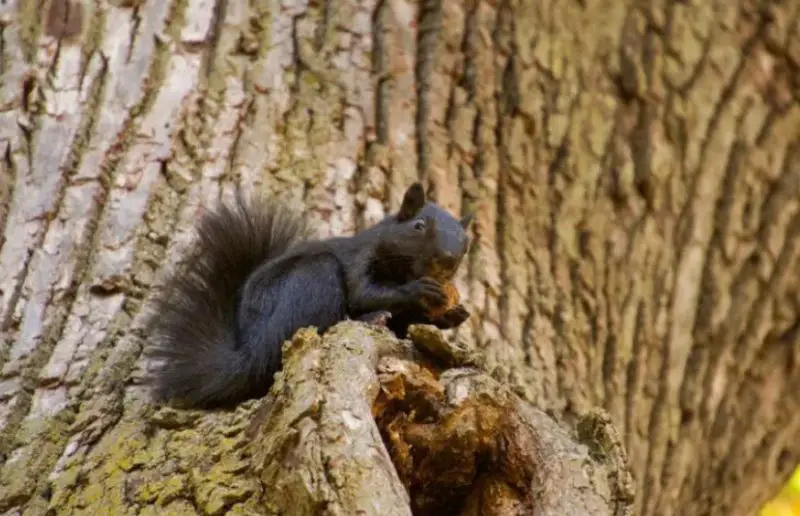
In West Virginia, forests stretch across hills, valleys, and winding mountain ridges, creating one of the most wildlife-rich landscapes in the eastern United States. Mature hardwood trees cover much of the state, and neighborhoods often sit right beside wooded slopes where wildlife moves quietly between natural habitats and suburban yards. Among the animals people see most often are squirrels darting along power lines, leaping between branches, or digging through fallen leaves beneath oak trees.
For many homeowners, squirrels become part of the daily rhythm of backyard life. They raid bird feeders, chase one another across fences, and bury nuts in gardens or lawns as autumn approaches. Most of the time these squirrels have the familiar gray coat that people associate with the eastern gray squirrel. But occasionally, a darker figure appears in the branches—an animal that looks almost identical except for its deep brown or jet-black fur.
When residents notice one of these darker squirrels, curiosity usually follows. Some assume it must be a different species. Others believe it might be a hybrid animal or a rare mutation that appears only occasionally. In reality, black squirrels are neither a separate species nor especially unusual in many parts of the Appalachian region.
The black squirrel is actually a color variation of the eastern gray squirrel (Sciurus carolinensis), the same species that dominates forests and suburban neighborhoods across much of eastern North America. Its dark coat comes from a genetic trait known as melanism, which causes the animal to produce larger amounts of dark pigment in its fur.
Although this difference might seem minor, it tells a fascinating story about wildlife adaptation, genetics, and the ways animals adjust to changing landscapes. In some areas of North America, black squirrels appear rarely, while in others they can make up a significant portion of the local population.
For West Virginia homeowners who occasionally notice these darker squirrels moving through backyard trees, understanding their origins reveals a deeper picture of how wildlife evolves and spreads across landscapes. What looks like a rare or mysterious animal is actually a natural variation that has quietly persisted in forest ecosystems for generations.
Table of Contents
- 1 The Genetics Behind Black Squirrels
- 2 Why Black Squirrels Appear in Certain Regions
- 3 Why Dark Fur May Offer Advantages
- 4 Black Squirrels in West Virginia’s Forest Ecosystems
- 5 Daily Life of a Black Squirrel
- 6 The Remarkable Memory of Tree Squirrels
- 7 Nesting and Shelter in Backyard Trees
- 8 Seasonal Behavior in Squirrel Populations
- 9 Interactions Between Squirrels and Homeowners
- 10 FAQs About Black Squirrels in West Virginia
- 11 Final Thoughts
The Genetics Behind Black Squirrels
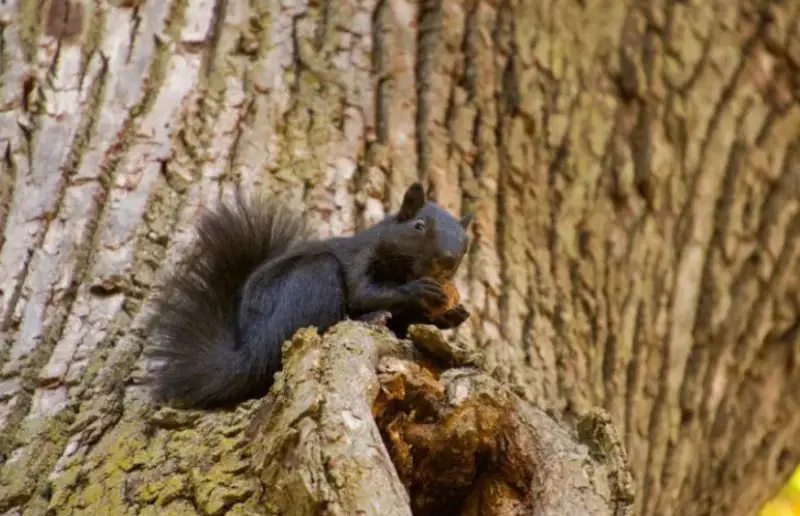
The dark coat that distinguishes black squirrels comes from a biological condition called melanism. Melanism occurs when animals produce higher levels of a pigment known as melanin, which gives color to hair, feathers, and skin.
In most eastern gray squirrels, the fur contains a mixture of light and dark pigments. This combination produces the familiar gray appearance that blends well with tree bark and forest environments.
However, when a squirrel carries certain genetic mutations, its body produces much more melanin than usual. As a result, the fur becomes much darker, sometimes appearing deep brown or almost completely black.
Scientists studying squirrel genetics have identified variations in genes responsible for controlling melanin production. These genes influence how pigment cells distribute color throughout the animal’s fur.
The presence of these genes does not change the squirrel’s behavior, intelligence, or survival abilities. The difference is almost entirely cosmetic.
Because the trait is genetic, black squirrels can pass the melanistic gene to their offspring. When two squirrels carrying the gene reproduce, some of their young may inherit the darker coat.
In many cases, litters can contain both gray and black squirrels depending on how the genes combine.
Over time, this inheritance pattern allows the melanistic trait to persist in squirrel populations across different regions.
Why Black Squirrels Appear in Certain Regions
The distribution of black squirrels across North America is not uniform. In some areas they are extremely rare, while in others they appear frequently.
One reason for this uneven distribution is genetic history. In certain regions, melanistic squirrels have existed naturally for many generations.
Another factor involves historical introductions by humans.
During the late nineteenth and early twentieth centuries, several towns and universities intentionally introduced black squirrels into parks or campuses because of their distinctive appearance.
These introductions sometimes led to stable local populations.
Over time, these squirrels bred with surrounding gray squirrel populations, spreading the melanistic gene into nearby forests and neighborhoods.
Because squirrels often disperse several miles from where they are born, the trait gradually expanded across larger areas.
In regions like the Midwest and parts of the Appalachian Mountains, this process helped black squirrels become a familiar sight.
Why Dark Fur May Offer Advantages
Researchers have long debated whether black squirrels possess advantages over gray squirrels in certain environments.
One possible benefit involves temperature regulation.
Dark colors absorb sunlight more efficiently than lighter colors. During cold mornings, black squirrels may warm up slightly faster while sitting in sunlight.
In northern climates, this small thermal advantage could help animals conserve energy during winter.
A squirrel that warms more quickly may begin searching for food earlier in the day.
Another possible advantage involves camouflage.
In dense forests where shadows and dark tree bark dominate the environment, darker fur may help squirrels blend into their surroundings.
Urban environments may also favor darker coloration.
Buildings, asphalt, and shaded city environments create darker backgrounds where black squirrels may be less visible to predators.
However, the trait also has disadvantages.
During snowy winters, black squirrels can stand out against bright white landscapes, potentially making them easier targets for predators.
Because these advantages and disadvantages balance differently depending on climate and habitat, melanism remains only one of several color variations within squirrel populations.
Black Squirrels in West Virginia’s Forest Ecosystems
West Virginia’s heavily forested landscape provides ideal habitat for eastern gray squirrels.
The state’s forests contain large numbers of oak, hickory, walnut, and beech trees, which produce nuts that form the foundation of a squirrel’s diet.
These trees create complex canopies where squirrels can travel from branch to branch while avoiding predators on the ground.
In such environments, both gray and black squirrels thrive equally well.
Because the animals belong to the same species, their behavior, diet, and nesting habits are identical regardless of fur color.
Black squirrels simply represent a different genetic expression within the same population.
For homeowners living near forested hillsides or wooded neighborhoods, spotting a black squirrel usually means the local squirrel population carries the melanistic gene.
Daily Life of a Black Squirrel
The daily routine of a black squirrel looks almost identical to that of its gray relatives.
Most activity occurs during early morning and late afternoon, when temperatures are moderate and food sources are easiest to locate.
Squirrels spend much of this time searching for nuts, seeds, fruits, mushrooms, and occasionally insects.
Their sharp claws allow them to climb trees effortlessly while their long tails help maintain balance during leaps between branches.
Although squirrels are excellent climbers, they frequently descend to the ground to gather food.
When they find a nut, they often bury it in the soil for later use.
These buried food stores become essential during colder months when fresh food becomes scarce.
The Remarkable Memory of Tree Squirrels
One of the most fascinating aspects of squirrel behavior is their ability to remember food caches.
Instead of storing all food in a single location, squirrels scatter hundreds of small caches across their territory.
This strategy is known as scatter hoarding.
By distributing food widely, squirrels reduce the risk of losing everything if another animal discovers one hiding place.
Research shows squirrels possess impressive spatial memory.
They can remember the approximate locations of hundreds of buried nuts using landmarks and scent cues.
However, squirrels do not recover every seed they bury.
Some forgotten nuts eventually sprout into new trees.
In this way, squirrels play an important role in forest regeneration.
Nesting and Shelter in Backyard Trees
Squirrels build nests called dreys, usually located high in tree branches.
These nests are constructed from twigs, leaves, moss, and grass woven together into a spherical structure.
Inside the nest, softer materials provide insulation against wind and cold.
During winter, thick nest walls help retain body heat.
Squirrels may also use natural tree cavities as shelter.
Hollow trunks or abandoned woodpecker holes provide excellent protection from predators and weather.
Black squirrels build and use these nests in exactly the same way as gray squirrels.
Homeowners sometimes notice squirrels carrying leaves or twigs into trees while constructing or repairing nests.
Seasonal Behavior in Squirrel Populations
The behavior of squirrels changes throughout the year as seasons shift.
Spring marks the beginning of the breeding season. Female squirrels typically give birth to litters of two to four young.
The babies remain inside nests for several weeks before venturing outside.
Summer becomes a time of learning for young squirrels.
They practice climbing, jumping, and locating food while exploring their environment.
Autumn is the busiest period of the year.
During this season squirrels gather and bury large numbers of nuts to prepare for winter.
Winter brings slower activity levels.
Although squirrels do not hibernate, they spend more time resting in nests during severe weather.
Their stored food supplies allow them to survive until spring returns.
Interactions Between Squirrels and Homeowners
In suburban neighborhoods, squirrels often become accustomed to human activity.
Bird feeders frequently attract squirrels searching for seeds and spilled grain.
Gardens may show small holes where squirrels dig while searching for buried nuts.
Occasionally squirrels chew on wood or enter attics through small openings.
These behaviors are typical for tree squirrels and are not unique to black individuals.
For many homeowners, squirrels provide entertaining wildlife encounters rather than serious pest problems.
Watching them leap between branches or chase one another across fences offers a glimpse into the natural world within residential landscapes.
FAQs About Black Squirrels in West Virginia
Are black squirrels a different species?
No. They are eastern gray squirrels with a genetic condition called melanism.
Why are some squirrels black?
A genetic mutation causes increased production of dark pigment in their fur.
Are black squirrels rare?
They are uncommon in some regions but fairly common in parts of the Midwest and Appalachian areas.
Do black squirrels behave differently?
No. Their behavior and diet are the same as gray squirrels.
Can black and gray squirrels mate?
Yes. They belong to the same species and frequently interbreed.
Do black squirrels live longer?
There is no strong evidence that fur color affects lifespan.
Why do they stand out in winter?
Their dark fur contrasts sharply with snow-covered landscapes.
What do black squirrels eat?
They eat nuts, seeds, fruits, fungi, and occasionally insects.
Final Thoughts
Black squirrels are one of the most intriguing wildlife variations that homeowners may encounter in West Virginia’s wooded landscapes. Although their dark coats may seem unusual at first glance, they are simply a different color form of the familiar eastern gray squirrel.
Their presence reflects the complex interaction between genetics, environmental conditions, and historical wildlife movement across North America.
For residents who enjoy watching wildlife from their yards, spotting a black squirrel racing along a tree branch or digging beneath fallen leaves can be a reminder that even common animals often contain hidden biological stories.
What appears to be a rare animal is actually nature expressing a different shade of the same species—quietly thriving in the forests and neighborhoods that define life in the Appalachian Mountains.