
Along Louisiana’s bayous, survival is never simple. Water levels rise and fall without warning. Heat presses down for months at a time. Floods reshape shorelines. Predators, prey, and people all move through the same narrow corridors of land and water. In this environment, the eastern cottonmouth does not merely exist. It adapts constantly.
Cottonmouths, also known as water moccasins, are one of the most misunderstood animals in the Deep South. In Louisiana, where bayous cut through forests, swamps, and human communities, these snakes have developed a set of survival skills finely tuned to wetland life. What looks like aggression, laziness, or fearlessness is often careful calculation.
Understanding how cottonmouths survive along Louisiana bayous requires looking at how they hunt, move, hide, regulate their bodies, and respond to threats in a landscape defined by water.
Table of Contents
- 1 Louisiana Bayous Create a Unique Survival Challenge
- 2 Semi-Aquatic Mastery Is Their Core Advantage
- 3 Using Water as Both Shelter and Escape
- 4 Ambush Hunting Fits the Bayou Perfectly
- 5 Camouflage Designed for Murky Water
- 6 Warning Displays Reduce the Need for Bites
- 7 Holding Ground Is a Survival Strategy
- 8 Thermoregulation in a Hot, Wet Climate
- 9 Using Flooded Forests to Their Advantage
- 10 Flexible Diet Supports Survival
- 11 Slow Metabolism Conserves Energy
- 12 Navigating Human-Altered Bayous
- 13 Learning Safe Zones Through Experience
- 14 Seasonal Movement Patterns Along Bayous
- 15 Overwintering Without True Hibernation
- 16 Coexisting With Predators
- 17 Why Cottonmouths Are Often Seen Near Shorelines
- 18 Misinterpreted Behaviors in Bayou Encounters
- 19 Role in Bayou Ecosystems
- 20 Why Survival Skills Matter for Coexistence
- 21 Living Alongside Cottonmouths in Louisiana
- 22 FAQs About Cottonmouth Survival Along Louisiana Bayous
- 22.1 Are cottonmouths aggressive snakes
- 22.2 Why do cottonmouths move toward water when disturbed
- 22.3 Do cottonmouths spend most of their time in water
- 22.4 What do cottonmouths eat along bayous
- 22.5 Why do cottonmouths hold their ground instead of fleeing
- 22.6 Are cottonmouths active year-round in Louisiana
- 22.7 Do cottonmouths hibernate during winter
- 22.8 Why are cottonmouths often seen near shorelines
- 22.9 Are cottonmouths important to bayou ecosystems
- 22.10 How can people safely coexist with cottonmouths
- 23 Final Thoughts
Louisiana Bayous Create a Unique Survival Challenge
Bayous are not static environments.
Water can be shallow one day and chest deep the next. Currents change direction. Vegetation grows thick and then dies back. Storms can flood entire forests overnight. Dry ground is often temporary.
For a snake living here, survival depends on flexibility.
Cottonmouths thrive in bayous because they are not tied to a single condition. They can hunt in water, rest on land, and shelter underground. Few predators in Louisiana can move as easily between these worlds.
Semi-Aquatic Mastery Is Their Core Advantage
Cottonmouths are truly semi-aquatic.
They swim confidently in still water and slow currents. Their bodies are heavy and muscular, allowing strong propulsion without frantic movement. Their heads ride high on the surface, keeping eyes and nostrils above water.
This ability allows them to patrol bayou edges, canals, flooded woods, and marshes where many snakes cannot hunt effectively.
Water is not an obstacle. It is an extension of their habitat.
Using Water as Both Shelter and Escape
Along Louisiana bayous, water provides safety.
When threatened on land, cottonmouths often move toward water rather than away from it. In water, they are more maneuverable and harder for many predators to pursue.
This behavior is frequently misinterpreted by people as aggression or chasing. In reality, the snake is choosing its strongest terrain.
Bayous offer countless escape routes. Sloughs, ditches, submerged roots, and flooded grass all become pathways to safety.
Ambush Hunting Fits the Bayou Perfectly
Cottonmouths are ambush predators.
They do not actively chase prey over long distances. Instead, they position themselves where prey is likely to pass. Along bayous, this means fish moving through shallow channels, frogs resting on banks, rodents crossing narrow land bridges, and birds feeding near water.
Stillness is a hunting strategy.
A cottonmouth may remain motionless for hours, blending into mud, leaf litter, or dark water. When prey moves within range, the strike is fast and decisive.
This strategy conserves energy and reduces exposure.
Camouflage Designed for Murky Water
Bayou water is rarely clear.
Tannins from decaying vegetation stain it dark. Mud clouds visibility. Reflections distort shapes. Cottonmouth coloration matches this environment perfectly.
Adults often appear dark brown, olive, or nearly black. Their patterns break up their outline in low light and murky water. When floating or resting at the edge, they resemble logs or debris.
This camouflage protects them from predators and allows prey to approach unnoticed.
Warning Displays Reduce the Need for Bites
Cottonmouths possess potent venom, but venom is costly to produce.
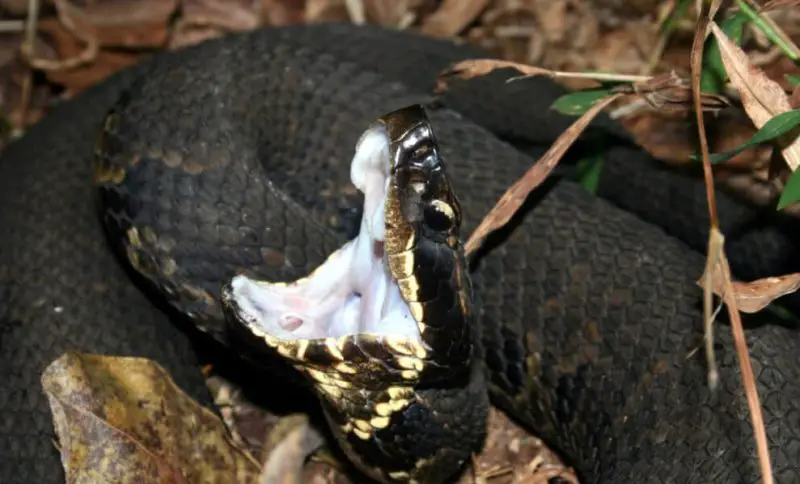
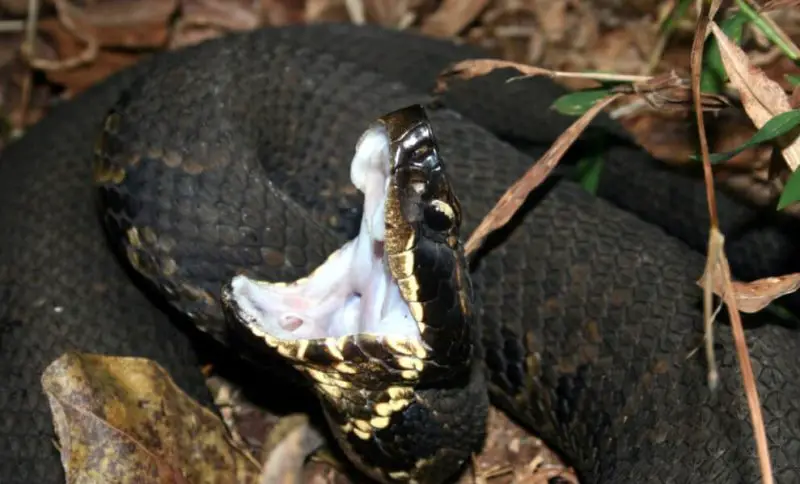
Along bayous where encounters are frequent, cottonmouths rely heavily on warning behaviors to avoid physical conflict. They coil their bodies, flatten their heads, vibrate their tails, and gape their mouths to reveal the white interior that gives them their name.
These displays communicate danger clearly.
In most cases, they stop an approach without requiring a bite. This conserves venom and reduces injury risk to the snake.
Holding Ground Is a Survival Strategy
Unlike many nonvenomous snakes that flee immediately, cottonmouths often hold their position.
In a bayou environment, fleeing blindly can be dangerous. Water may be deep. Vegetation may trap them. Predators may be nearby.
Standing ground while displaying warnings allows the snake to assess the situation. If the threat backs away, no energy is wasted. If escape is necessary, the snake chooses the safest direction.
This behavior often looks aggressive to humans, but it is defensive efficiency.
Thermoregulation in a Hot, Wet Climate
Louisiana’s climate presents constant thermal challenges.
Summers are long and humid. Surface temperatures can become dangerous. Winters are mild but unpredictable, with sudden cold snaps.
Cottonmouths regulate body temperature through behavior rather than endurance.
They bask during cooler mornings, retreat into shade during peak heat, and remain active during twilight and night in summer. In winter, they reduce activity but do not fully disappear.
Bayous offer microclimates everywhere. Shaded banks, submerged roots, hollow logs, and burrows provide temperature control within a few feet.
Using Flooded Forests to Their Advantage
Seasonal flooding is common along Louisiana bayous.
While floods displace many animals, cottonmouths exploit them. Flooded forests create new hunting opportunities. Small mammals are forced onto limited high ground. Amphibians concentrate in shallow pools.
Cottonmouths move easily through flooded vegetation, accessing prey that would otherwise be unavailable.
Floods that disrupt other species often benefit these snakes.
Flexible Diet Supports Survival
Cottonmouths are opportunistic feeders.
Along bayous, their diet includes fish, frogs, toads, salamanders, rodents, birds, eggs, and even other snakes. They adapt prey choice based on availability.
This flexibility is critical in a dynamic environment. When fish are scarce, mammals become more important. When amphibians explode in number after rains, cottonmouths take advantage.
They are not specialists tied to one food source.
Slow Metabolism Conserves Energy
Cottonmouths do not need to eat frequently.
Their slow metabolism allows them to survive long periods between meals. This is especially valuable during extreme heat, cold snaps, or flooding when hunting conditions are poor.
Energy conservation is a survival skill in itself.
By limiting unnecessary movement, cottonmouths reduce exposure to predators and humans.
Louisiana bayous are heavily influenced by people.
Canals, levees, drainage ditches, boat launches, and retention ponds now connect natural waterways. Cottonmouths adapt readily to these changes.
Artificial waterways mimic natural bayous. They offer water, cover, and prey. As a result, cottonmouths often appear near fishing spots, boat ramps, and residential edges.
This proximity does not indicate aggression. It reflects habitat availability.
Learning Safe Zones Through Experience
Cottonmouths are not mindless creatures.
Over time, they learn which areas are safe and which are dangerous. Frequent disturbance causes avoidance. Quiet areas become preferred resting spots.
Older snakes often show more effective shelter use and better timing than younger ones. Experience improves survival.
This learning process contributes to why some individuals persist in human-dominated landscapes.
Seasonal Movement Patterns Along Bayous
Cottonmouths adjust movement seasonally.
In spring, they increase activity as temperatures rise and prey becomes abundant. Summer activity shifts toward night. Fall brings renewed feeding before cooler weather. Winter activity drops but does not stop entirely.
Along bayous, water buffers temperature extremes, allowing cottonmouths to remain active longer than upland snakes.
This seasonal rhythm aligns closely with prey cycles.
Overwintering Without True Hibernation
Louisiana winters are mild compared to northern states, but cold snaps occur.
Cottonmouths do not hibernate deeply. Instead, they enter periods of reduced activity, sheltering in burrows, root systems, or hollow banks.
On warmer winter days, they may emerge briefly to bask before retreating again.
Bayous provide insulation against extreme cold, reducing winter mortality.
Coexisting With Predators
Cottonmouths are not top predators.
They face threats from alligators, large birds, mammals, and even other snakes. Their venom deters some predators but not all.
Camouflage, stillness, and shelter selection reduce detection. Warning displays discourage attacks from animals that recognize danger.
Survival depends on avoiding conflict rather than winning it.
Why Cottonmouths Are Often Seen Near Shorelines
Bayou edges concentrate life.
Prey moves along shorelines. Dry ground is limited. Thermal gradients are strongest at the water’s edge.
Cottonmouths position themselves where opportunities intersect. This makes them visible to people who also use shorelines.
Visibility does not equal abundance. It reflects shared space.
Misinterpreted Behaviors in Bayou Encounters
Many feared behaviors are misunderstood.
A cottonmouth floating on the surface is often resting or thermoregulating, not hunting people. A snake moving toward someone is usually heading to water. A snake holding ground is issuing a warning, not planning an attack.
Understanding context changes interpretation.
Role in Bayou Ecosystems
Cottonmouths play an important ecological role.
They help control rodent populations, reduce overabundant amphibians, and influence food web balance. They are part of the bayou system, not an intrusion.
Removing them would have ripple effects.
Why Survival Skills Matter for Coexistence
Understanding how cottonmouths survive along Louisiana bayous improves human safety.
Recognizing warning signs, giving space, and avoiding panic reduce negative encounters. Fear-driven reactions often increase risk.
Knowledge replaces myth with clarity.
Living Alongside Cottonmouths in Louisiana
Bayous will always support cottonmouths.
They have survived floods, droughts, predators, and landscape change for thousands of years. Their survival skills are not aggression or fearlessness. They are efficiency, patience, and adaptation.
Coexistence depends on respecting these realities.
FAQs About Cottonmouth Survival Along Louisiana Bayous
Are cottonmouths aggressive snakes
No. Cottonmouths rely on defensive displays and avoidance. They bite only when they feel trapped or threatened.
Why do cottonmouths move toward water when disturbed
Water is their safest escape route. Moving toward water is a defensive response, not an attempt to chase.
Do cottonmouths spend most of their time in water
They are semi-aquatic and use both land and water depending on temperature, prey, and safety.
What do cottonmouths eat along bayous
They eat fish, frogs, rodents, birds, eggs, and other small animals, adjusting their diet to what is available.
Why do cottonmouths hold their ground instead of fleeing
Holding position while displaying warnings conserves energy and reduces the need for biting.
Are cottonmouths active year-round in Louisiana
Yes. Activity slows in winter but does not stop completely due to Louisiana’s mild climate.
Do cottonmouths hibernate during winter
They do not fully hibernate. They enter periods of reduced activity and shelter during cold snaps.
Why are cottonmouths often seen near shorelines
Shorelines concentrate prey, warmth, and movement corridors, making them efficient hunting areas.
Are cottonmouths important to bayou ecosystems
Yes. They help regulate prey populations and maintain ecological balance.
How can people safely coexist with cottonmouths
Give them space, avoid sudden movement, watch footing near water, and do not attempt to handle or kill them.
Final Thoughts
Cottonmouths survive along Louisiana bayous through a combination of behavioral intelligence, physical adaptation, and environmental awareness.
They use water as refuge, ambush prey with patience, regulate their bodies through microhabitats, and rely on warning rather than violence. What looks threatening is often defensive strategy shaped by a demanding environment.
In the shifting world of Louisiana’s bayous, cottonmouths endure not by dominating the landscape, but by understanding it.