

Black squirrels capture attention wherever they appear. Their dark coats stand out sharply against pavement, desert soil, or pale tree bark. In many parts of North America, they are familiar sights in parks and city neighborhoods. In Nevada, however, they are something else entirely.
They are rare. Unexpected. Often questioned.
When Nevada residents report seeing a black squirrel, reactions are usually disbelief or curiosity. Some assume it escaped from captivity. Others think it must be a different species altogether. A few wonder if climate change or mutation is suddenly altering wildlife in the state.
The truth is more complex, quieter, and rooted in genetics, history, and how animals move through human-shaped landscapes.
Black squirrels in Nevada are not a new species, not a sign of sudden mutation, and not a natural desert adaptation. They are the visible result of a genetic trait that surfaced elsewhere and arrived in Nevada under very specific circumstances.
Table of Contents
- 1 Black Squirrels Are Not a Separate Species
- 2 Melanism Is a Genetic Variation, Not a Mutation Event
- 3 Why Black Squirrels Thrive Elsewhere but Not in Nevada
- 4 So Why Do Black Squirrels Appear in Nevada at All?
- 5 Historical Translocations Changed Squirrel Genetics Nationwide
- 6 Why Nevada Sightings Are So Isolated
- 7 Genetics Alone Cannot Sustain a Population
- 8 Heat Stress Limits Genetic Success
- 9 Predation Plays a Subtle Role
- 10 Why Black Squirrels Often Appear Larger or Bolder
- 11 Urban Environments Provide Temporary Refuge
- 12 Why Nevada Has Not Developed Stable Black Squirrel Populations
- 13 Black Squirrels Are Not Adapting to Nevada
- 14 Why Genetics Still Allows Occasional Sightings
- 15 Public Fascination Keeps the Myth Alive
- 16 Are Black Squirrels Protected in Nevada?
- 17 Could Climate Change Change the Outcome?
- 18 Could Black Squirrels Ever Become Common in Nevada?
- 19 Why Misidentification Happens
- 20 Why Nevada Is Still Important to the Story
- 21 What Scientists Learn From These Outliers
- 22 FAQs About Black Squirrels in Nevada
- 22.1 Are black squirrels native to Nevada?
- 22.2 Are black squirrels a different species?
- 22.3 Why are they rare in Nevada?
- 22.4 Do black squirrels behave differently?
- 22.5 Are black squirrels adapting to desert life?
- 22.6 Can black squirrels interbreed with gray squirrels?
- 22.7 Will black squirrels disappear entirely from Nevada?
- 22.8 Why do people think they are bigger?
- 23 Conclusion
Black Squirrels Are Not a Separate Species
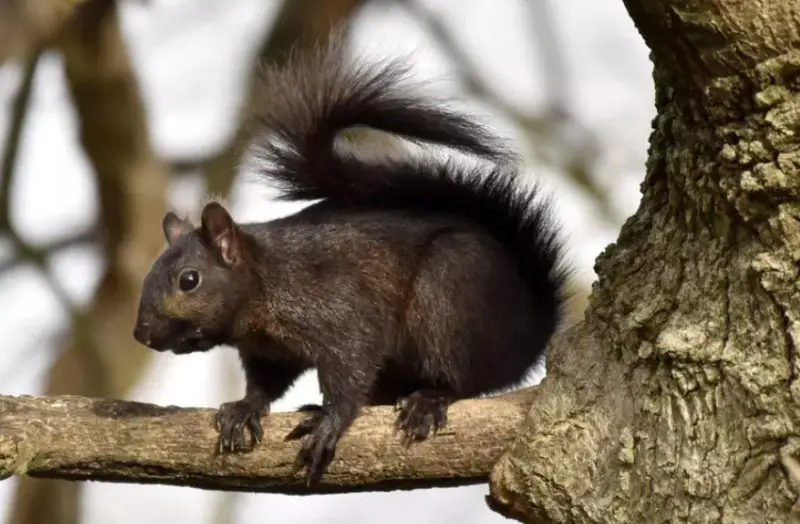
The first misconception to clear is the idea that black squirrels are their own species.
They are not.
Black squirrels are color variants of familiar species, primarily the eastern gray squirrel and, less commonly, the fox squirrel. The difference lies in pigmentation, not taxonomy.
The black coat comes from a genetic trait known as melanism, which increases the amount of dark pigment in the fur. This trait does not change behavior, diet, or intelligence. It changes appearance only.
What makes Nevada’s black squirrels interesting is not what they are, but how they got there.
Melanism Is a Genetic Variation, Not a Mutation Event
Melanism is often described casually as a mutation, but that language can be misleading.
The gene responsible for black fur already exists within squirrel populations. It does not suddenly appear out of nowhere. Instead, it is inherited when conditions allow it to persist.
In regions where black squirrels are common, such as parts of the Midwest and Canada, environmental and social factors allow melanistic squirrels to survive and reproduce successfully.
In Nevada, those same conditions rarely exist.
Why Black Squirrels Thrive Elsewhere but Not in Nevada
In colder regions, black fur offers subtle advantages. Dark coats absorb heat more efficiently, aiding thermoregulation during winter. In dense forests, black squirrels can also blend into shadowed environments.
Nevada presents the opposite conditions.
Hot summers, open landscapes, sparse tree cover, and intense sunlight reduce any advantage black fur might provide. In some cases, it may even be a disadvantage due to increased heat absorption and visibility to predators.
This makes widespread natural establishment unlikely.
So Why Do Black Squirrels Appear in Nevada at All?
The answer lies almost entirely with humans.
Most black squirrels found in Nevada are not the result of natural westward expansion. They are the descendants of squirrels intentionally or accidentally introduced from other regions.
In many cases, black squirrels arrive with landscaping projects, park developments, or relocation efforts tied to universities, city beautification programs, or private individuals.
Once introduced, a small number may survive for years without ever becoming widespread.
Historical Translocations Changed Squirrel Genetics Nationwide
Throughout the 20th century, squirrels were moved more often than people realize.
Cities relocated squirrels to repopulate parks. Campuses introduced black squirrels as mascots or novelty wildlife. Private landowners moved squirrels intentionally or unknowingly.
These translocations reshaped local genetics.
In places like Michigan and Ohio, introduced black squirrels found favorable conditions and flourished. In Nevada, introductions rarely led to lasting populations.
Why Nevada Sightings Are So Isolated
Black squirrel sightings in Nevada tend to cluster around specific locations.
College campuses. Historic parks. Old neighborhoods with mature trees. Golf courses. Botanical gardens.
These places share key traits. Irrigation. Tree density. Human tolerance.
Outside these pockets, survival becomes difficult.
This creates the illusion of mystery. A black squirrel appears, then seems to vanish from the wider landscape.
Genetics Alone Cannot Sustain a Population
For a genetic trait to persist, it must pass consistently to offspring.
Black squirrels require mating between carriers of the melanistic gene. In small, isolated populations dominated by gray squirrels, the black coat gene often fades within a few generations.
Without enough carriers, the trait becomes rare again.
Nevada’s black squirrels exist on the edge of genetic sustainability.
Heat Stress Limits Genetic Success
Dark fur absorbs more solar radiation.
In Nevada’s climate, this can increase heat stress during summer months. While squirrels regulate body temperature through behavior, prolonged exposure reduces survival margins.
Gray-coated squirrels reflect more heat, offering a slight advantage.
Over time, natural selection quietly favors lighter coats.
Predation Plays a Subtle Role
Visibility matters.
Against Nevada’s pale ground, desert vegetation, and open canopies, black squirrels stand out. This makes them easier targets for hawks, owls, coyotes, and other predators.
In dense Midwestern forests, black squirrels disappear into shadow. In Nevada, they often do not.
This does not cause immediate extinction, but it reduces long-term persistence.
Why Black Squirrels Often Appear Larger or Bolder
Many people report that black squirrels seem bigger or more confident.
This is a perception effect.
Dark coloration exaggerates size and movement. It draws the eye. It makes behavior seem more deliberate.
Genetically and biologically, black squirrels are no different from their gray counterparts.
The difference is visual impact.
Urban Environments Provide Temporary Refuge
Cities create microclimates.
Irrigation cools soil. Shade reduces heat. Structures block predators. Food sources are abundant.
In these environments, black squirrels can survive longer than they would in open desert or scrubland.
But even urban refuges in Nevada are limited.
Unlike eastern cities surrounded by forest, Nevada cities are surrounded by harsh terrain.
Why Nevada Has Not Developed Stable Black Squirrel Populations
Several factors combine to prevent stability.
Limited gene pools. Heat stress. Predation. Fragmented habitat. Isolation.
Even when black squirrels reproduce, their offspring often mate with gray squirrels, diluting the trait.
Over time, the black coat becomes rarer again.
Black Squirrels Are Not Adapting to Nevada
It is tempting to frame black squirrels as adapting to Nevada’s environment.
That is not what is happening.
They are surviving in pockets, not evolving into a desert-adapted population.
True adaptation requires many generations under selective pressure, favoring the trait.
In Nevada, the pressure works against melanism.
Why Genetics Still Allows Occasional Sightings
Even when the odds are low, genetics allows surprises.
A single melanistic gene can resurface unexpectedly when two carriers mate. A black squirrel can appear suddenly in a litter of gray squirrels.
This creates sporadic sightings without long-term establishment.
To observers, it feels mysterious.
To genetics, it is probability.
Public Fascination Keeps the Myth Alive
Black squirrels attract attention.
Photos circulate online. Local news stories appear. Rumors grow.
Because sightings are rare, each one feels significant.
The scarcity fuels myth, even though the explanation is grounded in well-understood biology.
Are Black Squirrels Protected in Nevada?
Black squirrels are not legally distinct from gray squirrels.
They receive no special protection based on color. However, most people choose not to harm them due to curiosity or appreciation.
Their rarity creates informal protection.
Could Climate Change Change the Outcome?
Climate change adds uncertainty.
Warmer winters do not help black squirrels in Nevada. Hotter summers likely hurt them.
Unless Nevada becomes significantly cooler or more forested, climate change does not favor melanistic squirrels here.
If anything, it reinforces existing barriers.
Could Black Squirrels Ever Become Common in Nevada?
Based on current science, this is unlikely.
Without large-scale forested habitat, cooler temperatures, and genetic reinforcement, black squirrels will remain rare and localized.
Their presence will continue to be a curiosity rather than a transformation.
Why Misidentification Happens
Some reported black squirrels are not squirrels at all.
They may be dark-colored chipmunks, juvenile fox squirrels, or even escaped pets.
This inflates perception of frequency.
Confirmed sightings remain uncommon.
Why Nevada Is Still Important to the Story
Nevada illustrates how genetics interacts with environment.
The same gene that thrives in one region fades in another. The difference is not luck. It is context.
Black squirrels in Nevada are not failing. They are demonstrating the limits of adaptation.
What Scientists Learn From These Outliers
Rare populations matter.
They show how far a trait can stretch before conditions push back. They reveal the role of human influence in wildlife distribution.
They remind researchers that not all expansions succeed.
FAQs About Black Squirrels in Nevada
Are black squirrels native to Nevada?
No. Most arrived through human-assisted introductions rather than natural expansion.
Are black squirrels a different species?
No. They are melanistic variants of gray or fox squirrels.
Why are they rare in Nevada?
Heat, habitat fragmentation, predation, and limited genetics prevent long-term establishment.
Do black squirrels behave differently?
No. Behavior is the same as gray squirrels.
Are black squirrels adapting to desert life?
No. They survive in pockets but are not evolving desert adaptations.
Can black squirrels interbreed with gray squirrels?
Yes. They are the same species, which dilutes the melanistic trait over time.
Will black squirrels disappear entirely from Nevada?
Likely they will remain rare but not completely absent.
Why do people think they are bigger?
Dark coloration exaggerates size perception.
Conclusion
The hidden genetic story behind rare black squirrels in Nevada is not about sudden mutation or mystery species.
It is about a gene traveling beyond its comfort zone.
Melanism thrives where climate, cover, and genetics align. In Nevada, those conditions exist only briefly and locally. Black squirrels appear, survive for a time, then fade back into rarity.
Their presence is not a sign of change overtaking the desert.
It is a reminder that genetics listens closely to the land.