
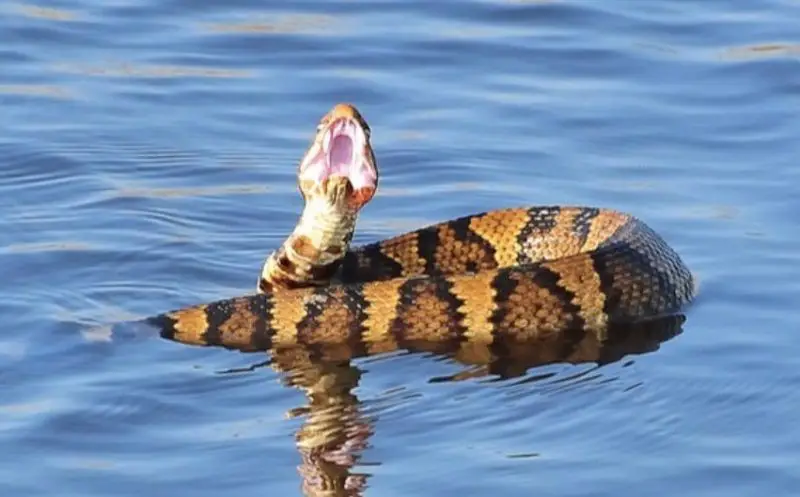
In Louisiana, few animals spark as much fear, argument, and storytelling as the water moccasin, often called the cottonmouth. Across bayous, swamps, levees, crawfish ponds, and slow-moving creeks, people share eerily similar accounts. A snake that did not flee. A snake that seemed to turn. A snake that came closer instead of backing away.
These stories are repeated by fishermen, hunters, farmers, kayakers, and lifelong residents. Some are calm retellings. Others are heated debates about whether water moccasins actually chase people or whether fear fills in the gaps. What makes Louisiana unique is not just the snake itself, but the environment. Narrow waterways. Thick vegetation. Limited escape routes. Encounters happen at close range, and close range changes perception.
This article does not dismiss those experiences, nor does it lean on myths alone. Instead, it examines real stories of water moccasins advancing toward people in Louisiana, why those moments happen, how they are misinterpreted, and when the danger is real.
Table of Contents
- 1 The Louisiana Setting That Shapes These Encounters
- 2 The Common Story Pattern People Describe
- 3 Stories From Fishermen Along Bayous and Canals
- 4 Kayakers and Canoeists in Close Quarters
- 5 Farm Workers and Irrigation Ditches
- 6 Defensive Posture That Looks Like Aggression
- 7 When Snakes Swim Toward People
- 8 Why Louisiana Stories Are Stronger Than Other States
- 9 Are There Cases Where Snakes Truly Advance?
- 10 Bites That Happen During These Encounters
- 11 Why These Stories Persist
- 12 How to Reduce Risk in Louisiana Habitats
- 13 FAQs About Water Moccasins Advancing Toward People in Louisiana
- 14 Final Thoughts
The Louisiana Setting That Shapes These Encounters

Louisiana’s wetlands create a very different kind of snake encounter compared to dry uplands or open trails. Water moccasins are not crossing paths with hikers on wide paths. They are encountered in tight, linear spaces. Bayou banks. Canal edges. Narrow trails between water and brush.
In many cases, people and snakes are moving along the same corridor. When a human steps into that corridor, the snake may already be committed to a direction. To the person, it looks like pursuit. To the snake, it may simply be the fastest exit.
Louisiana also has dense vegetation that limits visibility. People often spot the snake only after they are within a few feet. At that distance, almost any movement feels intentional.
The Common Story Pattern People Describe
Across dozens of firsthand accounts, a pattern repeats again and again.
Someone is fishing along a bank or walking a levee. They notice movement. A water moccasin lifts its head or coils slightly. Instead of sliding away into cover, it comes forward. Sometimes it enters the water and swims directly toward them. Sometimes it moves across land in short, aggressive-looking bursts.
The person retreats. The snake continues moving in the same direction. Fear escalates.
What matters most here is not whether the snake truly intended to chase. What matters is that the human experienced an advancing animal, and that experience sticks.
Stories From Fishermen Along Bayous and Canals
Fishermen provide some of the most consistent reports. Many describe standing on a muddy bank when a water moccasin drops from vegetation or emerges from grass. The snake raises its head, opens its mouth briefly, and moves forward.
In some cases, the snake slides directly into the water and swims toward the angler. This is especially common in narrow canals where the opposite bank is close. The fisherman assumes the snake is charging.
In reality, the snake may be moving toward cover on the opposite side. But when the swimmer is coming straight at you, intent feels irrelevant.
Several Louisiana anglers report abandoning gear, stepping backward into deeper water, or scrambling onto boats to avoid contact.
Kayakers and Canoeists in Close Quarters
Kayak encounters are among the most frightening because they remove solid ground from the equation.
In swampy backwaters, kayakers often surprise water moccasins resting on low branches or floating vegetation. When disturbed, the snake may drop into the water directly beside the boat.
Some snakes swim toward the kayak, bumping into it or following alongside for several feet. To the paddler, this feels deliberate and aggressive. The snake appears to track movement.
In tight waterways, the snake may simply be following the shoreline or current. But the kayak becomes the nearest object, and proximity creates fear.
In Louisiana, these encounters are not rare because paddlers often move through habitats that water moccasins use heavily.
Farm Workers and Irrigation Ditches
Another set of stories comes from agricultural workers. Crawfish ponds, rice fields, and irrigation ditches are prime water moccasin habitat.
Workers describe snakes emerging from ditch banks and moving toward them instead of retreating. In many cases, the ditch itself creates a barrier behind the snake, leaving only one clear path forward.
When the snake moves, it moves toward the person. The worker steps back. The snake continues forward, seeking the same exit route.
This is one of the most misunderstood scenarios. The snake is not choosing the human. It is choosing the only path that avoids deeper water, dense mud, or predators.
Defensive Posture That Looks Like Aggression
Water moccasins are known for a specific defensive display. They coil tightly, lift the head, and open the mouth wide to reveal the white interior. This behavior is meant to intimidate.
In Louisiana’s tight spaces, that display often happens at close range. When the snake then moves, even slightly, it appears to transition from defense to attack.
People interpret this as escalation. The snake looks bold. It does not flee. It advances a foot or two.
In reality, many venomous snakes will move toward perceived threats if they feel cornered. Distance does not always equal retreat.
When Snakes Swim Toward People
Swimming changes everything.
A water moccasin swimming in a straight line looks purposeful. People assume pursuit. But snakes in water often choose the shortest route to land or cover, not the safest route relative to people.
In Louisiana’s bayous, that shortest route may be directly toward a boat, a fisherman, or a bank occupied by a person.
This creates some of the most convincing “chasing” stories. The snake closes distance rapidly. The human retreats. Both move along the same line.
Why Louisiana Stories Are Stronger Than Other States
People in many states encounter cottonmouths, but Louisiana stories stand out for three reasons.
First, encounters happen at closer distances due to habitat. Second, water encounters increase perceived threat. Third, local culture passes down stories, reinforcing expectations.
When someone already believes water moccasins are aggressive, every encounter is interpreted through that lens. This does not mean the fear is irrational. It means experience and expectation interact.
Are There Cases Where Snakes Truly Advance?
Yes, but not in the way people imagine.
Water moccasins may advance to escape, to reach cover, or to reposition defensively. They may also strike if stepped on or cornered.
What they do not do is pursue humans across open ground with intent to attack. There is no biological advantage to chasing a large animal.
However, a snake moving toward you is still dangerous. Venom does not care about intent.
Bites That Happen During These Encounters
Most bites occur when people attempt to step past, jump over, or kill the snake. Advancing behavior increases panic, and panic increases mistakes.
Louisiana hospitals treat cottonmouth bites every year. Most victims were within a few feet of the snake when bitten. Many believed the snake was chasing them.
The lesson is not that the snake was evil. The lesson is that distance collapsed too quickly.
Why These Stories Persist
Stories persist because they feel true. A water moccasin did not retreat. It moved closer. That violates expectations.
Humans expect wild animals to flee. When they do not, we assign motive.
In Louisiana, where encounters are frequent and environments are constrained, those violations happen often.
How to Reduce Risk in Louisiana Habitats
Understanding behavior matters less than behavior on your part.
Do not assume a snake will flee. Give space immediately. Do not try to pass it. Do not throw objects to scare it. Back away slowly and change direction if possible.
On water, increase distance early. Do not paddle toward a swimming snake. Let it pass.
On land, avoid narrow banks where escape routes are limited.
FAQs About Water Moccasins Advancing Toward People in Louisiana
Do water moccasins chase people?
They do not chase in the sense of pursuit, but they may move toward people while escaping or repositioning.
Why do they seem more aggressive in Louisiana?
Dense wetlands, narrow corridors, and frequent water encounters create closer, more intense interactions.
Are swimming snakes attacking boats?
No. They are usually swimming toward land or cover, not targeting the boat.
Should you run if one moves toward you?
Back away calmly. Sudden movements increase risk.
Are cottonmouth bites common?
They are uncommon but occur yearly. Most happen at close range.
Do they defend territory?
They defend space when threatened but do not patrol or guard territory.
Is killing them legal?
Wildlife laws vary, but killing snakes often increases bite risk and is discouraged.
What is the safest response?
Distance. Space. Slow retreat.
Final Thoughts
Stories of water moccasins advancing toward people in Louisiana are not inventions. They are real experiences shaped by real environments.
What matters is understanding what those moments mean. The snake was not making a decision about you. It was reacting to space, threat, and terrain.
In Louisiana’s wetlands, distance disappears quickly. When it does, fear fills the gap.
Respect the animal. Respect the habitat. And remember that survival in these landscapes depends less on who is aggressive and more on who gives space first.