
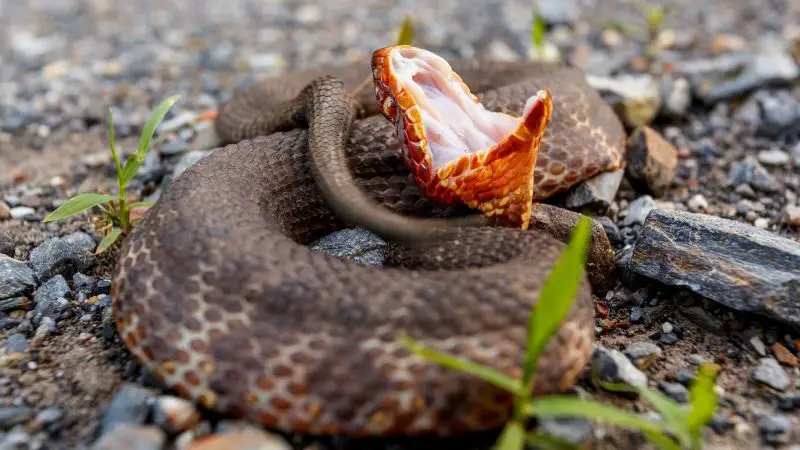
Stories about water moccasins chasing people have been told for decades. They surface every summer along riverbanks, lakes, and fishing spots. Someone walks too close to the water, a dark snake suddenly moves, and the encounter turns into a memory of being “chased.” The story spreads quickly, often growing more dramatic with each retelling.
In Ohio, these stories feel especially believable because snakes are common near water and fear takes over fast when an encounter is unexpected.
But when the fear is stripped away and the biology is examined carefully, the idea of water moccasins chasing people in Ohio begins to collapse. To understand why this myth persists, it is necessary to look at snake distribution, behavior, human perception under stress, and the specific species people actually encounter in the state.
Table of Contents
- 1 Understanding What a Water Moccasin Really Is
- 2 Do Water Moccasins Actually Live in Ohio?
- 3 Why People Still Believe Cottonmouths Are in Ohio
- 4 The Snakes Ohio Residents Are Actually Encountering
- 5 Why Defensive Behavior Gets Misinterpreted as Aggression
- 6 The Illusion of “Chasing” Explained Clearly
- 7 What Science Says About Cottonmouth Behavior
- 8 Why Chasing Would Be Biologically Illogical
- 9 Why Northern Water Snakes Seem “Aggressive”
- 10 The Role of Memory in Reinforcing the Myth
- 11 How Media and Social Platforms Fuel Fear
- 12 Snake Bites in Ohio and What Really Causes Them
- 13 How to Respond Safely to a Snake Encounter in Ohio
- 14 Why Fear Leads to Worse Outcomes Than Knowledge
- 15 Why the Myth Persists Despite Clear Evidence
- 16 The Real Risks Around Ohio’s Waterways
- 17 Why Education Makes a Real Difference
- 18 The Psychological Power of the “Chasing” Narrative
- 19 Why Cottonmouth Range Myths Keep Expanding
- 20 Why Killing Harmless Snakes Has Consequences
- 21 Separating Emotion From Evidence
- 22 What Experts Consistently Agree On
- 23 Why Calm Behavior Protects You Best
- 24 FAQs About Water Moccasins and Snake Encounters in Ohio
- 24.1 Do water moccasins actually live in Ohio
- 24.2 Why do so many people think they see cottonmouths in Ohio
- 24.3 Do water moccasins chase people
- 24.4 Can nonvenomous water snakes act aggressively
- 24.5 Why do snake encounters near water feel more intense
- 24.6 Are snake bites common in Ohio
- 24.7 What should I do if I see a snake near an Ohio river or lake
- 24.8 Are northern water snake bites dangerous
- 24.9 Why is the “chasing” myth so persistent
- 24.10 What is the biggest real danger near Ohio waterways
- 25 Final Thoughts
Understanding What a Water Moccasin Really Is
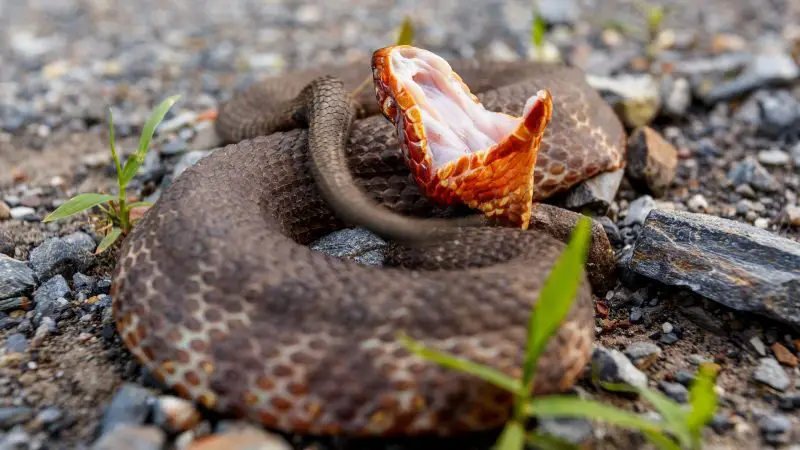
Water moccasins, more accurately called cottonmouths, are venomous pit vipers adapted to warm, wet environments. They are semi-aquatic snakes that spend much of their time near swamps, slow-moving rivers, bayous, and marshes. Their heavy bodies, broad heads, and distinctive defensive displays make them visually striking.
Cottonmouths are often portrayed as aggressive, but this reputation is largely cultural rather than scientific. Like most snakes, their behavior is shaped by survival, not hostility. They defend themselves when threatened and retreat when given the opportunity.
Understanding where cottonmouths live is the first step in addressing the myth.
Do Water Moccasins Actually Live in Ohio?
The answer remains clear and consistent among wildlife professionals. Water moccasins do not have established populations in Ohio. Their natural range is concentrated in the southeastern United States, where year-round warmth supports their survival and reproduction. Ohio’s climate, particularly its cold winters, places it well outside that range.
State wildlife agencies, herpetologists, and long-term field surveys have found no evidence of breeding cottonmouth populations in Ohio. While it is theoretically possible for an individual snake to be transported accidentally through human activity, isolated incidents do not constitute a native or sustainable presence.
In practical terms, if someone encounters a snake in Ohio, the probability that it is a water moccasin is effectively zero.
Why People Still Believe Cottonmouths Are in Ohio
Belief often overrides data when fear is involved. Cottonmouths are one of the most infamous snakes in North America, and their reputation travels far beyond their actual range. When people see a dark, thick-bodied snake near water, their mind jumps to the most dangerous explanation they know.
This cognitive shortcut is reinforced by repetition. Stories get told as warnings, not as biological observations. Over time, the idea that cottonmouths are “everywhere” feels true, even when it is not.
The Snakes Ohio Residents Are Actually Encountering
Ohio is home to several nonvenomous snakes that thrive near water. The most commonly misidentified species is the northern water snake. This snake is widespread, abundant, and frequently encountered by anglers, kayakers, and hikers.
Northern water snakes have thick bodies and dark coloration that becomes more uniform with age. They bask openly on logs and rocks and do not flee as quickly as many other snakes when approached. When startled, they may flatten their bodies, strike repeatedly, and release a strong-smelling musk.
To an untrained eye, this looks aggressive and dangerous.
In reality, it is a defensive display from a snake that feels trapped.
Why Defensive Behavior Gets Misinterpreted as Aggression
Most people expect snakes to flee immediately. When a snake does not retreat right away, the behavior feels intentional. A snake that holds its ground or moves suddenly triggers panic, and panic distorts perception.
Defensive strikes are often mistaken for attacks. Rapid movement toward water is mistaken for pursuit. The brain, flooded with adrenaline, interprets movement as threat rather than escape.
This is how myths are born.
The Illusion of “Chasing” Explained Clearly
The idea that a snake chased someone usually comes down to shared escape routes. When a snake is startled near water, it almost always tries to reach cover. Water, vegetation, or rocks provide that cover. If a person is standing between the snake and its escape route, the snake may move in the same direction the person is retreating.
From the human perspective, the snake is following. From the snake’s perspective, it is fleeing.
Water amplifies this illusion. Snakes swim efficiently and quickly. Humans do not expect fast movement in water, so the visual impact feels dramatic and threatening.
What Science Says About Cottonmouth Behavior
In areas where cottonmouths genuinely live, their behavior has been studied extensively. Researchers consistently report that cottonmouths do not chase humans. They rely on warning displays, camouflage, and retreat when possible.
Their famous open-mouth display is meant to deter predators without physical conflict. If escape is available, they take it. If escape is blocked, they defend themselves.
There is no evolutionary advantage for a snake to pursue a large animal that poses a threat.
Why Chasing Would Be Biologically Illogical
Snakes are energy-efficient animals. They conserve energy carefully because hunting, digestion, and survival depend on it. Chasing a human would waste energy and expose the snake to injury or death.
Cottonmouths eat fish, amphibians, birds, and small mammals. Humans are not prey, and nothing about human behavior triggers hunting responses in snakes.
The idea of chasing contradicts everything known about snake biology.
Why Northern Water Snakes Seem “Aggressive”
Northern water snakes are not aggressive in the way people imagine. They are simply less inclined to flee instantly. This makes them stand out among snake species and gives them a reputation they do not deserve.
Their defensive confidence comes from experience. Water snakes are frequently harassed or killed by people, and standing ground is sometimes their only option.
Unfortunately, this behavior leads to frequent misidentification and unnecessary killing.
The Role of Memory in Reinforcing the Myth
Memory is not a recording. It is a reconstruction. Under stress, memory fills gaps with familiar narratives. When people recall a frightening snake encounter, the brain emphasizes threat and intent.
Later retellings feel vivid and convincing. Over time, the memory becomes less about what actually happened and more about how it felt.
This is why personal stories are so persuasive, even when they conflict with evidence.
How Media and Social Platforms Fuel Fear
Videos and photos labeled as “cottonmouth chasing person” circulate widely online. Many of these clips involve nonvenomous species or snakes swimming toward cover while people move nearby.
Once labeled, the content spreads rapidly. Few viewers question species identification or behavior. Each share reinforces the myth.
Fear travels faster than correction.
Snake Bites in Ohio and What Really Causes Them
Snake bites in Ohio are rare and almost always defensive. They typically occur when people step on snakes, attempt to kill them, or try to handle them.
Bites attributed to “cottonmouths” in Ohio are overwhelmingly bites from nonvenomous snakes. These bites can be painful and may become infected, but they are not medically dangerous in the way venomous bites are.
Calm distance prevents almost every bite.
How to Respond Safely to a Snake Encounter in Ohio
If you encounter a snake near water in Ohio, the safest response is simple. Remain calm, stop moving toward it, and slowly back away. Give the snake space and a clear path to escape. Most snakes will retreat once they realize they are no longer threatened.
Attempts to kill or corner snakes are what escalate encounters. Distance resolves them.
Why Fear Leads to Worse Outcomes Than Knowledge
Fear causes people to react impulsively. Running blindly, flailing, or attacking snakes increases risk. Knowledge encourages measured responses that keep both people and animals safe.
Understanding that snakes do not chase humans changes how people behave during encounters.
Why the Myth Persists Despite Clear Evidence
Myths persist because they serve emotional purposes. They validate fear, create warnings, and simplify complex situations into memorable stories.
Correcting a myth requires patience, repetition, and trust in evidence. Fear requires none of those things.
The Real Risks Around Ohio’s Waterways
Slippery banks, hidden debris, sharp hooks, and bacterial infections pose far greater risks than snakes. Yet snakes dominate fear because they are misunderstood and visually startling.
Perspective matters.
Why Education Makes a Real Difference
Education replaces panic with awareness. People who understand snake behavior give space, remain calm, and avoid unnecessary risk. Communities that understand local wildlife see fewer negative encounters.
Fear thrives on ignorance. Safety thrives on understanding.
The Psychological Power of the “Chasing” Narrative
Being chased implies intent. It turns an animal into a villain. This narrative is far more compelling than one about misunderstanding and escape routes.
Unfortunately, it is also inaccurate.
Why Cottonmouth Range Myths Keep Expanding
Climate change discussions often fuel rumors of venomous snakes expanding northward. While some species shift ranges gradually, there is no evidence that cottonmouths have established populations in Ohio.
One-off sightings or misidentifications do not equal ecological reality.
Why Killing Harmless Snakes Has Consequences
Snakes play important roles in ecosystems by controlling rodent and fish populations. Killing harmless snakes out of fear disrupts balance and creates new problems.
Respecting wildlife benefits everyone.
Separating Emotion From Evidence
Fear is understandable. Snake encounters are startling. Painful bites, even from nonvenomous species, leave strong impressions.
But evidence matters more than emotion when it comes to safety and coexistence.
What Experts Consistently Agree On
Wildlife biologists, herpetologists, and state agencies agree on three points. Water moccasins do not live in Ohio. Snakes do not chase humans. Most aggressive-seeming encounters are defensive misunderstandings.
Consensus matters.
Why Calm Behavior Protects You Best
Snakes respond to movement and vibration. Calm behavior reduces perceived threat. Distance resolves nearly every encounter without harm.
This principle applies everywhere, not just Ohio.
FAQs About Water Moccasins and Snake Encounters in Ohio
Do water moccasins actually live in Ohio
No. Water moccasins, also called cottonmouths, do not have established populations in Ohio. Wildlife agencies and herpetologists have found no evidence of breeding cottonmouths in the state.
Why do so many people think they see cottonmouths in Ohio
Most sightings involve nonvenomous northern water snakes, which are common in Ohio and often misidentified because of their dark color and defensive behavior near water.
Do water moccasins chase people
No. Cottonmouths do not chase humans. What feels like chasing is usually a snake trying to reach water or cover while a person moves in the same direction.
Can nonvenomous water snakes act aggressively
They can appear aggressive when startled or cornered. Defensive behaviors include flattening the body, striking, and holding their ground, but these snakes are not attacking.
Why do snake encounters near water feel more intense
Snakes move quickly in water, and sudden movement combined with fear can distort perception, making escape behavior look like pursuit.
Are snake bites common in Ohio
No. Snake bites are rare and usually happen when people try to handle, kill, or step on snakes rather than giving them space.
What should I do if I see a snake near an Ohio river or lake
Stay calm, keep your distance, and allow the snake a clear escape route. Most snakes will retreat on their own if not threatened.
Are northern water snake bites dangerous
They are not venomous, but bites can be painful and may become infected if not cleaned properly.
Why is the “chasing” myth so persistent
Fear, vivid personal stories, misidentification, and viral videos reinforce the myth more strongly than quiet scientific explanations.
What is the biggest real danger near Ohio waterways
Slips, falls, sharp debris, and water-related injuries pose far greater risks than snakes in Ohio.
Final Thoughts
The idea that water moccasins chase people in Ohio is a powerful myth, but it is still a myth. Cottonmouths are not native to the state, and even where they do exist, they do not pursue humans. What Ohio residents encounter are nonvenomous water snakes defending themselves when startled or cornered.
Understanding this reality does not erase fear overnight, but it replaces panic with clarity. And clarity, far more than myth, is what actually keeps people safe around Ohio’s waterways.