

In Wisconsin neighborhoods, parks, and wooded suburbs, a flash of dark fur often darts across lawns, tree trunks, and backyard fences. At first glance, many people assume they are simply seeing another gray squirrel moving through the yard. But occasionally the animal looks different. Its fur is deep black instead of gray, and its silhouette stands out sharply against winter snow or green summer grass. These animals are known as black squirrels, and they have become a familiar sight in many communities across Wisconsin.
Despite how commonly they appear, most homeowners know surprisingly little about these animals. Many assume black squirrels are a completely different species, while others believe they are rare or unusual wildlife visitors. In reality, black squirrels are usually just a color variation of the eastern gray squirrel, one of the most widespread tree squirrels in North America.
What makes black squirrels fascinating is not just their color, but the biological and environmental factors that allow them to thrive in certain regions. Their dark fur results from a genetic mutation that changes pigment production in the animal’s coat. This mutation has spread in some squirrel populations, especially in colder climates such as parts of the Midwest and northern United States.
Wisconsin’s mixture of forests, suburban neighborhoods, and city parks provides an ideal environment for these squirrels. Oak trees produce acorns, maple trees offer seeds, and human landscaping provides additional food sources such as bird feeders and garden plants. Over time, black squirrels have adapted well to these environments, often living surprisingly close to human homes.
Yet behind their familiar presence lies a deeper story about genetics, adaptation, and animal behavior. Black squirrels illustrate how wildlife populations evolve and respond to environmental conditions.
For Wisconsin homeowners who regularly see these dark-furred animals running across fences or burying nuts in the yard, understanding their biology reveals a surprising truth: these squirrels may represent one of the most interesting examples of natural adaptation hiding in plain sight.
Table of Contents
- 1 Black Squirrels Are Usually a Color Variant of the Eastern Gray Squirrel
- 2 Melanism Is the Result of a Genetic Mutation
- 3 Black Squirrels May Have Advantages in Cold Climates
- 4 Black Squirrels Are Especially Visible in Winter
- 5 Black Squirrels Display the Same Behavior as Gray Squirrels
- 6 Squirrels Play an Important Role in Forest Ecosystems
- 7 Urban and Suburban Areas Provide Ideal Habitat
- 8 Squirrels Have Impressive Memory Skills
- 9 Black Squirrels Have Become Symbols in Some Communities
- 10 FAQs About Black Squirrels in Wisconsin
- 10.1 Are black squirrels a different species?
- 10.2 Why are some squirrels black?
- 10.3 Are black squirrels rare?
- 10.4 Do black squirrels behave differently?
- 10.5 Are black squirrels better adapted to cold weather?
- 10.6 What do black squirrels eat?
- 10.7 Do squirrels remember where they bury food?
- 10.8 Do squirrels help forests grow?
- 11 Final Thoughts
Black Squirrels Are Usually a Color Variant of the Eastern Gray Squirrel
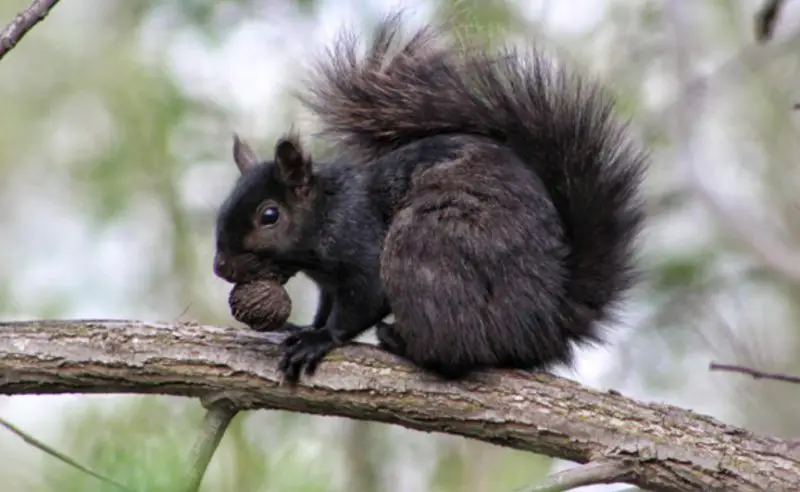
Most black squirrels seen in Wisconsin are not a separate species. Instead, they are eastern gray squirrels (Sciurus carolinensis) with a genetic mutation that causes their fur to appear black.
The eastern gray squirrel normally has gray or silver-colored fur with white underparts and a bushy tail. However, some individuals carry a gene that produces higher levels of dark pigment called melanin.
When this gene is expressed strongly, the squirrel’s fur appears almost entirely black.
This condition is known as melanism, and it occurs in many animal species, including birds, reptiles, and mammals.
Melanism does not affect the squirrel’s overall anatomy or behavior. Black squirrels are essentially the same animals as gray squirrels except for their coat color.
However, the darker fur can sometimes influence how the animals interact with their environment.
In certain climates, melanistic individuals may gain advantages related to heat absorption or camouflage.
These factors help explain why black squirrels appear more frequently in some regions than others.
Melanism Is the Result of a Genetic Mutation
The black coloration found in these squirrels originates from changes in genes responsible for pigment production.
Researchers have discovered that melanistic squirrels often possess a mutation in a gene known as MC1R, which regulates melanin production in hair and skin.
This mutation causes the body to produce more dark pigment.
As a result, the squirrel’s fur appears black instead of gray.
Interestingly, this genetic change can be inherited. If both parents carry the melanistic gene, their offspring may also display black fur.
Over generations, this gene can spread through a population.
In some areas of North America, entire populations of squirrels consist largely of black individuals.
In others, both gray and black squirrels coexist within the same habitat.
The presence of melanistic squirrels in Wisconsin reflects this complex genetic history.
Black Squirrels May Have Advantages in Cold Climates
Scientists have proposed several theories explaining why black squirrels appear more frequently in northern regions.
One possibility involves heat absorption.
Dark fur absorbs sunlight more efficiently than lighter fur. This means black squirrels may warm up faster during cold mornings.
In colder climates like Wisconsin, this advantage could help them conserve energy during winter months.
A squirrel that warms up quickly can spend more time searching for food and less time shivering or conserving heat.
Another theory suggests that darker coloration may provide camouflage in forest environments where shadows dominate the landscape.
While gray squirrels blend well with tree bark, black squirrels may be less visible in shaded areas.
Although the exact advantages remain debated, many researchers believe natural selection may favor melanistic squirrels in certain climates.
Black Squirrels Are Especially Visible in Winter
One reason Wisconsin residents often notice black squirrels is the dramatic contrast they create against snow.
During winter months, when landscapes become blanketed in white, a black squirrel stands out clearly.
This visibility makes them easier for people to spot compared with gray squirrels that blend more easily with snowy surroundings.
Interestingly, this contrast may also influence how predators detect them.
In open snowy areas, black squirrels may actually be easier for predators to see.
However, their agility and quick escape behavior often compensate for this risk.
Squirrels rely heavily on speed, climbing ability, and knowledge of their surroundings to avoid predators.
Because of these traits, coat color alone rarely determines survival.
Black Squirrels Display the Same Behavior as Gray Squirrels
Despite their unusual appearance, black squirrels behave almost identically to gray squirrels.
They are highly active during daylight hours, spending much of their time searching for food.
Their diet includes nuts, seeds, buds, berries, mushrooms, and occasionally insects.
One of their most important food sources in Wisconsin is the acorn.
Oak trees produce large quantities of acorns in the fall, which squirrels collect and store for winter.
This behavior is known as scatter hoarding.
Instead of storing all food in one location, squirrels bury individual nuts across many hiding spots.
These hidden caches serve as food reserves during winter months.
Interestingly, squirrels rely heavily on memory and scent to relocate these buried foods.
Their ability to remember hundreds of hiding places demonstrates impressive cognitive skills.
Squirrels Play an Important Role in Forest Ecosystems
Although squirrels sometimes frustrate homeowners by digging in gardens or stealing birdseed, they actually provide important ecological services.
By burying nuts and seeds, squirrels contribute to seed dispersal.
Many buried seeds are never recovered by the squirrels.
These forgotten seeds may eventually sprout into new trees.
In this way, squirrels help forests regenerate and expand.
Oak, walnut, and hickory trees often depend on squirrels to spread their seeds across the landscape.
Squirrels also influence soil health by digging small holes during food storage.
These disturbances can help aerate soil and promote plant growth.
Because of these ecological contributions, squirrels are considered key participants in forest ecosystems.
Urban and Suburban Areas Provide Ideal Habitat
Wisconsin’s suburban landscapes often offer excellent habitat for squirrels.
Residential neighborhoods frequently contain mature trees that produce nuts and seeds.
Lawns, gardens, and bird feeders provide additional food sources.
Structures such as fences, roofs, and utility lines also serve as convenient travel routes between trees.
Squirrels adapt quickly to these environments.
They learn where food appears regularly and become familiar with human activity patterns.
This adaptability explains why squirrels often seem comfortable living near people.
Black squirrels, like their gray counterparts, have taken full advantage of these opportunities.
Squirrels Have Impressive Memory Skills
One of the most remarkable abilities squirrels possess is their memory.
Studies have shown that squirrels remember the locations of hundreds or even thousands of buried food items.
They use visual landmarks such as trees, rocks, and buildings to navigate back to these sites.
Their spatial memory rivals that of many other animals known for caching food.
This skill is essential for winter survival.
During cold months, when fresh food becomes scarce, squirrels rely on stored caches to sustain themselves.
Without a strong memory system, retrieving these hidden supplies would be nearly impossible.
For homeowners observing squirrels burying nuts in their yards, this behavior represents part of a sophisticated survival strategy.
Black Squirrels Have Become Symbols in Some Communities
In certain towns across North America, black squirrels have become local symbols.
Some communities even celebrate their presence through festivals or mascots.
Although Wisconsin does not have a statewide tradition surrounding black squirrels, their presence often sparks curiosity among residents.
Because they appear less common than gray squirrels, sightings can feel special or unusual.
However, in areas where melanistic genes are widespread, black squirrels may become just as common as their gray relatives.
Their striking appearance continues to attract attention from wildlife enthusiasts and photographers alike.
FAQs About Black Squirrels in Wisconsin
Are black squirrels a different species?
No. Most black squirrels are eastern gray squirrels with a genetic mutation causing darker fur.
Why are some squirrels black?
A genetic mutation increases melanin production, resulting in dark fur.
Are black squirrels rare?
In some areas they are uncommon, but in others they may appear frequently depending on local genetics.
Do black squirrels behave differently?
No. Their behavior and diet are essentially the same as gray squirrels.
Are black squirrels better adapted to cold weather?
Some researchers believe darker fur may help them absorb heat more efficiently.
What do black squirrels eat?
They eat nuts, seeds, fruits, fungi, and occasionally insects.
Do squirrels remember where they bury food?
Yes. Squirrels possess excellent spatial memory that helps them retrieve hidden food.
Do squirrels help forests grow?
Yes. By burying seeds and forgetting some of them, squirrels help new trees grow.
Final Thoughts
Black squirrels may seem like unusual visitors in Wisconsin backyards, but they represent a fascinating example of how wildlife adapts to environmental conditions.
Their dark coats result from genetic variation, yet their behavior remains identical to that of the familiar gray squirrel.
Through their daily activities—climbing trees, burying nuts, and exploring neighborhoods—these animals contribute quietly to the health of local ecosystems.
They help disperse seeds, shape forest growth, and demonstrate the remarkable adaptability of wildlife living alongside humans.
For Wisconsin homeowners who notice a dark shape racing across the yard or perched on a tree branch, that squirrel may represent more than just a backyard visitor.
It may be a small but powerful reminder of how evolution, genetics, and nature continue shaping the wildlife that shares our communities.