

In New Hampshire, skunks often make their presence known long before anyone actually sees them. A sudden musky odor along a roadside, near a barn, or behind a house is usually the first sign that a skunk is nearby. Despite their strong reputation, skunks are quiet, adaptable animals that play an important role in local ecosystems.
New Hampshire is home to two skunk species, each with distinct identification traits, behaviors, and habitat preferences. One is common and widespread, while the other is far less frequently encountered and often misunderstood.
This guide explores the two types of skunks found in New Hampshire, with detailed identification tips, behavior patterns, habitat use, and ecological importance to help you understand which species you are seeing and why.
Table of Contents
- 1 Why Skunks Thrive in New Hampshire
- 2 Striped Skunk (Mephitis mephitis)
- 3 Eastern Spotted Skunk (Spilogale putorius)
- 4 How to Tell the Two Skunks Apart
- 5 Skunks and Human Conflict in New Hampshire
- 6 Why Skunks Are Important to New Hampshire Ecosystems
- 7 Living Alongside Skunks Safely
- 8 FAQs About Skunks in New Hampshire
- 8.1 How many skunk species live in New Hampshire?
- 8.2 Which skunk is most commonly seen in New Hampshire?
- 8.3 Are spotted skunks aggressive or more dangerous than striped skunks?
- 8.4 Do skunks in New Hampshire hibernate during winter?
- 8.5 What attracts skunks to yards and neighborhoods?
- 8.6 Are skunks dangerous to humans?
- 8.7 Can skunks carry rabies in New Hampshire?
- 8.8 How can I tell a striped skunk from a spotted skunk?
- 8.9 Are eastern spotted skunks protected in New Hampshire?
- 8.10 What should I do if I encounter a skunk?
- 9 Final Thoughts
Why Skunks Thrive in New Hampshire
New Hampshire’s mix of forests, farmland, wetlands, and suburban landscapes creates ideal conditions for skunks. Seasonal food availability, cold winters, and abundant shelter options shape how these animals live and behave.
Skunks are not aggressive animals. Their defensive spray is a last resort, not a hunting strategy. Most conflicts with humans happen because skunks adapt well to living near people, especially where food scraps, insects, and shelter are available.
Understanding the differences between New Hampshire’s skunk species helps reduce fear and unnecessary conflict.
Striped Skunk (Mephitis mephitis)
Identification Overview
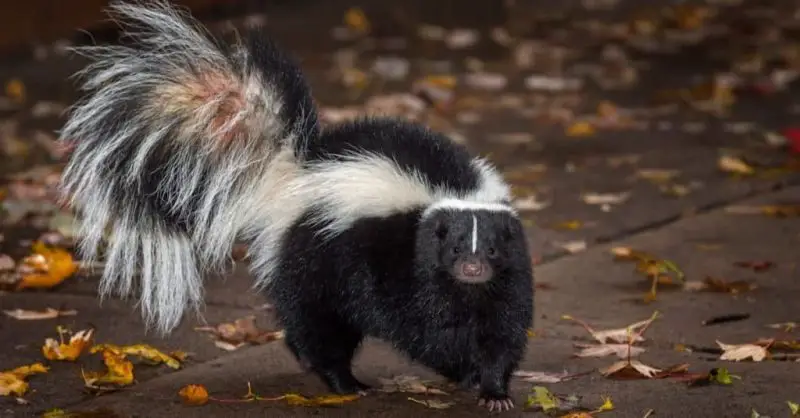
The striped skunk is the most common and recognizable skunk in New Hampshire. It has a black body with two bold white stripes running from the head down the back, often meeting at the shoulders and extending toward the tail. The tail is bushy and usually tipped with white.
Adults typically measure between 20 and 30 inches long, including the tail. Weight ranges from 4 to 10 pounds, with males generally larger than females. Their compact, low-slung build and short legs give them a distinctive waddling walk.
Behavior and Activity
Striped skunks are primarily nocturnal. They leave their dens at dusk to forage and return before daylight. During summer and fall, they are highly active as they build fat reserves for winter.
They are calm and deliberate movers rather than fast runners. When threatened, striped skunks rely on warning signals first. These include stamping their front feet, raising the tail, hissing, and turning their back toward the perceived threat. Spraying is used only if those warnings are ignored.
Striped skunks are solitary outside of breeding season. Females raise young alone, while males roam wider areas, especially during mating season.
Habitat in New Hampshire
Striped skunks are extremely adaptable and can be found throughout New Hampshire. They occupy forests, farmland, wetlands, suburban neighborhoods, and even the edges of towns and cities.
They prefer areas that provide a mix of cover and open foraging space. Old stone walls, brush piles, hollow logs, abandoned burrows, sheds, and crawl spaces all serve as suitable den sites.
Because of this flexibility, striped skunks are the skunk species most likely to be encountered near homes.
Diet and Ecological Role
Striped skunks are omnivorous and opportunistic. Their diet includes insects, grubs, beetles, worms, small rodents, amphibians, bird eggs, fruits, berries, and carrion.
In New Hampshire, their appetite for insects and rodents provides a valuable ecological service. By controlling pest populations, skunks help reduce agricultural damage and limit insect outbreaks.
They are also important prey for larger predators, including great horned owls, coyotes, and bobcats.
Seasonal Behavior and Winter Survival
Striped skunks do not hibernate, but they reduce activity significantly during winter. In colder months, they remain in dens for extended periods, sometimes sharing space with other skunks to conserve heat.
They emerge during mild winter nights to forage briefly. Most winter sightings occur during warmer spells or when skunks are disturbed from dens.
Eastern Spotted Skunk (Spilogale putorius)
Identification Overview
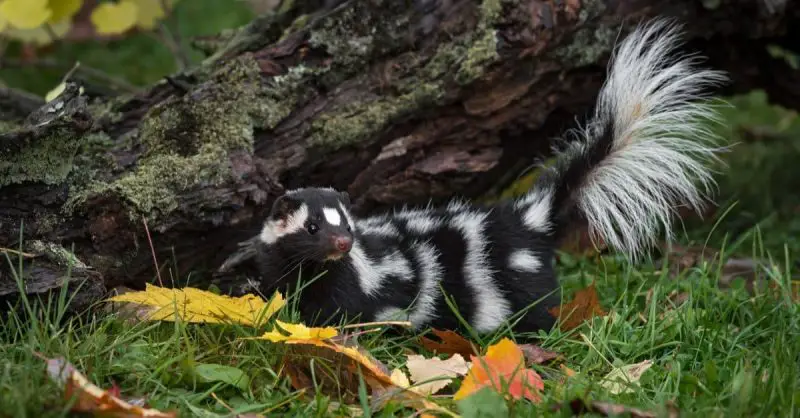
The eastern spotted skunk is much smaller and far less commonly seen than the striped skunk. Instead of long stripes, it has a complex pattern of broken white spots and short stripes across a black body. The pattern appears more jagged and irregular, giving it a striking appearance.
Adults typically measure 14 to 19 inches long, including the tail, and weigh between 1 and 3 pounds. Their smaller size, shorter tail, and more athletic build set them apart from striped skunks.
Behavior and Activity
Eastern spotted skunks are nocturnal and far more secretive than striped skunks. They are agile climbers and quicker movers, capable of squeezing into tight spaces and navigating rocky terrain.
When threatened, spotted skunks perform a unique defensive display. They may stomp their feet, hiss, and even stand on their front legs in a brief handstand to appear larger. This display often deters predators without the need to spray.
Spraying does occur, but like striped skunks, it is a last resort.
Habitat in New Hampshire
The eastern spotted skunk has a very limited and patchy presence in New Hampshire. Historically, it was more widespread, but populations have declined significantly across much of its range.
In New Hampshire, it is most likely to be found in southern parts of the state, particularly in areas with rocky outcrops, forest edges, old farm structures, and mixed woodland habitats. Dense forests with little ground cover are less suitable.
Because of its rarity and secretive behavior, many residents never encounter this species at all.
Diet and Ecological Role
Eastern spotted skunks feed on insects, small rodents, reptiles, amphibians, bird eggs, fruits, and berries. Compared to striped skunks, they rely more heavily on insects and small prey.
Their role in controlling insect and rodent populations is important, especially in rocky and edge habitats where other predators may be less effective.
Conservation Status and Decline
Eastern spotted skunks have experienced population declines throughout much of the eastern United States. Habitat loss, changes in farming practices, increased road mortality, and pesticide use have all contributed.
In New Hampshire, the species is considered rare, and sightings are valuable for wildlife monitoring. Protection of old structures, forest edges, and mixed habitats helps support remaining populations.
How to Tell the Two Skunks Apart
Distinguishing between New Hampshire’s two skunk species becomes much easier once you focus on body structure, movement style, and behavior rather than just color alone. At a quick glance, both are black-and-white mammals with similar defensive abilities, but their differences are noticeable when viewed carefully.
Size and Build
Striped skunks are significantly larger and heavier-bodied. Their shape is broad and low to the ground, with short legs and a thick torso that gives them a slow, rolling gait. Adult striped skunks often appear bulky, especially in late summer and fall when they carry extra fat reserves.
Eastern spotted skunks are much smaller and more compact. Their bodies are leaner, their legs proportionally longer, and their movements noticeably quicker. They look more agile than striped skunks, almost weasel-like in posture, and can move through rocky areas or tight spaces with ease.
If a skunk appears surprisingly small and fast-moving, it is far more likely to be a spotted skunk.
Fur Pattern
The fur pattern is the most obvious visual difference. Striped skunks have long, continuous white stripes that run from the head down the back. These stripes are usually clean and well-defined, creating a bold, symmetrical appearance that is instantly recognizable.
Eastern spotted skunks have a far more complex pattern. Instead of long stripes, their coats feature broken bands, spots, and short streaks of white scattered across the back and sides. The pattern looks jagged and irregular rather than smooth. This broken design helps them blend into rocky or brushy environments where light and shadow break up their outline.
When the white markings look fragmented instead of flowing, the skunk is almost certainly a spotted skunk.
Behavior When Threatened
Behavioral cues are often more reliable than markings during brief encounters. Striped skunks rely heavily on warning signals before spraying. They raise their tail, stomp their front feet, hiss, and slowly turn their back toward the perceived threat. This sequence gives plenty of warning and is meant to stop an approach without escalation.
Spotted skunks behave differently. They are more dramatic in their defense and may perform a brief handstand, balancing on their front legs while arching their body upward. This display makes them appear larger and more intimidating than they actually are. In many cases, the handstand alone is enough to deter predators without spraying.
Seeing a skunk briefly stand upright on its front legs is a strong indicator that it is a spotted skunk.
Likelihood of Encounter
Striped skunks are common throughout New Hampshire and are the species most people encounter near homes, roadsides, barns, and wooded edges. Their adaptability allows them to live comfortably in a wide range of environments.
Eastern spotted skunks are rare in the state and restricted to specific habitats. Most residents will never encounter one, and many reported sightings turn out to be striped skunks seen under poor lighting or at a distance.
In practical terms, the odds strongly favor a striped skunk unless the sighting occurs in a known spotted skunk habitat and includes clear identifying features.
Skunks and Human Conflict in New Hampshire
Most skunk encounters in New Hampshire are non-events that pass without incident. Skunks are not aggressive animals and have no interest in confrontation. Problems arise almost entirely from attractants that bring skunks close to human structures.
Unsecured trash, fallen bird seed, pet food left outdoors, compost piles, and crawl spaces under sheds or decks provide easy access to food and shelter. Once skunks find these resources, they may return repeatedly, increasing the chance of close encounters.
Spraying is not a default response. It occurs almost exclusively when a skunk feels cornered, startled at close range, or physically threatened. Giving skunks room to retreat and removing attractants dramatically reduces negative interactions.
Why Skunks Are Important to New Hampshire Ecosystems
Skunks play a quiet but valuable role in maintaining ecological balance. Their diet includes large numbers of insects, grubs, beetles, rodents, and carrion. By consuming these animals, skunks help regulate populations that could otherwise damage crops, lawns, or native vegetation.
Their digging behavior, often blamed for lawn damage, actually benefits soil health. As skunks forage for insects, they aerate the soil, improve water penetration, and mix organic material into the ground. Over time, this activity supports healthier plant growth.
Skunks also serve as prey for larger predators such as great horned owls, coyotes, and bobcats, making them an important link in the food web rather than a nuisance species.
Living Alongside Skunks Safely
Coexisting with skunks in New Hampshire is largely a matter of prevention rather than removal. Securing trash containers, removing outdoor food sources, sealing crawl spaces, and clearing debris near buildings significantly reduces skunk activity.
Motion-activated lights can discourage skunks from lingering, especially around sheds and entry points. Keeping yards tidy and eliminating den opportunities makes properties less attractive without harming wildlife.
If a skunk is encountered, the safest response is calm retreat. Moving slowly, avoiding direct approaches, and giving the animal space allows it to leave without resorting to defensive behavior. Sudden movements, chasing, or cornering increase the likelihood of spraying.
In most cases, understanding skunk behavior is enough to prevent conflict entirely.
FAQs About Skunks in New Hampshire
How many skunk species live in New Hampshire?
New Hampshire is home to two skunk species: the striped skunk and the eastern spotted skunk. The striped skunk is common statewide, while the eastern spotted skunk is rare and limited to specific habitats.
Which skunk is most commonly seen in New Hampshire?
The striped skunk is by far the most commonly encountered skunk in New Hampshire. It frequently appears near forests, farmland, and residential areas where food and shelter are available.
Are spotted skunks aggressive or more dangerous than striped skunks?
No. Spotted skunks are not more aggressive. They rely on warning displays, including foot stomping and handstand behavior, before spraying and usually avoid confrontation.
Do skunks in New Hampshire hibernate during winter?
Skunks do not hibernate. During winter, they remain in dens for long periods and become less active, emerging mainly during warmer nights.
What attracts skunks to yards and neighborhoods?
Unsecured trash, pet food, compost, fallen fruit, and easy den sites under sheds or decks commonly attract skunks to residential areas.
Are skunks dangerous to humans?
Skunks are not dangerous and rarely bite. The primary risk comes from being sprayed, which occurs only when a skunk feels threatened or cornered.
Can skunks carry rabies in New Hampshire?
Skunks can carry rabies, but transmission to humans is rare. Avoid handling skunks or approaching injured animals, and report unusual behavior to wildlife authorities.
How can I tell a striped skunk from a spotted skunk?
Striped skunks are larger with long white stripes. Spotted skunks are smaller and have broken white spots and short stripes across the body.
Are eastern spotted skunks protected in New Hampshire?
Eastern spotted skunks are rare and monitored due to population declines. While not commonly encountered, habitat protection is important for their conservation.
What should I do if I encounter a skunk?
Remain calm, avoid sudden movements, and slowly back away. Giving the skunk space usually prevents spraying.
Final Thoughts
New Hampshire is home to two very different skunk species. The striped skunk is common, adaptable, and familiar, while the eastern spotted skunk is rare, elusive, and quietly declining.
Both species are non-aggressive animals that rely on avoidance and warning rather than confrontation. Understanding their behavior, habitat needs, and ecological value helps replace fear with awareness.
Skunks are not pests by default. They are part of New Hampshire’s wildlife heritage, quietly shaping the ecosystems they inhabit.