
Montana’s landscapes are defined by large animals. Elk herds move across mountain valleys and open parks. White-tailed deer slip through river bottoms and agricultural edges. Mule deer roam badlands, foothills, and sagebrush country. Because these species often share the same ground, hunters, landowners, and wildlife watchers regularly ask the same question.
Can elk in Montana interbreed with deer?
At first glance, the idea feels possible. Elk and deer look related. They occupy overlapping habitats. They sometimes graze the same meadows or cross the same trails. When someone sees an animal that looks slightly “off,” hybridization seems like a simple explanation.
But in wildlife biology, what looks plausible is not the same as what is biologically possible. To answer this question clearly, we need to look at genetics, evolution, behavior, and decades of scientific research across Montana and the broader Rocky Mountain region.
Table of Contents
- 1 Montana Supports Multiple Large Cervid Species
- 2 Elk and Deer Belong to Different Genera
- 3 Genetic Incompatibility Prevents Hybridization
- 4 Why Being in the Same Family Is Not Enough
- 5 Chromosome Myths Add to the Confusion
- 6 Deer Can Hybridize With Other Deer, But Not Elk
- 7 No Scientific Evidence Supports Elk–Deer Hybrids
- 8 Behavior Creates an Additional Barrier
- 9 Breeding Seasons Do Not Align
- 10 Size Difference Makes Mating Unrealistic
- 11 Why the Myth Persists in Montana
- 12 Elk and Deer Show Natural Variation
- 13 Juvenile Animals Are Commonly Misidentified
- 14 Trail Cameras Add to Confusion
- 15 What Montana Wildlife Agencies Say
- 16 Why Understanding This Matters
- 17 Disease and Hybrid Myths
- 18 Climate Change Does Not Change the Answer
- 19 What To Do If You See an Unusual Ungulate
- 20 Elk and Deer Play Different Ecological Roles
- 21 Why Hybrid Populations Do Not Form
- 22 What Science Tells Us Clearly
- 23 FAQs About Elk and Deer Hybridization in Montana
- 23.1 Can elk in Montana breed with deer
- 23.2 Has an elk–deer hybrid ever been confirmed
- 23.3 Why do people think elk and deer can interbreed
- 23.4 Do elk and deer belong to the same species
- 23.5 Can mule deer and white-tailed deer hybridize
- 23.6 Do elk and deer share the same breeding season
- 23.7 Are size differences important in preventing hybridization
- 23.8 Can appearance alone identify a hybrid
- 23.9 What should I do if I see an unusual elk or deer
- 23.10 What do Montana wildlife agencies say
- 24 Final Thoughts
Montana Supports Multiple Large Cervid Species
Montana is home to some of the most diverse and abundant large hoofed mammals in North America.
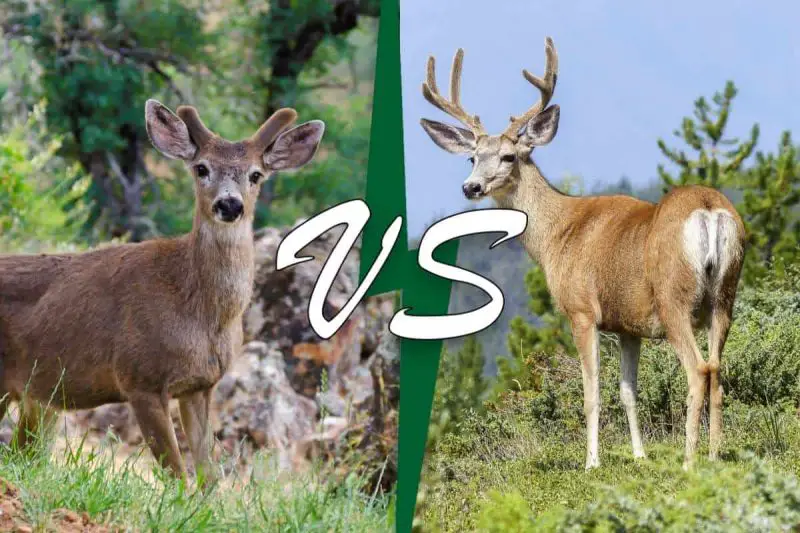
Elk (Cervus canadensis) are widespread across western and central Montana, occupying mountain forests, foothills, and open valleys. White-tailed deer (Odocoileus virginianus) are common statewide, especially along rivers, agricultural areas, and forest edges. Mule deer (Odocoileus hemionus) thrive in open country, sagebrush, breaks, and transitional habitats.
These species often overlap geographically. Seeing elk and deer in the same drainage or pasture is normal in Montana.
Geographic overlap, however, does not imply genetic mixing.
Elk and Deer Belong to Different Genera
Elk and deer are part of the same family, Cervidae, but they are not the same kind of animal.
Elk belong to the genus Cervus.
White-tailed and mule deer belong to the genus Odocoileus.
That distinction matters enormously.
Genera represent deep evolutionary separation. Elk and deer diverged from a common ancestor millions of years ago and followed different evolutionary paths in body size, antler structure, behavior, and reproduction.
Hybridization across genera is extremely rare and usually impossible.
Genetic Incompatibility Prevents Hybridization
The most important fact is simple.
Elk and deer cannot interbreed.
Their chromosome numbers, structures, and pairing mechanisms do not align. Even if mating behavior somehow occurred, fertilization would fail or embryos would not develop properly.
There are no scientifically verified cases of elk–deer hybrids anywhere in the world. Not in Montana. Not in captivity. Not historically.
Modern genetic tools are precise. If hybrids existed, they would have been detected.
Why Being in the Same Family Is Not Enough
Many people assume animals in the same family can interbreed.
This is a common misunderstanding.
Wolves and foxes share a family but cannot interbreed. Horses and zebras can hybridize, but horses and cattle cannot. Belonging to the same family does not guarantee compatibility.
Reproductive compatibility depends on very specific genetic alignment, not broad classification.
Elk and deer do not meet those requirements.
Chromosome Myths Add to the Confusion
Some hybrid myths arise from partial information.
People hear that different deer species can sometimes hybridize and assume elk must be able to do the same. But chromosome structure matters more than appearance or name.
Even among closely related species, small chromosomal differences can completely prevent viable reproduction.
Elk and deer are separated by far more than small differences.
Deer Can Hybridize With Other Deer, But Not Elk
It is true that some deer species can hybridize.
White-tailed deer and mule deer have produced rare hybrids in regions where their ranges overlap. These species belong to the same genus and are closely related.
Elk do not fall into this category.
Their genetic distance from Odocoileus deer is too great.
This distinction is often lost in casual discussion.
No Scientific Evidence Supports Elk–Deer Hybrids
Wildlife agencies, universities, and researchers have studied Montana’s ungulates for decades.
Elk and deer are routinely sampled for disease monitoring, population genetics, migration studies, and harvest management. DNA analysis is standard practice.
Not a single confirmed elk–deer hybrid has ever been documented.
Every unusual animal examined genetically has been identified as a pure elk, a pure deer, or a deer–deer hybrid where applicable.
Behavior Creates an Additional Barrier
Even if genetics allowed hybridization, behavior would still prevent it.
Elk and deer live very different social lives.
Elk are herd animals, especially outside the breeding season. They rely on group dynamics, vocal communication, and seasonal migration. Deer are more solitary or form small groups.
Their courtship behaviors differ. Their mating calls differ. Their breeding timing differs.
They do not recognize each other as potential mates.
Breeding Seasons Do Not Align
Timing matters in reproduction.
Elk rut typically occurs in September and October. Bulls bugle, gather harems, and defend females aggressively. Deer breeding seasons occur later, usually in November.
Even if elk and deer were compatible, their breeding windows do not overlap sufficiently.
Nature enforces separation through timing as well as genetics.
Size Difference Makes Mating Unrealistic
The size difference between elk and deer is enormous.
Adult bull elk can weigh 600 to 700 pounds or more. Even cows often exceed 400 pounds. White-tailed and mule deer usually weigh between 100 and 300 pounds.
An attempted mating would pose serious injury risk, especially to deer. Animals do not engage in behavior that offers extreme risk without reproductive payoff.
From an evolutionary standpoint, such interaction makes no sense.
Why the Myth Persists in Montana
Montana’s wide open landscapes fuel speculation.
Animals are often seen at a distance. Lighting and terrain distort size and shape. Winter coats change appearance. Juveniles look different from adults.
When an animal does not fit expectations, the brain looks for explanation. Hybridization feels novel and exciting.
Stories spread faster than science.
Elk and Deer Show Natural Variation
Both elk and deer vary widely in appearance.
Elk body size changes with nutrition and age. Antler shape varies dramatically. Coat color shifts seasonally.
Deer show even more variation. Mule deer and white-tailed deer look different, but hybrids between them can look confusing.
Variation within species often explains “strange” sightings.
Juvenile Animals Are Commonly Misidentified
Young animals account for many hybrid claims.
Young elk may look deer-like before reaching full size. Large deer may look elk-like at a distance.
Without scale references, misidentification is easy.
Age matters more than ancestry in many sightings.
Trail Cameras Add to Confusion
Trail cameras distort perception.
Wide-angle lenses stretch bodies. Night images exaggerate eye shine and leg length. Lack of scale removes context.
An elk photographed at an odd angle can look deer-like. A deer close to the camera can look massive.
Technology unintentionally creates mystery.
What Montana Wildlife Agencies Say
Montana Fish, Wildlife & Parks is clear on this topic.
Elk and deer do not interbreed. There is no evidence of hybrids. Hybridization is not a management concern.
Unusual animals are consistently explained through known species, age differences, lighting, or deer–deer hybrids where applicable.
Science guides policy, not rumor.
Why Understanding This Matters
Belief in elk–deer hybrids is not harmless.
It can lead to misinformation about population health, disease transmission, and conservation priorities. It can confuse hunters and landowners.
Accurate understanding supports better wildlife management and coexistence.
Disease and Hybrid Myths
Some people assume hybridization spreads disease.
Disease transmission does not require hybridization. Elk and deer can share diseases like chronic wasting disease through proximity alone.
Blaming hybrids distracts from real disease management strategies.
Climate Change Does Not Change the Answer
Climate change can shift ranges and behavior.
It does not rewrite genetics.
Even if elk and deer overlap more in the future, they will remain reproductively incompatible.
What To Do If You See an Unusual Ungulate
If you see an animal that looks unusual, observe carefully.
Note body size, antler structure, tail shape, habitat, and behavior. Photographs help, but assumptions do not.
Report unusual observations if necessary and allow experts to evaluate them.
Elk and Deer Play Different Ecological Roles
Elk influence vegetation structure, migration corridors, and predator dynamics at large scales.
Deer shape understory growth, edge habitats, and localized browsing pressure.
Each species fills a distinct ecological niche.
Nature keeps those niches separate for a reason.
Why Hybrid Populations Do Not Form
Even when hybridization occurs in other species, stable populations rarely form unless hybrids have clear advantages.
In the case of elk and deer, hybrids cannot even exist biologically.
The barrier is absolute.
What Science Tells Us Clearly
Science provides a definitive answer.
Elk and deer cannot interbreed. There are no hybrids. There is no evidence suggesting otherwise.
This conclusion is supported by genetics, behavior, anatomy, and decades of research across Montana and North America.
FAQs About Elk and Deer Hybridization in Montana
Can elk in Montana breed with deer
No. Elk and deer are genetically incompatible and cannot produce offspring.
Has an elk–deer hybrid ever been confirmed
No. There are no scientifically verified cases of elk–deer hybrids anywhere in the world.
Why do people think elk and deer can interbreed
Because they look related, share habitats, and people sometimes confuse species seen at a distance.
Do elk and deer belong to the same species
No. Elk belong to the genus Cervus, while deer belong to the genus Odocoileus.
Can mule deer and white-tailed deer hybridize
Yes, but only rarely, because they are closely related. This does not apply to elk.
No. Elk rut occurs earlier than deer breeding seasons, preventing overlap.
Are size differences important in preventing hybridization
Yes. The large size gap makes mating unrealistic and dangerous.
Can appearance alone identify a hybrid
No. Visual traits are unreliable due to natural variation and age differences.
What should I do if I see an unusual elk or deer
Observe carefully, document if possible, and report to wildlife officials if needed.
What do Montana wildlife agencies say
They state clearly that elk and deer do not interbreed and hybrids are not a concern.
Final Thoughts
The idea that elk in Montana can interbreed with deer is understandable, but it is not true.
Elk and deer share landscapes, not DNA. They overlap geographically, not genetically.
What people see are elk, deer, or misidentified animals shaped by distance, lighting, age, and expectation.
Nature draws firm boundaries. In Montana, that boundary between elk and deer remains intact, just as it has for thousands of years.