
New Jersey may be one of the smaller states in the U.S., but when it comes to hawks, it punches well above its weight. Forests, wetlands, farmland, coastal marshes, and expanding suburban areas all create ideal hunting grounds for different species of hawks throughout the year. Some are permanent residents, others appear only during migration or winter, and a few are elusive enough to feel like a reward when spotted.
This guide covers all 8 hawk species found in New Jersey, with detailed identification help, behavior notes, habitat preferences, and practical field tips.
Table of Contents
Hawks of New Jersey: What Makes Them Unique
Hawks belong to a group of birds of prey known for keen eyesight, strong talons, and aerial hunting skill. In New Jersey, hawks fill different ecological roles depending on size and habitat. Woodland hawks specialize in tight forest hunting. Open-country hawks dominate fields and marshes. Some species migrate thousands of miles to pass through the state each year.
Despite their differences, most hawks share common traits. They soar using thermal air currents, rely heavily on vision rather than smell, and play an important role in controlling rodent and small bird populations.
Sharp-shinned Hawk

Identification
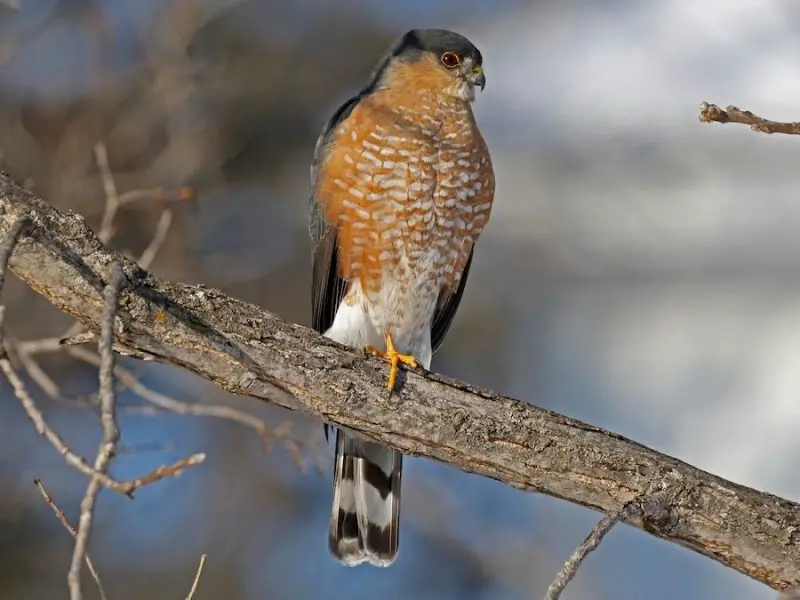
The Sharp-shinned Hawk is the smallest hawk regularly found in New Jersey, and overall size is one of the most reliable identification clues. Adults typically measure 9 to 13 inches in body length, with a wingspan of about 17 to 22 inches. As with many hawks, females are noticeably larger than males, sometimes approaching the size of a small Cooper’s Hawk, which can make field identification challenging.
Adult Sharp-shinned Hawks show blue-gray upperparts and finely barred reddish underparts that are most visible on the chest and belly. The tail is long and narrow with a squared-off tip, often showing a thin white band at the end when perched. The head appears small and rounded, barely extending beyond the wings in flight. Juveniles differ strongly in appearance, with brown upperparts and heavy vertical brown streaking on a pale chest.
This species is frequently confused with Cooper’s Hawks, but several details help separate them. Sharp-shinned Hawks have very thin legs, a smaller and less blocky head, and a tail that looks straighter across the tip rather than rounded. Their wingbeats are quicker and more irregular, giving them a nervous, jittery flight style compared to the steadier, more powerful flight of Cooper’s Hawks.
Habitat and Behavior
Sharp-shinned Hawks are strongly associated with dense woodland habitats, including mixed forests and mature deciduous woods. Their compact size and short wings allow them to maneuver efficiently through tight forest interiors. In New Jersey, they are also commonly seen in suburban areas, especially during migration, where backyard bird feeders attract their preferred prey.
They are highly specialized ambush predators that rely on speed and surprise rather than soaring. Sharp-shinned Hawks primarily hunt small songbirds, launching sudden attacks from concealed perches or bursting through shrubs and tree cover in pursuit. Their hunting flights are often low and direct, lasting only seconds from ambush to capture.
In flight, Sharp-shinned Hawks use rapid wingbeats followed by short glides. They move quickly through cluttered spaces, weaving between trees with impressive precision. This fast, darting flight style is one of the best behavioral clues for identifying the species in the field.
Seasonal Presence in New Jersey
Sharp-shinned Hawks are most visible in New Jersey during fall migration, especially from September through November. During this period, large numbers move south through the state, making them much easier to observe along forest edges, ridgelines, and suburban neighborhoods.
Some individuals remain in New Jersey year-round, but winter sightings are far less common than in migration seasons. During colder months, they tend to stay hidden within wooded areas and are less likely to be seen in open spaces.
Spring migration occurs from late March through April, though it is generally less noticeable than fall movement. For most observers, autumn remains the best time to reliably see Sharp-shinned Hawks in New Jersey.
Cooper’s Hawk
Identification
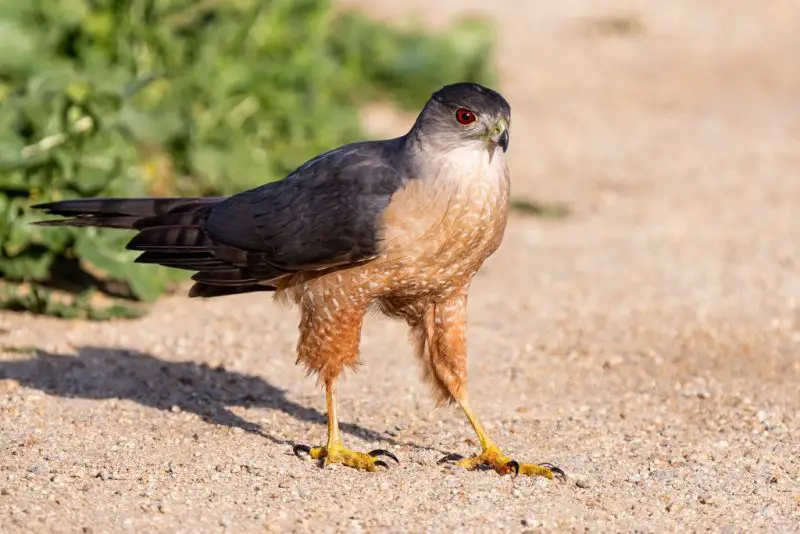
Cooper’s Hawks are medium-sized woodland hawks, noticeably larger and heavier-bodied than Sharp-shinned Hawks. Adults typically measure 14–20 inches (36–51 cm) in length, with a wingspan of about 24–35 inches (62–90 cm). Females are substantially larger than males, sometimes approaching the size of a small Red-shouldered Hawk.
Adults have blue-gray upperparts and warm rufous barring across the chest and belly. The head is relatively large and blocky, often projecting well beyond the wings in flight. The tail is long and rounded at the tip, usually showing a broad white terminal band. Juveniles are brown above with bold vertical streaking on a pale underside, giving them a streaky, high-contrast appearance.
When compared to Sharp-shinned Hawks, Cooper’s Hawks show several consistent differences. They have thicker legs, a more pronounced head, and a tail that appears rounded rather than squared. Their flight looks stronger and more deliberate, lacking the jittery, rapid wingbeats typical of Sharp-shinned Hawks.
Habitat and Behavior
Cooper’s Hawks have adapted extremely well to human-altered landscapes. In New Jersey, they are common in suburban neighborhoods, city parks, forest edges, and mature residential areas with tall trees. These environments provide abundant prey and suitable nesting sites.
They are aggressive, highly skilled predators that specialize in hunting medium-sized birds such as doves, starlings, and jays, as well as small mammals. Cooper’s Hawks often hunt by surprise, launching sudden attacks from concealed perches or gliding low between trees to flush prey.
Unlike some hawks that avoid visibility, Cooper’s Hawks frequently perch in open, elevated locations. Their confidence, size, and tolerance of human presence make them one of the most frequently observed hawks in New Jersey.
Seasonal Presence in New Jersey
Cooper’s Hawks are year-round residents across most of New Jersey. Their numbers appear more noticeable in fall and winter, when migrating individuals from farther north increase local populations and leafless trees make them easier to spot.
Red-shouldered Hawk

Identification
The Red-shouldered Hawk is a medium-sized woodland hawk with distinctive coloration and patterning. Adults measure 15–19 inches (38–48 cm) in length, with a wingspan of roughly 37–43 inches (94–110 cm). Their proportions are slimmer than Red-tailed Hawks but broader-winged than Cooper’s Hawks.
Adults show rich rufous barring across the chest and belly, contrasting with bold black-and-white checkered wings. When perched, reddish shoulder patches are often visible. In flight, one of the most reliable field marks is the pair of translucent pale crescents near the tips of the wings.
Juveniles lack the red tones of adults. They appear brown above, with streaked underparts and a more muted overall pattern, which can make them harder to identify without observing habitat and behavior.
Habitat and Behavior
Red-shouldered Hawks are strongly associated with mature forests near water. In New Jersey, they favor swamps, wooded streams, floodplain forests, and wet bottomlands, particularly in areas with tall trees and minimal disturbance.
They are vocal hawks and frequently announce their presence with loud, repeated calls that carry through the forest. These calls are often the first clue to their presence, even when the bird itself remains hidden.
Their diet is diverse and reflects their wet-forest habitat. Red-shouldered Hawks feed on small mammals, frogs, snakes, lizards, crayfish, and large insects. They often hunt from perches, scanning the forest floor and shallow water for movement.
Seasonal Presence in New Jersey
Red-shouldered Hawks are permanent residents throughout much of New Jersey. They are especially common in forested regions of central and southern parts of the state, where suitable wet woodland habitat remains intact.
Broad-winged Hawk

Identification
Broad-winged Hawks are compact, stocky hawks with relatively short tails and broad wings. Adults measure 13–17 inches (34–44 cm) in length, with a wingspan of about 31–39 inches (79–100 cm). Their silhouette often appears chunky compared to other forest hawks.
Adults have brown upperparts and pale underparts with fine horizontal barring. In flight, the tail typically shows a single bold dark band near the tip, which stands out against the otherwise pale tail. Juveniles are similar in shape but show heavier streaking below rather than clean barring.
Because of their compact shape and subtle plumage, Broad-winged Hawks are often overlooked outside migration periods.
Habitat and Behavior
Broad-winged Hawks breed in dense, mature forests, where they remain surprisingly secretive. During the nesting season, they are often detected only by their high-pitched calls or brief flights above the canopy.
This species is best known for its dramatic migration behavior. In fall, Broad-winged Hawks gather in large groups called kettles, soaring on thermal currents as they move south. Thousands may pass through migration corridors in a single day, creating one of the most impressive raptor spectacles in New Jersey.
Outside migration, they hunt quietly within forest interiors, feeding mainly on small mammals, reptiles, amphibians, and insects.
Seasonal Presence in New Jersey
Broad-winged Hawks are present in New Jersey primarily during spring and fall migration. They breed in parts of northern New Jersey during summer but are absent in winter, migrating to Central and South America.
Red-tailed Hawk
Identification
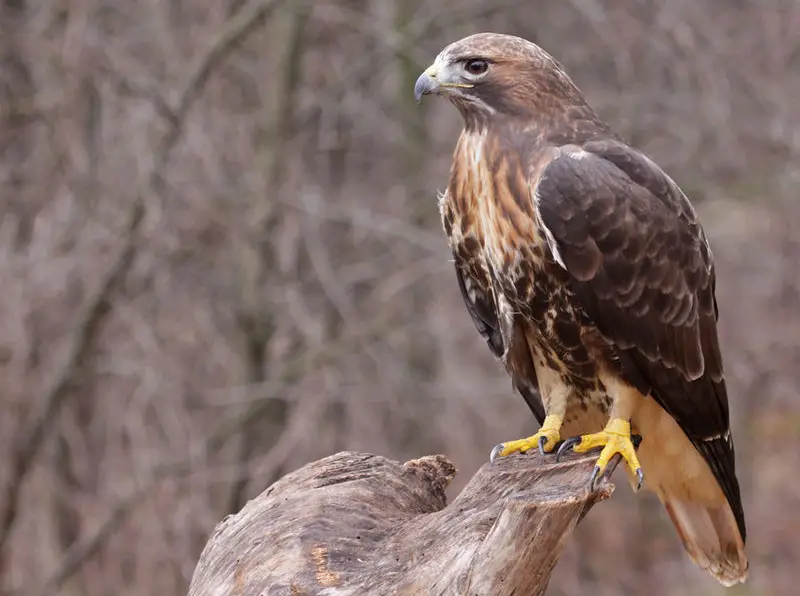
The Red-tailed Hawk is the largest and most familiar hawk in New Jersey. Adults typically measure 18–26 inches (45–65 cm) in length, with a wingspan of about 43–57 inches (110–145 cm). Their size alone often makes identification straightforward.
Most adults show a pale chest and belly with a dark belly band, along with the species’ signature brick-red tail, which is visible both perched and in flight. Plumage varies widely, and some individuals appear much darker or lighter than average.
Juveniles lack the red tail and instead show brown banding across a grayish tail. Their overall coloration is more mottled and less cleanly defined than that of adults.
Habitat and Behavior
Red-tailed Hawks are among the most adaptable raptors in North America. In New Jersey, they thrive in open landscapes such as farmland, fields, highways, coastal plains, and forest edges. They are frequently seen perched on utility poles, fence posts, or tall trees, scanning the ground below.
They primarily hunt rodents but also take rabbits, snakes, birds, and carrion when available. Red-tailed Hawks rely heavily on soaring, often circling high on thermals before dropping toward prey.
Their loud, raspy scream is iconic and commonly used in films and television, even when other bird species are shown on screen.
Seasonal Presence in New Jersey
Red-tailed Hawks are year-round residents throughout New Jersey. They are often easier to spot in winter, when leafless trees and open fields make their perches and soaring flights more visible.
Rough-legged Hawk

Identification
Rough-legged Hawks are medium to large hawks that appear in New Jersey only during the colder months. Adults typically measure 18–23 inches (46–59 cm) in length, with a wingspan of about 52–54 inches (132–137 cm), giving them a long-winged, broad-bodied silhouette in flight.
One of the most distinctive identification features is their feathered legs, which extend all the way down to the toes, a trait shared by very few hawk species. Plumage varies considerably, but many individuals show a pale head, dark belly patches, and strong black markings at the wrist of the wings. The tail is usually pale with a bold dark band near the tip, visible when soaring.
Their ability to hover in place while facing into the wind is an important behavioral clue. This hovering behavior, combined with long wings and a pale, high-contrast pattern, helps separate Rough-legged Hawks from Red-tailed Hawks in open winter landscapes.
Habitat and Behavior
Rough-legged Hawks strongly prefer open habitats. In New Jersey, they are most often found in agricultural fields, coastal marshes, grasslands, and wide open floodplains where small mammals are abundant.
They hunt primarily rodents, especially voles and mice. When searching for prey, Rough-legged Hawks may hover low over the ground or perch on fence posts, utility poles, and low trees. Their hunting style is patient and methodical, relying on vision and movement detection rather than speed.
These hawks breed in the Arctic tundra and boreal regions. As winter approaches and prey becomes scarce in the north, they migrate south, reaching New Jersey only during the non-breeding season.
Seasonal Presence in New Jersey
Rough-legged Hawks appear in New Jersey from late November through March, with numbers peaking in mid-winter. They are completely absent during the breeding season and leave the state by early spring as they return north.
Northern Harrier

Identification
Northern Harriers are slender, long-winged hawks with a flight profile unlike most other raptors. Adults typically measure 16–20 inches (41–50 cm) in length, with a wingspan of about 38–48 inches (97–122 cm). Their long tail and narrow wings give them an elegant, buoyant appearance.
Adult males are pale gray with black wingtips, while females and juveniles are brown with heavy streaking on the underparts. One consistent field mark across all ages and sexes is the white rump patch, which flashes clearly when the bird is in flight. The facial disk, similar to that of an owl, helps funnel sound toward the ears.
Habitat and Behavior
Northern Harriers specialize in hunting over open landscapes. Marshes, grasslands, coastal meadows, and agricultural fields provide ideal conditions in New Jersey. They fly low to the ground with wings held in a shallow V, slowly quartering back and forth in search of prey.
Unlike most hawks, Northern Harriers rely partly on hearing in addition to vision. This adaptation allows them to detect small mammals hidden in tall grass or dense vegetation. Their prey includes rodents, small birds, reptiles, and amphibians.
Their low, gliding flight and white rump patch make them one of the easiest hawks to recognize once the observer is familiar with their hunting style.
Seasonal Presence in New Jersey
Northern Harriers are most common in New Jersey during winter, particularly in coastal and southern regions of the state. Smaller numbers may be seen during migration periods in spring and fall, but winter offers the best chance for consistent sightings.
Northern Goshawk
Identification
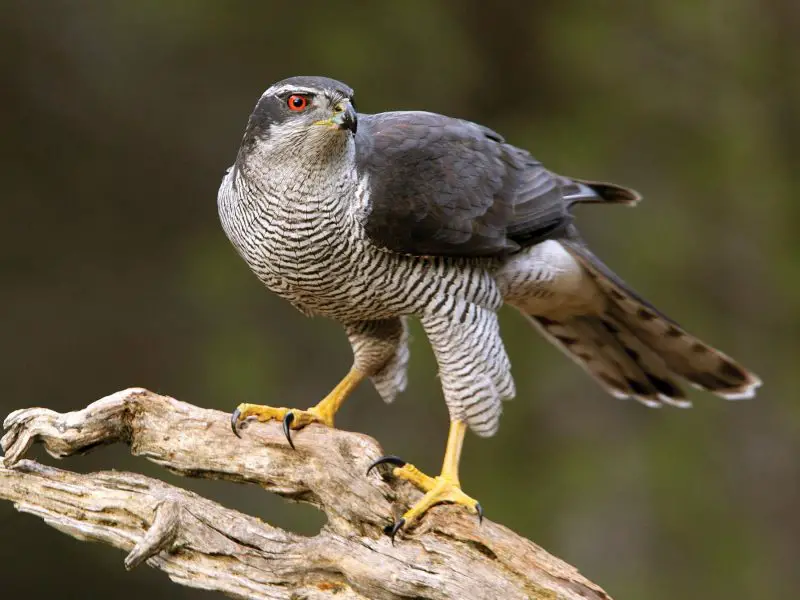
Northern Goshawks are large, powerful forest hawks and among the most imposing raptors that can appear in New Jersey. Adults typically measure 20–26 inches (51–66 cm) in length, with a wingspan of approximately 40–46 inches (102–117 cm). Females are significantly larger than males.
Adults have slate-gray upperparts, pale underparts with fine horizontal barring, and a bold white eyebrow stripe that gives the bird a fierce, intense expression. The tail is long and broadly banded. Juveniles are brown above with heavy vertical streaking on the chest and belly, making them appear bulkier and darker overall.
Their size, thick legs, broad wings, and aggressive posture help distinguish them from Cooper’s Hawks, even though the two species are closely related.
Habitat and Behavior
Northern Goshawks prefer deep, mature forests, particularly large tracts of undisturbed woodland. They are highly territorial and notoriously elusive, often remaining hidden within dense tree cover.
They are aggressive and powerful hunters capable of taking relatively large prey, including rabbits, squirrels, grouse, and other birds. When defending nests, Northern Goshawks may act boldly and are known for intimidating displays.
Because of their secretive nature and preference for remote habitats, sightings in New Jersey are rare and often brief, making any observation noteworthy.
Seasonal Presence in New Jersey
Northern Goshawks are rare winter visitors in New Jersey. They usually appear only during irruption years, when food shortages in northern breeding areas force them to move farther south than usual. In most winters, they are completely absent from the state.
Best Times and Places to Observe Hawks in New Jersey
Best Time of Year
The most productive time to observe hawks in New Jersey is fall migration, especially from September through November. During this period, multiple species pass through the state in large numbers, including Sharp-shinned Hawks, Broad-winged Hawks, and Cooper’s Hawks. Cooler temperatures and strong thermals make hawk activity more visible, particularly on clear days with steady winds.
Winter, from December through February, is ideal for spotting species that remain or move south for the season. Red-tailed Hawks, Northern Harriers, and Rough-legged Hawks are easiest to observe during this time, as leafless trees and open landscapes improve visibility.
Spring migration, from March through April, brings fewer birds than fall but still offers chances to see Broad-winged Hawks and Sharp-shinned Hawks moving north.
Best Habitats to Watch Hawks
Different hawk species favor different landscapes, and choosing the right habitat greatly improves success. Open fields, farmland, and marshes are excellent places to observe Red-tailed Hawks, Rough-legged Hawks, and Northern Harriers, especially during winter.
Forested areas and wooded suburbs are better for Cooper’s Hawks, Sharp-shinned Hawks, and occasional Northern Goshawks. These species often hunt along forest edges, parks, and residential neighborhoods with mature trees.
During migration, ridgelines, coastal areas, and open corridors become prime viewing locations as hawks follow natural pathways while traveling south or north.
Best Time of Day
Hawks are most active from mid-morning through early afternoon, when rising air currents help them soar efficiently. Migration activity often increases late in the morning as thermals strengthen. Early mornings can be productive for woodland hawks that hunt from perches, while afternoons favor soaring species.
Weather Conditions That Increase Sightings
Clear skies, light to moderate winds, and cool temperatures create ideal conditions for hawk movement. Windy days are especially good for observing Rough-legged Hawks hovering over fields or Broad-winged Hawks forming large migration kettles.
Cloudy or rainy weather generally reduces visibility and flight activity, making hawks harder to spot.
Seasonal Patterns to Keep in Mind
Some hawk species are simply absent at certain times of year. Broad-winged Hawks do not remain in New Jersey during winter, while Rough-legged Hawks appear only in colder months. Knowing which species are expected in each season helps narrow identification quickly and prevents confusion.
FAQs About Hawks in New Jersey
Are hawks protected in New Jersey?
Yes. All hawks are protected under federal and state wildlife laws. It is illegal to harm, capture, or disturb them or their nests.
Which hawk is most common in New Jersey?
The Red-tailed Hawk is the most widespread and frequently seen species statewide.
Do hawks attack pets?
Hawks rarely attack pets, and incidents are extremely uncommon. Small animals left unattended outdoors may be at risk, but attacks on people do not occur.
When is the best time to see hawks?
Fall migration from September to November offers the greatest diversity and number of sightings.
Can hawks live in cities?
Some species, especially Cooper’s Hawks and Red-tailed Hawks, adapt well to urban and suburban environments.
What do hawks eat in New Jersey?
Their diet includes rodents, birds, reptiles, amphibians, and insects, depending on species and habitat.
How can I tell a hawk from a falcon?
Hawks have broader wings and soar more, while falcons have pointed wings and fast, direct flight.
Do hawks migrate through New Jersey?
Yes. New Jersey is an important migration corridor, especially along the coast and ridge lines.
Final Thoughts
New Jersey’s hawks reflect the state’s ecological diversity. From marsh-hunting Northern Harriers to forest-dwelling Goshawks and ever-present Red-tailed Hawks, each species plays a vital role in maintaining balance in local ecosystems.
Learning to identify these birds adds depth to every hike, drive, or backyard moment. Once you start noticing hawks, you will realize they have been overhead all along, silently shaping the landscape from above.