

Oklahoma hosts a surprisingly rich variety of squirrels, from tree-dwelling species and prairie burrowers to elusive flying squirrels and even the hefty groundhog. Each species brings its own shape, color, and behavior to the landscapes of forests, prairies, and suburban neighborhoods across the state. For wildlife watchers, this variety makes Oklahoma one of the most interesting places in the region to observe squirrel diversity.
These mammals play important ecological roles by dispersing seeds, shaping vegetation, and serving as prey for raptors and carnivores. Their presence in forests, city parks, and open grasslands highlights just how adaptable and resilient squirrel species can be. From the alert Thirteen-lined Ground Squirrel to the nocturnal Southern Flying Squirrel, every species offers something unique for observers.
This guide introduces all the squirrel and squirrel-family species found in Oklahoma, explaining how to identify them, where they live, and when they are easiest to observe. Whether you’re a birder, photographer, or casual nature lover, understanding these species will make each visit to Oklahoma’s outdoor spaces more rewarding.
Table of Contents
- 1 Different Types of Squirrels Found in Oklahoma
- 1.1 Eastern Gray Squirrel (Sciurus carolinensis)
- 1.2 Fox Squirrel (Sciurus niger)
- 1.3 Southern Flying Squirrel (Glaucomys volans)
- 1.4 Rock Squirrel (Otospermophilus variegatus)
- 1.5 Thirteen-lined Ground Squirrel (Ictidomys tridecemlineatus)
- 1.6 Eastern Chipmunk (Tamias striatus)
- 1.7 Groundhog / Woodchuck (Marmota monax)
- 2 Best Time and Places to Observe Squirrels in Oklahoma
- 3 FAQs About Squirrels in Oklahoma
- 3.1 Are squirrels active year-round in Oklahoma?
- 3.2 Which squirrel species are easiest to see in Oklahoma?
- 3.3 Are flying squirrels common in Oklahoma?
- 3.4 Where can I find ground squirrels in Oklahoma?
- 3.5 Are groundhogs native to Oklahoma?
- 3.6 Do squirrels pose risks to homes or property?
- 3.7 Are squirrels protected in Oklahoma?
- 3.8 What should I do if I find a baby squirrel?
- 3.9 Can squirrels and chipmunks be attracted with food?
- 3.10 Is it possible to see all Oklahoma squirrel species in one region?
- 4 Conclusion
Different Types of Squirrels Found in Oklahoma
Eastern Gray Squirrel (Sciurus carolinensis)

The Eastern Gray Squirrel is a medium-sized tree squirrel with soft gray fur, white underparts, and a large, bushy tail edged in silver. Its overall appearance tends to be sleek and agile, and melanistic (black) individuals occasionally appear, though they are less common in Oklahoma. Their sharp claws and flexible ankles allow them to grip bark securely and maneuver easily through tall hardwood trees.
Identification is relatively straightforward because this species shows a consistent gray coat, rounded ears, and expressive dark eyes. The tail is long and full, helping with balance during quick leaps between branches. Compared to fox squirrels, grays are slightly smaller and appear more streamlined, which can help observers tell them apart when both species occupy the same area.
Adult gray squirrels typically measure 16 to 20 inches from nose to tail tip and weigh between 1 and 1.5 pounds. Their movements are quick and energetic, especially during early morning and late afternoon when they forage for nuts, seeds, buds, and fruits. Their excellent memory allows them to locate cached food even months later, which helps them survive harsher winter conditions.
In Oklahoma, Eastern Gray Squirrels are most common in the eastern half of the state where dense hardwood forests dominate. They show a strong preference for mixed oak–hickory habitats, river corridors, and mature urban neighborhoods with large shade trees. Although less abundant in western Oklahoma, they can still appear in towns and parks wherever suitable canopy cover is available.
Fox Squirrel (Sciurus niger)

The Fox Squirrel is the largest tree squirrel in Oklahoma, dressed in a thick blend of rusty red, brown, and black fur. Its sizeable frame and bold coloration make it the easiest squirrel to identify at a distance. The tail is equally bushy but tends to show more reddish tones compared to the pale-tipped tail of gray squirrels.
Identification is aided by the species’ stocky build, heavier head, and distinctive orange belly. Many individuals in Oklahoma display a characteristic grizzled-black back with a bright cinnamon underside, though local color variations can appear. Because they spend more time on the ground than gray squirrels, observers frequently see them crossing open lawns or foraging in low shrubs.
Fox squirrels measure 18 to 28 inches long and can weigh up to 2.5 pounds, making them noticeably bigger and slower than Eastern Gray Squirrels. Their behavior is often more deliberate, but they remain excellent climbers when retreating to trees for safety. Their diet includes acorns, nuts, seeds, fruits, agricultural crops, and occasionally insects or bird eggs.
Throughout Oklahoma, the Fox Squirrel is widespread and common in nearly every county. It thrives in patchy habitats such as woodlot edges, savannas, parks, and residential areas where open ground is mixed with scattered trees. This adaptability allows the species to flourish even in drier western counties where other tree squirrels are less common.
Southern Flying Squirrel (Glaucomys volans)

The Southern Flying Squirrel is the smallest squirrel in Oklahoma and one of the state’s most elusive mammals. It features silky gray-brown fur, a flat tail, and enormous black eyes adapted for nocturnal vision. The species’ most recognizable trait is its patagium, a flexible membrane connecting its limbs that allows it to glide effortlessly between trees.
Identification relies on the squirrel’s petite size, large round eyes, and subtle cream-colored belly. Unlike gray and fox squirrels, this species is rarely seen during the day, making evidence such as soft vocal chirps or signs near nest cavities important for detection. Its tail is flattened rather than rounded, helping with stability during gliding.
Southern Flying Squirrels measure about 9 to 10 inches long and weigh only 2 to 3 ounces. Despite their small size, they are incredibly agile and capable of gliding 50 to 100 feet in a single leap. They are highly social mammals that often share winter nests for warmth and feed on nuts, seeds, fungi, insects, bird eggs, and sap.
In Oklahoma, this species is primarily found in the eastern third of the state where moist hardwood forests, old stands of oak and hickory, and tree cavities are abundant. Their range follows major riparian corridors and mature woodlands, and sightings become rare as one moves west into drier grasslands. Because of their nocturnal habits, most people never realize flying squirrels live nearby.
Rock Squirrel (Otospermophilus variegatus)

The Rock Squirrel is a large, ground-dwelling species with gray-mottled fur, a long tail, and a noticeably sturdy build. It resembles a cross between a tree squirrel and a ground squirrel, favoring rocky slopes rather than forest canopies. The coat often shows a salt-and-pepper pattern, which provides excellent camouflage against boulders and canyon walls.
Identification is based on its speckled back, semi-bushy tail, and preference for rocky, arid terrain. The head is broad, the ears are short, and the body proportions are heavier than those of tree squirrels. When alarmed, this species often stands upright on hind legs to survey its surroundings before retreating into crevices or burrows.
Rock Squirrels measure 17 to 21 inches long and weigh between 1 and 2 pounds. Their behavior includes sunning themselves on rocks, foraging for seeds and vegetation, and emitting sharp alarm calls when predators approach. They spend more time underground than arboreal squirrels and may hibernate in the coldest parts of their range.
In Oklahoma, the Rock Squirrel is extremely localized, occurring mainly in the far western panhandle and areas bordering New Mexico and Texas. It inhabits dry canyons, rocky bluffs, mesas, and desert-like environments where boulders and crevices provide shelter. Sightings are uncommon, making this one of the rarest squirrels found in the state.
Thirteen-lined Ground Squirrel (Ictidomys tridecemlineatus)

The Thirteen-lined Ground Squirrel is a small, slender ground-dwelling species marked by a beautifully patterned coat of alternating stripes and spots. Its fur displays seven light stripes and six dark stripes running from head to tail, each dark stripe containing a dotted line. This intricate pattern makes the species one of the easiest squirrels to recognize on open grasslands.
Identification relies on its compact body, short tail, and rapid, low-to-the-ground movements. The eyes are large and alert, and the face has a pointed, almost weasel-like appearance. Because it prefers staying close to the ground, observers typically see it darting between clumps of vegetation or sitting upright near burrow entrances.
Adult Thirteen-lined Ground Squirrels typically measure 6 to 12 inches long and weigh around 4 to 9 ounces. Their behavior includes constant foraging during warm months, feeding on seeds, insects, grasses, and even small vertebrates such as young mice or tiny lizards. They enter a deep hibernation in winter, sometimes for more than six months, which is one of their most distinctive seasonal traits.
In Oklahoma, this species is most common in the northern and western regions, especially in prairies, shortgrass fields, cemeteries, and roadside rights-of-way. They favor well-drained soils where burrows can be constructed easily. Their distribution becomes patchier in the wooded eastern counties, but they remain widespread in areas dominated by grassland and agricultural fields.
Eastern Chipmunk (Tamias striatus)
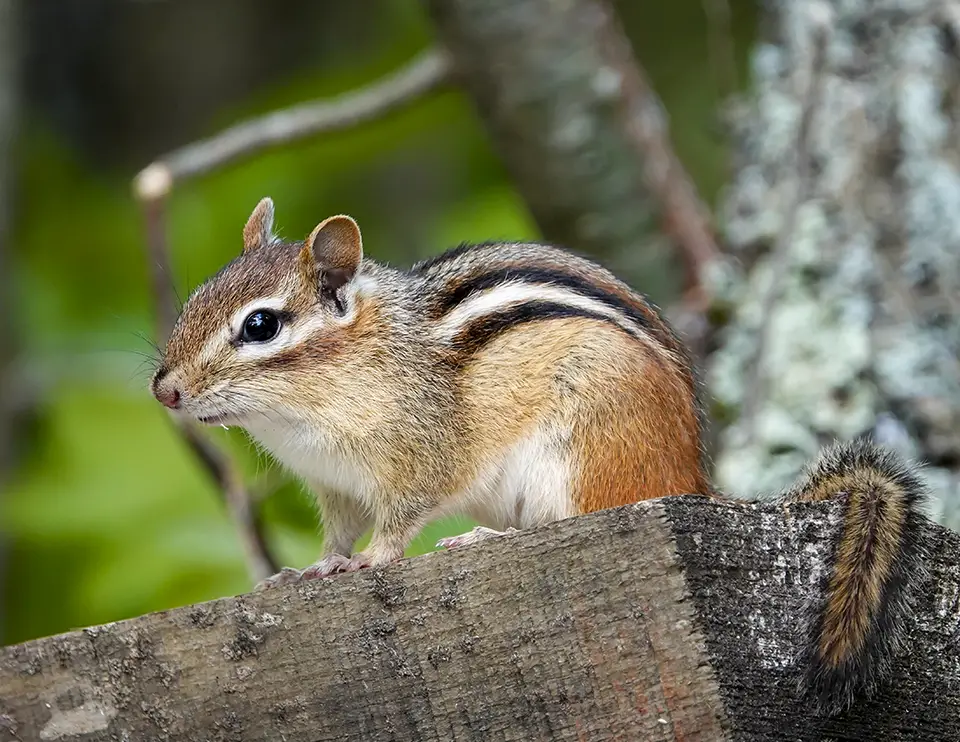
The Eastern Chipmunk is a small, ground-dwelling member of the squirrel family known for its bright reddish-brown fur, contrasting black and white stripes, and expressive cheek pouches. Its colorful appearance and quick, jerky movements make it one of the most recognizable small mammals in wooded environments. The tail is relatively short and lightly furred compared to tree squirrels.
Identification is straightforward thanks to the five dark stripes along its back and the prominent white stripe above and below each eye. Chipmunks have a smaller, more delicate build than tree squirrels, with pointed faces and high-pitched vocalizations used for warning other animals. Their energetic bounding motion sets them apart from the smoother run of ground squirrels.
Adults measure about 8 to 10 inches long and weigh between 2 and 5 ounces. Their behavior includes gathering seeds, nuts, fruits, mushrooms, and insects, which they often store in underground chambers using their expandable cheek pouches. They are solitary animals, defending their burrow systems but occasionally sharing overlapping foraging ranges with neighboring chipmunks.
In Oklahoma, the Eastern Chipmunk has a very limited distribution, occurring mainly in the far northeastern corner of the state where forested hills and rocky slopes dominate. Suitable habitat includes oak–hickory woodlands, brushy ravines, and areas with abundant leaf litter for cover. Outside these localized pockets, chipmunks are rarely encountered.
Groundhog / Woodchuck (Marmota monax)

The Groundhog, or Woodchuck, is one of the largest members of the squirrel family and is known for its stout body, thick brown fur, and powerful digging claws. Its appearance is instantly recognizable: a broad head, short tail, and strong limbs that support its burrowing lifestyle. Unlike tree squirrels, groundhogs display a more robust, marmot-like silhouette.
Identification is aided by the species’ coarse fur, rounded ears, and wide, strong jaw adapted for chewing tough vegetation. Their movements are slow and deliberate, especially when grazing, but they can scurry quickly when threatened. When standing upright to survey surroundings, their stout body and short, flattened tail are clear distinguishing features.
Groundhogs typically measure 16 to 26 inches in length and weigh between 5 and 13 pounds, depending on season and food availability. Their behavior revolves around daily foraging for grasses, leaves, crops, fruits, and bark. They are expert diggers that create extensive burrow systems used for shelter, raising young, and hibernating during winter.
In Oklahoma, Groundhogs are uncommon but present primarily in the northeastern part of the state, especially near the Ozark foothills and along river valleys. They prefer open meadows, pasture edges, fields, and wooded borders where soft soil allows deep burrowing. Sightings become scarce farther west as wooded cover and moisture decline.
Best Time and Places to Observe Squirrels in Oklahoma
Observing squirrels in Oklahoma is easiest during the early morning and late afternoon, when most species are actively foraging. Tree squirrels such as the Eastern Gray Squirrel and Fox Squirrel tend to be most visible shortly after sunrise as they move between branches in search of acorns and seeds. Flying squirrels, being nocturnal, are best observed at night using red-filtered flashlights to avoid disturbing their natural behavior. Ground-dwelling species like the Thirteen-lined Ground Squirrel are most active during warm daylight hours, especially late spring through early fall.
The best places to observe squirrels across Oklahoma vary depending on habitat preferences. For tree squirrels, large city parks, river corridors, and hardwood forests in eastern and central counties offer the highest encounter rates. Flying squirrels occur mostly in old woodland stands in the far eastern region, especially in areas with abundant tree cavities. Ground squirrels and groundhogs are easier to spot in open grasslands, agricultural edges, and prairie preserves in northern and western counties. Observers who walk slowly and remain quiet can often spot individuals sitting upright, feeding, or vocalizing near burrow entrances.
Seasonal conditions also play a significant role in observing these species. Spring and fall provide the most activity for tree squirrels, as they gather food and defend territories. Summer is peak viewing time for ground squirrels, which disappear underground during winter hibernation. Winter observations are still possible for Fox and Eastern Gray Squirrels, but flying squirrels become harder to detect as they stay insulated in communal nests. Patience and repeated visits to suitable habitats usually lead to reliable sightings throughout the year.
FAQs About Squirrels in Oklahoma
Are squirrels active year-round in Oklahoma?
Tree squirrels such as gray and fox squirrels remain active all year, even in winter. Ground squirrels and groundhogs, however, hibernate and are only visible during warmer months.
Which squirrel species are easiest to see in Oklahoma?
Fox Squirrels are the most visible due to their abundance and preference for open park-like areas. Eastern Gray Squirrels are also common in wooded neighborhoods and forests.
Are flying squirrels common in Oklahoma?
Southern Flying Squirrels are present but not commonly seen because they are nocturnal and mostly restricted to eastern hardwood forests with mature tree cavities.
Where can I find ground squirrels in Oklahoma?
Thirteen-lined Ground Squirrels are widely distributed in northern and western portions of the state, especially in prairies, grassy fields, and roadside embankments.
Are groundhogs native to Oklahoma?
Yes. Groundhogs are native but occur mainly in northeastern Oklahoma, where forest edges and river valleys provide suitable soils for burrowing.
Do squirrels pose risks to homes or property?
Tree squirrels may occasionally chew on wooden structures, wiring, or enter attics in search of nesting sites. Groundhogs can cause issues by digging burrows near foundations or gardens.
Are squirrels protected in Oklahoma?
Some species are classified as game animals and can be hunted during regulated seasons, while others, such as flying squirrels, are nongame wildlife and cannot be hunted.
What should I do if I find a baby squirrel?
It is usually best to leave the young squirrel where it was found unless it is clearly injured. The mother is often nearby and will return once the area is quiet.
Can squirrels and chipmunks be attracted with food?
Yes. Bird feeders, sunflower seeds, peanuts, and fruit can attract squirrels, though consistent feeding may encourage them to become overly bold around humans.
Is it possible to see all Oklahoma squirrel species in one region?
No single region contains them all. Tree squirrels dominate the east and center, flying squirrels are limited to the far east, and ground squirrels are more common in the west and north.
Conclusion
Oklahoma hosts a surprisingly diverse group of squirrels, from familiar tree-dwellers to elusive nocturnal gliders and burrow-loving ground species. Each one plays an important role in local ecosystems, whether dispersing seeds, aerating soil, or providing prey for native predators. Observing these animals across forests, prairies, and suburban parks offers a deeper appreciation of the state’s varied habitats and wildlife richness. With the right timing, quiet observation, and an understanding of species-specific behaviors, wildlife enthusiasts can enjoy rewarding encounters with Oklahoma’s many squirrel species throughout the year.