

In homes across California, a familiar scene plays out almost every evening. As the sun sets and ceiling lights flick on, insects begin to appear. Small flies circle overhead. Moths flutter erratically near fixtures. Tiny beetles land on walls close to bulbs. Sometimes the activity is subtle. Other times, it feels constant and impossible to ignore.
Many homeowners assume this is random behavior or a sign of poor cleanliness. Others blame open windows or seasonal changes. But insects gathering around ceiling lights is not accidental, and it has very little to do with how clean a home is.
The real explanation sits at the intersection of insect biology, artificial lighting, California’s climate, modern building design, and subtle environmental cues most people never notice. Ceiling lights are not just sources of illumination. To insects, they act as navigational disruptors, heat beacons, and false moons rolled into one.
Understanding why this happens requires looking at how insects evolved to interact with light, and why California homes create ideal conditions for this ancient instinct to misfire.
Table of Contents
- 1 Insects Did Not Evolve With Artificial Light
- 2 Why Ceiling Lights Are Especially Attractive Indoors
- 3 The Role of Light Spectrum
- 4 Heat Adds Another Layer of Attraction
- 5 Why California Homes See This More Often
- 6 Insects Enter Homes for Reasons Beyond Light
- 7 Why Different Insects React Differently
- 8 Bathrooms and Kitchens See Stronger Effects
- 9 Why Insects Circle Instead of Landing
- 10 Artificial Lighting Disrupts Natural Insect Behavior
- 11 Why Turning Lights Off Sometimes Makes It Worse
- 12 Seasonal Patterns in California Homes
- 13 Why Clean Homes Still Have This Problem
- 14 How Modern Architecture Plays a Role
- 15 Why This Feels Worse at Night
- 16 Are These Insects Dangerous?
- 17 Why Ceiling Fans Change Insect Behavior
- 18 The Psychological Impact of Ceiling Insects
- 19 Light Choice Matters More Than Most People Think
- 20 Why This Is a Long-Term Issue
- 21 What This Behavior Really Tells Us
- 22 FAQs about Why Insects Keep Gathering Around Ceiling Lights in California Homes
- 22.1 Why are insects attracted to ceiling lights in California homes?
- 22.2 Why do insects circle ceiling lights instead of flying away?
- 22.3 Are ceiling lights pulling insects into the house?
- 22.4 Why does this happen more often at night?
- 22.5 Do certain light bulbs attract more insects?
- 22.6 Why are insects more common near bathroom or kitchen ceiling lights?
- 22.7 Does turning off the lights make insects go away?
- 22.8 Are insects near ceiling lights dangerous?
- 23 Final Thoughts
Insects Did Not Evolve With Artificial Light
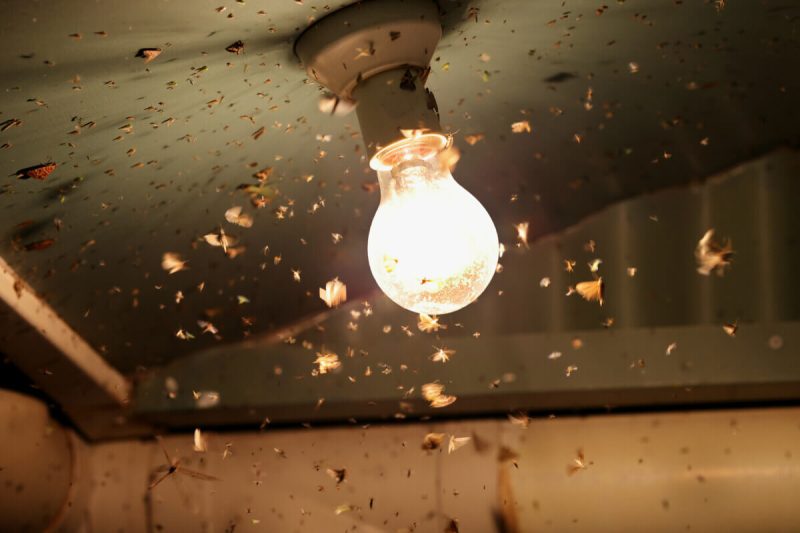
For millions of years, nocturnal insects evolved under one consistent nighttime light source: the moon.
They developed navigation systems that rely on maintaining a constant angle relative to distant light. This method works perfectly when the light source is far away and fixed in the sky.
Artificial lights break that system.
Ceiling lights are close, intense, and stationary. When insects attempt to use them as navigational references, the math fails. Instead of flying in straight lines, they spiral inward, circling endlessly until they collide with the fixture or nearby surfaces.
This is why insects do not simply pass by lights. They become trapped in looping behavior.
Why Ceiling Lights Are Especially Attractive Indoors
Not all lights attract insects equally. Ceiling lights have several traits that make them unusually effective at drawing insects inside homes.
First, ceiling lights are elevated. Many flying insects naturally orient upward when navigating indoor spaces, especially after entering through doors, windows, or vents. The ceiling becomes a visual boundary they follow instinctively.
Second, ceiling lights create a strong contrast against darker surroundings. Insects are drawn to sharp light gradients, not just brightness itself.
Third, ceiling lights often remain on for long periods at night, providing a stable visual target that insects continue to orbit.
Once insects reach the ceiling zone, their escape options become limited, keeping them in view longer.
The Role of Light Spectrum
The color of light matters more than most people realize.
Insects are particularly sensitive to ultraviolet, blue, and violet wavelengths. These wavelengths closely resemble the natural sky light insects evolved to follow.
Many common household bulbs, especially older fluorescent and cool-white LED bulbs, emit light in these attractive ranges. Even bulbs marketed as “white” often contain significant blue-spectrum output.
In California homes, where LED adoption is widespread due to energy regulations, this effect has become more noticeable in recent years.
Warm-toned bulbs emit less blue light and tend to attract fewer insects, though they do not eliminate the effect entirely.
Heat Adds Another Layer of Attraction
Light is not the only factor drawing insects to ceiling fixtures.
Many bulbs produce heat, especially incandescent and halogen types. Even LEDs generate localized warmth near the fixture.
Insects are cold-blooded. They rely on external heat sources to regulate body temperature. A warm ceiling light becomes a microclimate that feels safe and energizing, particularly at night when temperatures drop.
In cooler coastal or high-elevation areas of California, this warmth can be especially appealing.
Heat does not replace light attraction. It amplifies it.
Why California Homes See This More Often
California’s climate plays a significant role in insect-light interactions.
Much of the state experiences mild evenings, long warm seasons, and relatively small temperature drops after sunset. This allows insects to remain active well into the night for much of the year.
In contrast, colder regions see insect activity drop sharply after dark.
California’s extended insect season means ceiling lights become nightly gathering points for months, not weeks.
Additionally, drought conditions in many parts of the state push insects toward human structures in search of moisture, increasing indoor encounters.
Insects Enter Homes for Reasons Beyond Light
Ceiling lights do not pull insects through walls. Insects must already be inside or near entry points.
Common entry routes include open doors and windows, small gaps around frames, attic vents, bathroom exhaust ducts, and poorly sealed utility penetrations.
Once inside, insects move upward, following airflow patterns and light gradients until they reach ceiling fixtures.
Light does not cause infestation. It reveals and concentrates insect presence.
Why Different Insects React Differently
Not all insects swarm lights in the same way.
Moths are the most visible because their navigation relies heavily on celestial light cues. Flies respond more to contrast and movement. Beetles may be drawn by heat and shelter rather than light itself.
Gnats and small midges often gather near lights because those areas intersect with airflow currents and humidity zones near ceilings.
This diversity explains why ceiling light activity varies night to night and season to season.
Bathrooms and Kitchens See Stronger Effects
Ceiling lights in bathrooms and kitchens tend to attract more insects.
These rooms have higher humidity, warmer air, and plumbing access points that insects use to move between spaces. Moisture supports insect survival and increases nighttime activity.
In California homes without strong ventilation, steam and warmth linger near ceilings, creating ideal insect conditions.
The light becomes the final attractor in an already favorable environment.
Why Insects Circle Instead of Landing
Many people wonder why insects do not simply land on the light.
Navigation confusion is the primary reason. Insects attempt to maintain a fixed angle to the light source. Because the light is close, maintaining that angle forces them into curved paths.
Landing requires breaking that navigation loop, which insects struggle to do until exhausted or disrupted.
This is why insects often appear frantic around lights rather than settling calmly.
Artificial Lighting Disrupts Natural Insect Behavior
Artificial lighting does more than attract insects. It alters their daily rhythms.
Prolonged exposure to light at night can interfere with feeding, mating, and predator avoidance. Insects drawn indoors may remain active longer than they should, increasing visibility and annoyance.
In suburban and urban California, light pollution amplifies these effects across entire neighborhoods, not just individual homes.
Ceiling lights are part of a much larger environmental shift.
Why Turning Lights Off Sometimes Makes It Worse
Turning off ceiling lights does not always make insects disappear immediately.
Once insects are inside, they may linger on ceilings or walls, using residual warmth or navigating toward other light sources.
Sudden darkness can also disorient insects further, causing erratic movement before they settle.
Consistent lighting choices matter more than momentary changes.
Seasonal Patterns in California Homes
Insect-light behavior changes with the seasons.
Spring brings new insect populations emerging from dormancy. Summer increases activity and reproduction. Fall drives insects indoors as outdoor conditions shift. Even winter remains active in milder regions.
California’s lack of a true insect off-season means ceiling lights remain relevant year-round.
Understanding this seasonal rhythm helps explain sudden spikes in activity.
Why Clean Homes Still Have This Problem
Cleanliness does not prevent insects from gathering around ceiling lights.
Light attraction is not driven by food debris. It is driven by sensory biology.
Even spotless homes with sealed food and regular cleaning experience insect-light interactions, especially during peak seasons.
This misconception often causes unnecessary frustration.
How Modern Architecture Plays a Role
Modern homes are more airtight but also more complex.
Tighter construction reduces airflow but traps heat and humidity indoors. Recessed ceiling fixtures create cavities where insects can hide and emerge.
Attics warmed by daytime heat release warmth downward at night, drawing insects toward ceilings.
Architecture unintentionally funnels insects upward toward lights.
Why This Feels Worse at Night
Human perception plays a role too.
At night, ceiling lights create high contrast against dark surroundings. Movement near the ceiling becomes highly noticeable.
Quiet nighttime environments amplify awareness of fluttering or buzzing sounds.
The insects were often present earlier. Darkness makes them more obvious.
Are These Insects Dangerous?
Most insects attracted to ceiling lights are harmless.
They do not bite, sting, or transmit disease in typical household encounters. However, their presence can indicate larger environmental patterns, such as open entry points or excessive moisture.
In rare cases, consistent indoor insect activity may signal breeding sources nearby.
Light attraction itself is not a health threat.
Why Ceiling Fans Change Insect Behavior
Ceiling fans disrupt insect gathering in two ways.
They break up warm air layers near the ceiling and interfere with flight stability. Even slow-moving air currents can push insects away from light sources.
This is why fans often reduce visible insect activity without eliminating insects entirely.
Air movement matters more than brightness.
The Psychological Impact of Ceiling Insects
Seeing insects near ceiling lights triggers discomfort because it feels invasive.
Ceilings are perceived as clean, protected spaces. Movement there violates expectation.
This reaction is emotional, not rational, but entirely normal.
Understanding the cause helps reduce stress even before solutions are applied.
Light Choice Matters More Than Most People Think
Switching bulb types can significantly reduce insect attraction.
Warm-spectrum LEDs, amber bulbs, and reduced blue light output minimize insect response. Lower wattage and diffused fixtures reduce contrast.
Light placement also matters. Indirect lighting attracts fewer insects than exposed bulbs.
Small changes can make noticeable differences.
Why This Is a Long-Term Issue
Insects will continue responding to light as long as artificial lighting exists.
This behavior is not new. It has intensified as lighting becomes brighter, more widespread, and more spectrally attractive.
California’s climate ensures insect populations remain active long enough for this interaction to stay visible.
Ceiling lights are simply the most obvious focal point.
What This Behavior Really Tells Us
Insects gathering around ceiling lights is not random chaos.
It is the result of evolutionary instincts colliding with modern environments. Homes replicate the warmth, shelter, and visual cues insects evolved to follow, but in distorted ways.
Ceiling lights become false guides in an artificial night.
FAQs about Why Insects Keep Gathering Around Ceiling Lights in California Homes
Why are insects attracted to ceiling lights in California homes?
Insects are drawn to light wavelengths that disrupt their natural navigation, especially blue and ultraviolet tones common in indoor lighting.
Why do insects circle ceiling lights instead of flying away?
They try to maintain a fixed angle to the light source, which causes looping flight patterns around close, artificial lights.
Are ceiling lights pulling insects into the house?
No. Insects enter through doors, windows, or small gaps, then gather around ceiling lights once inside.
Why does this happen more often at night?
Most insects are nocturnal and become active after dark, when ceiling lights create strong visual contrast.
Do certain light bulbs attract more insects?
Yes. Cool-white LEDs and fluorescent bulbs attract more insects than warm or amber-toned lights.
Why are insects more common near bathroom or kitchen ceiling lights?
These rooms have higher humidity and warmth, which increases insect activity near ceiling fixtures.
Does turning off the lights make insects go away?
Turning lights off may reduce activity, but insects already inside can linger due to warmth or residual light.
Are insects near ceiling lights dangerous?
Most are harmless, though frequent activity may indicate entry points or moisture issues nearby.
Final Thoughts
Insects keep gathering around ceiling lights in California homes because those lights hijack ancient navigation systems designed for moonlit skies. Combined with warmth, humidity, airflow patterns, and year-round insect activity, ceiling fixtures become unavoidable gathering points.
This is not a sign of poor hygiene or unusual infestation. It is a predictable interaction between biology and modern living.
Understanding why it happens turns irritation into insight and helps homeowners make informed adjustments rather than reacting with frustration.
In California’s illuminated nights, ceiling lights tell insects a story they cannot ignore—even when that story leads them straight into our homes.