

Cottonmouths carry one of the strongest reputations of any snake in the eastern United States. In western Kentucky, that reputation often feels larger than the animal itself. Stories circulate about aggressive snakes, sudden encounters, and waterways that feel unsafe simply because cottonmouths might be present.
What most people don’t realize is that much of what is believed about cottonmouths in western Kentucky is shaped by fear, misidentification, and misunderstanding, not by how these snakes actually live or behave.
Cottonmouths do exist in western Kentucky, but not in the way many residents imagine. Their distribution is limited, their behavior is often misread, and their ecological role is quietly important. Understanding the reality behind the myths changes how these snakes are seen and how often real risk actually exists.
Table of Contents
- 1 What a Cottonmouth Really Is
- 2 Western Kentucky Sits at the Edge of Their Range
- 3 Why Cottonmouths Are Often Reported Where They Don’t Exist
- 4 Why Cottonmouth Behavior Is Misunderstood
- 5 The Persistent Myth That Cottonmouths Chase People
- 6 Why Encounters Feel More Intense Near Water
- 7 Venom Reality Versus Reputation
- 8 How Rare Bites Really Are in Western Kentucky
- 9 Seasonal Activity in Western Kentucky
- 10 Where Encounters Actually Happen
- 11 Why Cottonmouths Seem to “Drive People Away”
- 12 The Ecological Role Cottonmouths Play
- 13 Why Killing Cottonmouths Increases Risk
- 14 Climate Change and the Future in Western Kentucky
- 15 What To Do If You Encounter a Cottonmouth
- 16 FAQs About Cottonmouths in Western Kentucky
- 17 Final Thoughts
What a Cottonmouth Really Is
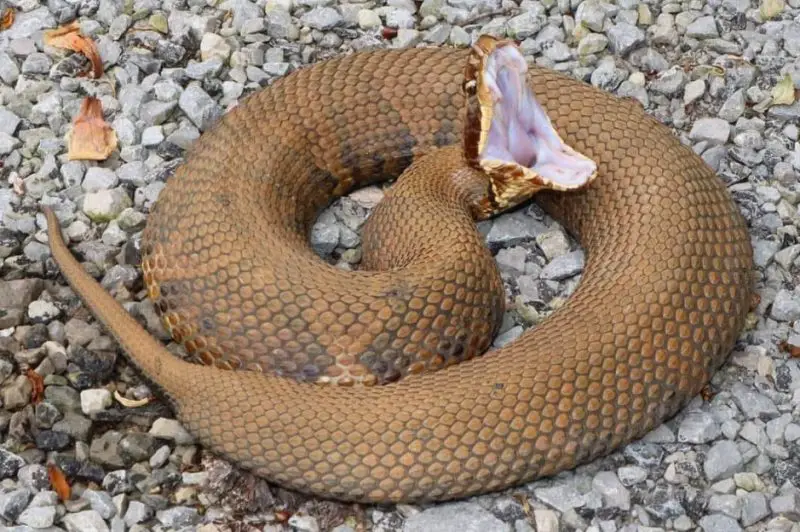
The cottonmouth, also known as the water moccasin, is a venomous pit viper native to the southeastern United States. Its scientific name is Agkistrodon piscivorus, and it belongs to the same genus as copperheads.
This relationship explains several shared traits. Cottonmouths and copperheads have similar body shapes, venom types, and defensive behaviors. Both rely on camouflage, warning displays, and stillness rather than speed or pursuit.
Unlike many snakes that occasionally swim, cottonmouths are semi-aquatic by design. Their thick bodies, muscular build, and natural buoyancy allow them to move comfortably between land and water. They are well adapted to wetlands, slow-moving creeks, and swampy environments where prey is abundant.
The name “cottonmouth” comes from a defensive display. When threatened, the snake may open its mouth wide, revealing a bright white interior. This is not an attack signal. It is a warning meant to stop further approach.
Western Kentucky Sits at the Edge of Their Range
One of the most misunderstood facts about cottonmouths in Kentucky is where they actually exist.
Cottonmouths are not spread evenly across the state. They are not common throughout western Kentucky, and they are completely absent from most of central and eastern regions. In reality, western Kentucky represents the very northern edge of the cottonmouth’s natural range.
Their presence is tightly confined to areas influenced by the Mississippi River system. This includes low-elevation floodplains, backwater wetlands, and slow-moving waterways that retain warmth longer than surrounding landscapes.
Cottonmouths in western Kentucky are most closely associated with:
-
The Mississippi River corridor
-
Oxbow lakes and abandoned river channels
-
Backwater sloughs that warm quickly in summer
-
Cypress swamps and seasonally flooded bottomlands
-
Marshy wetlands with dense aquatic vegetation
Even within these environments, cottonmouth distribution is uneven. Habitat must meet very specific criteria: shallow warm water, stable humidity, reliable prey, and nearby shelter. Much of this habitat has been drained, developed, or altered over the last century.
Because of this, cottonmouths exist in small, localized pockets. Seeing one is possible. Encountering many is not.
Why Cottonmouths Are Often Reported Where They Don’t Exist
A large percentage of cottonmouth sightings in western Kentucky do not involve cottonmouths at all.
Nonvenomous water snakes are far more common and are responsible for the majority of encounters near water. Species such as the northern water snake (Nerodia sipedon) and plain-bellied water snake (Nerodia erythrogaster) thrive throughout the region.
These snakes are frequently seen because they:
-
Swim openly during daylight
-
Bask along shorelines and logs
-
Flatten their heads when threatened
-
Strike repeatedly if cornered
To someone unfamiliar with snake behavior, these traits look aggressive and dangerous. The visual similarity to cottonmouths reinforces fear-based assumptions.
Cottonmouths are often blamed because their reputation fills the identification gap. When uncertainty exists, people default to the name they fear most.
Why Cottonmouth Behavior Is Misunderstood
Cottonmouths behave differently from many snakes, and this difference fuels fear.
When approached, most snakes flee immediately. Cottonmouths often do not. They may remain still, coil slightly, or open their mouth in a defensive display. To humans, this feels confrontational.
In reality, it is risk assessment.
In dense wetlands, sudden movement can expose a snake to predators or push it into deeper danger. Holding position while evaluating escape options is often safer than bolting blindly.
Stillness is not aggression.
It is caution.
Humans interpret lack of retreat as intent. The snake is simply deciding whether movement will reduce risk or increase it.
The Persistent Myth That Cottonmouths Chase People
This myth persists across generations, despite no evidence supporting it.
Cottonmouths do not chase people. They do not pursue humans on land. They do not defend territory against fishermen, hikers, or swimmers.
So where does the belief come from?
It usually begins along narrow banks, trails, or flooded paths where both human and snake are moving toward the same exit. The snake moves toward water. The person retreats in the same direction. The distance closes.
The human feels chased.
The snake is fleeing.
Fear reframes overlapping movement as pursuit.
Why Encounters Feel More Intense Near Water
Water fundamentally changes how people perceive danger.
Balance feels less secure. Escape feels slower. Depth is uncertain. Seeing a venomous snake swimming nearby triggers panic even when the snake is simply crossing between habitats.
In reality, cottonmouths are less likely to bite in water than on land. Swimming requires focus, balance, and energy. The snake is not hunting people and gains nothing from confrontation.
Most documented cottonmouth bites occur when:
-
A snake is handled
-
A snake is stepped on
-
A snake is being killed
Not when someone swims past.
Venom Reality Versus Reputation
Cottonmouth venom is hemotoxic. It damages tissue and blood cells rather than attacking the nervous system.
Bites are painful and medically significant, but modern treatment has changed outcomes dramatically. Fatalities are extremely rare. Permanent damage is uncommon with prompt care.
The snake’s reputation suggests uncontrolled danger. The medical reality is far more predictable.
The real risk comes from delayed treatment, infection, or repeated trauma during attempted killing.
How Rare Bites Really Are in Western Kentucky
Confirmed cottonmouth bites in western Kentucky are rare.
Most reported snakebites involve:
-
Copperheads
-
Nonvenomous snakes
-
Misidentified species
The level of fear does not match documented bite data. Cottonmouths are far more talked about than encountered.
Seasonal Activity in Western Kentucky
Cottonmouths are active from late spring through early fall.
Spring activity increases with basking and mating. Summer is peak feeding season. Fall movement declines as temperatures drop.
During winter, cottonmouths enter brumation in root systems, animal burrows, and underground cavities near water. They do not migrate or roam during cold months.
Winter sightings are uncommon and typically involve disturbed individuals.
Where Encounters Actually Happen
Encounters usually occur in predictable situations:
-
Fishing along swampy or vegetated banks
-
Clearing brush near wetlands
-
Wading through shallow floodplain water
-
Working around drainage ditches or culverts
They are rarely found in neighborhoods unless wetlands are directly adjacent.
Reports of cottonmouths far from water almost always involve misidentified snakes.
Why Cottonmouths Seem to “Drive People Away”
Fear alters behavior long before danger does.
Fishing spots go unused. Trails are avoided. Wetlands gain reputations as places to stay away from.
Ironically, reduced human presence makes rare encounters feel more dramatic when they occur.
Cottonmouths are not driving people away.
Fear is.
The Ecological Role Cottonmouths Play
Cottonmouths are mid-level predators that regulate fish, amphibian, small mammal, and snake populations.
They also serve as prey for raptors and larger predators. Their presence signals functioning wetlands with intact food webs.
Removing them destabilizes ecosystems rather than improving safety.
Why Killing Cottonmouths Increases Risk
A significant number of bites occur during attempted killing.
A cornered or injured snake is far more dangerous than an undisturbed one. Killing attempts turn manageable encounters into emergencies.
Avoidance reduces risk.
Confrontation multiplies it.
Climate Change and the Future in Western Kentucky
Warmer winters may help cottonmouths persist at the northern edge of their range.
However, habitat loss remains the primary limiting factor. Without wetlands, temperature alone does nothing.
Widespread northward expansion is unlikely.
What To Do If You Encounter a Cottonmouth
Encountering a cottonmouth can feel intense, especially near water, but what happens next depends almost entirely on how the situation is handled. These snakes rely on warning and avoidance, not pursuit. Staying calm and deliberate is the safest response.
Stop Moving
The first and most important step is to stop. Sudden movement increases stress for both you and the snake. Cottonmouths react to motion more than presence. Freezing in place allows the snake to assess the situation without feeling pressured. In many cases, the snake will remain still as well, waiting to see if the threat passes.
Stopping also prevents accidental contact. Many bites occur when someone steps closer without realizing how near the snake is.
Create Distance
Once you have stopped and located the snake, slowly increase the space between you and it. Move backward or sideways at a steady pace, keeping your eyes on the snake without staring or making sudden gestures. Distance reduces perceived threat and gives the snake room to choose escape.
Avoid turning your back immediately or running. Rapid retreat can feel unpredictable and increase the chance of stumbling, especially on muddy banks or uneven ground.
Give the Snake an Escape Route
Cottonmouths need a clear path away from perceived danger. If the snake is between you and water or thick cover, step aside rather than blocking its route. Most cottonmouths will retreat toward water or dense vegetation once they feel the pressure has eased.
Blocking escape is one of the most common reasons snakes hold their ground or display defensively. When an exit is obvious, the situation usually resolves itself without incident.
Let the Encounter End Naturally
Most cottonmouth encounters last only seconds once space is restored. The snake either retreats quietly or remains still until the person moves away. There is no need to throw objects, attempt relocation, or force movement.
Respecting space is what ends the encounter. Cottonmouths are not interested in confrontation. They want distance just as much as you do.
Avoid Common Mistakes
Do not attempt to handle or kill the snake. Do not poke it with sticks. Do not try to photograph it at close range. These actions increase stress and dramatically raise bite risk.
Shoes, long pants, and awareness near water reduce the chance of accidental encounters far more effectively than aggressive responses.
Why This Works
Cottonmouths rely on assessment rather than attack. When motion stops, distance increases, and escape is available, the snake’s safest option is to disengage. Most encounters end quietly for this reason.
The snake is not testing you.
It is looking for a way out.
When space is respected, both sides leave unharmed.
FAQs About Cottonmouths in Western Kentucky
Are cottonmouths common in western Kentucky?
No. They are limited to specific wetland habitats near the Mississippi River floodplain and are not widespread.
Do cottonmouths really chase people?
No. This is a myth caused by misinterpreting defensive movement as pursuit.
Are cottonmouths more dangerous than copperheads?
They have stronger venom, but bites are rarer. Both should be treated seriously.
Can cottonmouths live far from water?
They stay close to wetlands and slow-moving water. Sightings far from water are usually misidentifications.
What should I do if I see one while fishing?
Stay calm, back away slowly, and give the snake space to retreat.
Final Thoughts
Cottonmouths in western Kentucky are real, but they are not what most people imagine. They are not aggressive invaders or roaming threats. They are specialized wetland snakes living at the edge of their natural range.
Fear fills the gaps left by limited understanding. Once those gaps are closed, cottonmouth behavior becomes predictable, risk becomes manageable, and coexistence becomes possible.
The snake has not changed.
The story around it has.