

Winter in Kansas transforms the landscape into a season of survival, and for hawks, it becomes a testing ground of instinct, strategy, and adaptation. Food becomes scarcer, temperatures drop, and snow or frozen ground limits easy access to prey. Yet hawks continue to thrive. Their diet in winter changes, expands, and sometimes becomes surprisingly opportunistic.
Many people assume hawks simply continue hunting the same prey year-round, but winter forces adjustments. Prey populations shift, hunting behaviors change, and hawks rely on intelligence as much as power. Some foods become far more important than they are in spring or summer, while others disappear entirely.
This article explores what hawks in Kansas really eat during winter, why their diet changes, how different hawk species adapt, and what this reveals about survival in colder months.
Table of Contents
- 1 Hawks in Kansas Face Real Winter Challenges
- 2 Small Mammals Remain a Winter Staple
- 3 Birds Become Critical Winter Prey
- 4 Rabbits Play a Major Role
- 5 Carrion Becomes a Valuable Resource
- 6 Insects Disappear — But Not Entirely
- 7 Reptiles and Amphibians Are Off the Menu
- 8 Different Hawk Species Eat Differently in Winter
- 9 Winter Hunting Strategies Change
- 10 Weather Directly Influences Diet
- 11 Human Landscapes Shape Winter Diet
- 12 Winter Diet Reflects Survival Intelligence
- 13 FAQs About What Hawks Eat in Winter in Kansas
- 13.1 Do hawks still hunt every day in winter?
- 13.2 Do hawks attack pets in winter?
- 13.3 Do hawks eat birds at backyard feeders?
- 13.4 Why do hawks sit on fence posts in winter?
- 13.5 Do hawks migrate out of Kansas in winter?
- 13.6 Do hawks eat carrion a lot in winter?
- 13.7 What prey disappears from their diet in winter?
- 13.8 What food helps hawks survive harsh winters most?
- 14 Conclusion
Hawks in Kansas Face Real Winter Challenges
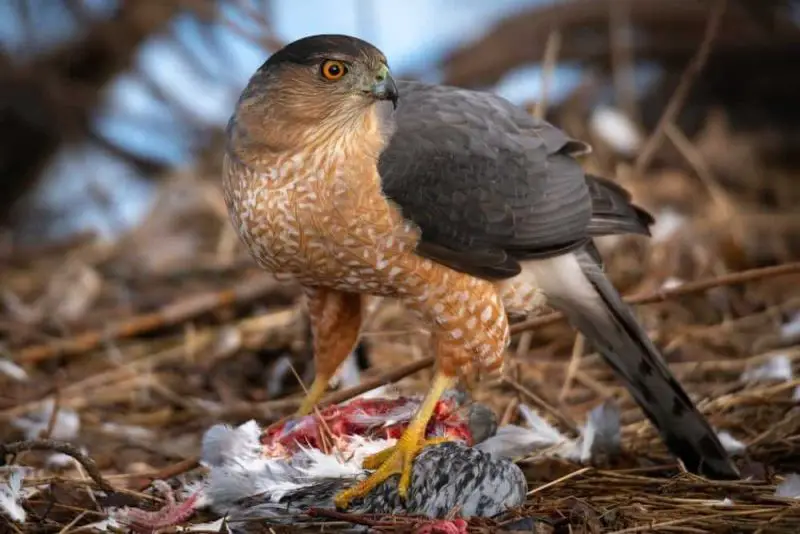
Kansas winters are not just cold; they reshape entire ecosystems. Open fields freeze, small mammals burrow deeper, and many birds migrate south. These conditions force hawks to:
-
Work harder to locate prey
-
Hunt in different habitats
-
Expand dietary choices
-
Conserve energy while remaining effective predators
Winter is not only about strength. It is about efficiency.
Small Mammals Remain a Winter Staple
Despite the weather, small mammals remain the backbone of a hawk’s winter diet in Kansas. Many species do not hibernate, meaning hawks can still rely on them.
Voles and Mice Are Top Targets
Even under snow, voles create tunnels and leave surface signs. Hawks detect movement or sound, then strike with precision. Mice remain active around barns, fields, grasslands, and rural properties, making them highly accessible.
Rats Become More Important
Winter pushes rats closer to human structures for warmth and food. Hawks take advantage, frequently hunting around farms, grain storage areas, and abandoned buildings.
Ground Squirrels and Other Rodents
Where available, ground squirrels also remain on the menu, though less frequently than voles or mice. Rodent populations help sustain hawks through the harshest months.
Small mammals provide:
-
Reliable availability
-
High energy
-
More predictable locations
That reliability keeps hawks alive.
Birds Become Critical Winter Prey
In winter, many mammals burrow deeper or become harder to find. Birds remain above ground — and hawks take notice.
Songbirds Become Winter Targets
Smaller birds gather at feeders, shrubs, hedgerows, and farmsteads. Hawks learn to patrol these areas, not because they recognize feeders, but because they recognize concentrated prey sources.
Common winter songbird prey includes:
-
Sparrows
-
Starlings
-
Blackbirds
-
Finches
Larger Birds Are Also Hunted
Red-tailed Hawks and Ferruginous Hawks occasionally take pigeons and medium-sized birds when opportunities arise.
Winter forces hawks to be flexible, and birds often fill the nutritional gap.
Rabbits Play a Major Role
Rabbits remain one of the most nutritious winter meals for hawks in Kansas. They do not migrate, and they remain active dawn and dusk — perfect hunting windows.
Snow exposes rabbit trails. Bare winter landscapes reduce hiding cover, making detection easier. When a hawk captures a rabbit, the meal provides enough energy to sustain it much longer than a mouse would.
However, rabbits are harder to catch. Winter ice, snow, and reduced daylight force hawks to be strategic and patient hunters.
Carrion Becomes a Valuable Resource
Winter turns hawks from strictly hunters into opportunists.
Frozen ground, harsh winds, ice-storm conditions, and reduced prey activity lead hawks to scavenge more frequently. Carrion is energy without the risk of failed hunting attempts.
They may feed on:
-
Road-killed animals
-
Frozen carcasses in fields
-
Dead livestock remains on farms
Harsh winters produce more animal fatalities — and hawks take advantage rather than waste energy hunting constantly.
Insects Disappear — But Not Entirely
Winter kills off most insect populations, removing one common summer food source. However, not every insect vanishes.
Hawks occasionally feed on:
-
Winter-active beetles
-
Remaining grasshoppers in milder years
-
Dormant insects found under leaves or exposed soil
While insects are not a major winter diet component, they become opportunistic supplements when found.
Reptiles and Amphibians Are Off the Menu
Unlike warmer months, reptiles and amphibians are almost nonexistent in winter. They enter brumation underground, beneath logs, or underwater.
This eliminates a once-available food group entirely.
For hawks, winter hunting becomes a game of mammals, birds, and opportunity.
Different Hawk Species Eat Differently in Winter
Not all hawks approach winter the same way. Kansas is home to several species in colder months, each adapting diet to its strengths.
Red-Tailed Hawks
The most common winter hawk in Kansas, red-tails rely heavily on:
-
Voles
-
Mice
-
Rabbits
-
Medium-sized birds
They perch-hunt frequently, saving energy while scanning the landscape.
Rough-Legged Hawks
These Arctic visitors migrate into Kansas only in winter. They are specialists at detecting rodents under snow and thrive on:
-
Voles
-
Lemmings-like mammals
-
Field rodents
Their feathered legs protect them from cold, allowing long winter exposure.
Northern Harriers
These hawks hunt low, gliding over open fields. Winter prey includes:
-
Rodents
-
Small birds
-
Occasionally young rabbits
Their hunting flight style allows them to cover wide ground efficiently.
Ferruginous Hawks
Where grasslands remain open, Ferruginous Hawks continue hunting:
-
Ground squirrels
-
Rabbits
-
Prairie rodents
They are powerful winter hunters in western Kansas.
Winter Hunting Strategies Change
Diet and hunting style are deeply connected. Winter forces hawks to adjust how they hunt to match changing prey.
Perch-and-Wait Becomes Common
Winter burns calories fast. Instead of endless flying, many hawks:
-
Sit on fence posts
-
Use tree edges
-
Watch from utility poles
They conserve energy while waiting for movement.
Low-Glide Hunting
Harriers and some others hunt by skimming low over fields, listening and watching for movement beneath snow or grass.
Ambush Around Human Activity
Where humans concentrate food (barns, feedlots, bird feeders), prey gathers. Hawks learn patterns — not because of human awareness but because of ecological logic.
Winter rewards patience, positioning, and intelligence.
Weather Directly Influences Diet
Kansas winter weather affects what hawks can eat and how easily they can get it.
Snow Cover Makes Hunting Harder — and Easier
Snow hides some prey but also reveals movement paths. Pure ice is the worst condition because scent and movement signals are reduced.
Strong Winds Change Flight Patterns
High winds give hawks soaring advantages but can reduce hunting precision.
Extreme Cold Forces Riskier Hunts
In severe cold snaps, hawks take bigger chances, attempt larger prey, or scavenge more frequently simply for survival.
Winter is unpredictable — and hawks must constantly adapt.
Human Landscapes Shape Winter Diet
Winter pushes wildlife toward human resources, and hawks follow.
They hunt:
-
Around barns and livestock areas
-
Along highways near roadkill
-
Around suburban neighborhoods with bird feeders
Human infrastructure unintentionally creates winter hunting zones.
Winter Diet Reflects Survival Intelligence
What hawks eat in winter in Kansas is not simply instinct. It’s problem-solving.
Their diet proves:
-
They adapt quickly
-
They recognize opportunity
-
They conserve energy wisely
-
They shift behavior based on conditions
Winter reveals the mental capability of hawks as much as their physical strength.
FAQs About What Hawks Eat in Winter in Kansas
Do hawks still hunt every day in winter?
Yes, but winter forces them to hunt more strategically. They conserve energy and rely on high-value prey.
Do hawks attack pets in winter?
It is extremely rare. Hawks prefer wild prey and usually only target pets if other food is unavailable.
Do hawks eat birds at backyard feeders?
Yes. Winter feeders attract prey, and hawks may occasionally target smaller birds.
Why do hawks sit on fence posts in winter?
It saves energy while they scan for movement, making perch-hunting more efficient.
Do hawks migrate out of Kansas in winter?
Some leave, but others remain, and some northern hawks migrate into Kansas specifically for winter.
Do hawks eat carrion a lot in winter?
More than in summer, yes. Winter creates opportunities, and scavenging conserves energy.
What prey disappears from their diet in winter?
Snakes, lizards, frogs, insects (mostly), and many migratory birds.
What food helps hawks survive harsh winters most?
Rodents and rabbits remain the most critical energy sources.
Conclusion
Hawks in winter in Kansas are not simply survivors; they are adaptive specialists. Their winter diet shifts to rodents, birds, rabbits, and occasionally carrion. They remain patient, efficient hunters, adjusting behavior to match wind, snow, prey movement, and changing habitats.
What they eat in winter reflects intelligence, flexibility, and incredible biological resilience. While winter challenges nearly every species in Kansas, hawks continue to glide through the cold season with strategy and precision, proving that survival is as much about adaptation as strength.
If you ever see a hawk perched on a Kansas fence post against a winter sky, you are watching a predator completely tuned to the realities of the season — not just enduring winter, but mastering it.