
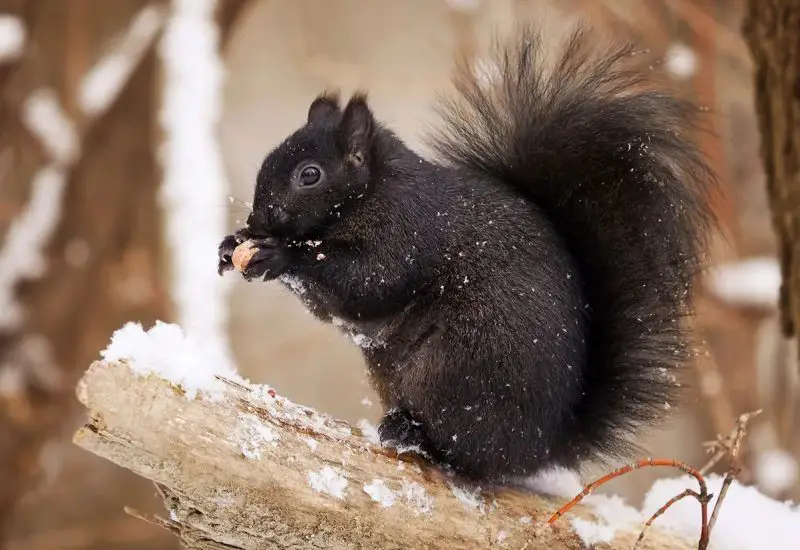
In Connecticut, black squirrels are not rare visitors from the forest. They are part of daily life. They cross roads, dart across college campuses, disappear into backyard trees, and reappear months later when snow still blankets the ground.
What many people never notice is how much planning is happening behind those quick movements. Long before winter arrives, black squirrels in Connecticut are already preparing. Not instinctively. Intelligently.
Their survival through cold New England winters depends less on strength or speed and more on memory, decision making, and behavioral flexibility. The way they store food is not random. It is one of the most sophisticated survival strategies among small mammals in the region.
Table of Contents
- 1 Why Black Squirrels Are So Common in Connecticut
- 2 Winter Is the Real Challenge in Connecticut
- 3 Black Squirrels Do Not Store Food Randomly
- 4 Memory Is Their Most Powerful Tool
- 5 Why Black Squirrels Fake Bury Food
- 6 They Choose Storage Locations Carefully
- 7 Timing Matters More Than Quantity
- 8 Not All Food Is Treated Equally
- 9 How They Find Food Under Snow
- 10 Why They Forget Some Caches on Purpose
- 11 Intelligence Helps Them Adapt to Human Areas
- 12 Black Squirrels Learn From Experience
- 13 Winter Survival Is Not Just About Food
- 14 Why Some Squirrels Survive While Others Do Not
- 15 What People Mistake for Luck Is Planning
- 16 Why This Matters for Connecticut Ecosystems
- 17 Living With Black Squirrels in Connecticut
- 18 FAQs About Black Squirrels in Connecticut
- 18.1 Are black squirrels a separate species?
- 18.2 Why are black squirrels so common in Connecticut?
- 18.3 Do black squirrels store more food than gray squirrels?
- 18.4 How do black squirrels remember where food is buried?
- 18.5 Can black squirrels smell buried food under snow?
- 18.6 Why do black squirrels pretend to bury food?
- 18.7 Do black squirrels forget their food caches?
- 18.8 Are black squirrels more intelligent than gray squirrels?
- 18.9 Do black squirrels survive winter better than gray squirrels?
- 18.10 Why do black squirrels appear active even in winter?
- 18.11 Are black squirrels a problem for Connecticut ecosystems?
- 18.12 Should people feed black squirrels during winter?
- 19 Final Thoughts
Why Black Squirrels Are So Common in Connecticut
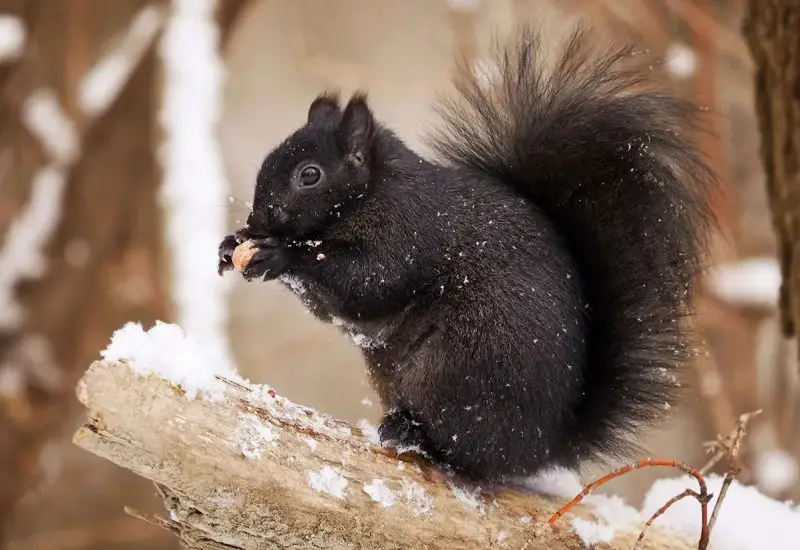
Black squirrels are not a separate species. They are a melanistic color variation of the eastern gray squirrel. In Connecticut, this darker form has become especially noticeable and widespread compared to many other states.
The darker fur provides several subtle but meaningful advantages in a New England climate. Black fur absorbs and retains more solar heat during cold months, allowing squirrels to warm their bodies more efficiently during winter days. This thermal advantage becomes critical during prolonged cold spells when conserving energy determines survival.
Camouflage also plays a role. In winter forests filled with dark tree trunks, wet leaf litter, and long shadows, black squirrels blend in more effectively than lighter gray individuals. This can reduce detection by aerial predators such as hawks and owls.
There is also evidence that darker squirrels may appear larger or more dominant to predators and competitors. Over many generations, these small advantages added up. In colder regions like southern New England, black squirrels gained a survival edge, allowing their numbers to grow and remain stable across Connecticut.
Winter Is the Real Challenge in Connecticut
Connecticut winters are unpredictable and often harsh for small mammals. Snow cover can persist for weeks. Freezing rain can seal the ground beneath a hard layer of ice. Sudden warm spells may thaw food access briefly, only to refreeze overnight.
For squirrels, these conditions make fresh food unreliable. Nuts fall during a limited window in autumn. Plants enter dormancy. Insects disappear almost entirely. Once winter fully sets in, foraging opportunities shrink dramatically.
Survival depends almost entirely on what was stored earlier in the year. A squirrel that fails to prepare properly has little chance of making it through a long Connecticut winter.
This is where intelligence, not just instinct, becomes the deciding factor.
Black Squirrels Do Not Store Food Randomly
A common misconception is that squirrels bury food at random and rely on luck to find it later. Black squirrels in Connecticut demonstrate the opposite.
They use a strategy known as scatter hoarding. Instead of placing all food in a single cache, they distribute hundreds or even thousands of individual storage sites across their territory. Each cache contains only one or a few food items.
This approach dramatically reduces risk. If another animal discovers one cache, the loss is limited. Most stored food remains untouched elsewhere.
Equally important is memory. Black squirrels do not depend on chance. They remember the locations of many caches and revisit them strategically throughout winter.
Memory Is Their Most Powerful Tool
Black squirrels rely heavily on spatial memory rather than scent alone. While smell may help at close range, it is unreliable under snow, ice, and frozen ground.
Research shows that squirrels memorize food locations using visual landmarks. Tree shapes, fallen logs, stone walls, fence lines, and shadows all become reference points. In Connecticut neighborhoods, human features also serve as landmarks. Sidewalk corners, porch steps, garden edges, and retaining walls become part of their mental maps.
When snow covers the ground, these mental maps guide retrieval. A squirrel that cannot remember where food is hidden is unlikely to survive the season.
Why Black Squirrels Fake Bury Food
One of the most remarkable behaviors observed in Connecticut black squirrels is deceptive caching.
When a squirrel senses it is being watched by another squirrel, bird, or potential thief, it may perform a fake burial. The squirrel digs a hole, mimics placing food inside, carefully covers it, and leaves. No food is actually stored there.
The real cache is placed elsewhere, out of sight.
This behavior demonstrates awareness of observation and intent. It is not a reflex. It is a calculated strategy. In winter survival terms, deception protects future meals and reduces theft.
They Choose Storage Locations Carefully
Black squirrels do not bury food indiscriminately. Location choice is deliberate.
They favor loose soil that will not freeze solid too quickly. Areas near tree roots retain warmth and allow easier digging later. Sites with leaf litter provide insulation. Slightly elevated spots reduce the risk of flooding during winter thaws.
In Connecticut, squirrels often choose south-facing slopes, stone wall edges, forest margins, and sheltered backyard areas. These microhabitats increase the likelihood that food remains accessible months later.
Good location selection often matters more than the amount of food stored.
Timing Matters More Than Quantity
Black squirrels begin caching long before winter arrives. In Connecticut, this behavior starts in late summer and intensifies throughout autumn as nut production peaks.
They do not collect everything at once. Caching behavior changes based on food abundance, competition, and weather conditions. A warm autumn allows extended preparation. An early cold snap increases urgency.
This ability to adjust timing shows flexibility and learning rather than rigid instinct.
Not All Food Is Treated Equally
Black squirrels show clear preferences when deciding what to eat immediately versus what to store.
White oak acorns spoil quickly due to lower tannin levels, so squirrels often consume them soon after finding them. Red oak acorns last longer and are more commonly buried for winter use.
Walnuts and hickory nuts, which are high in fat and calories, are prioritized for long-term storage. These choices reflect nutritional awareness and future planning.
Food value influences storage decisions.
How They Find Food Under Snow
Once winter arrives, black squirrels shift from active foraging to cache retrieval.
They rely on memory first. If memory fails, they may use scent at close range. Snow depth changes movement patterns. Squirrels follow packed routes, revisit known cache zones, and reduce unnecessary exploration.
Even when snow obscures landmarks, squirrels orient themselves using tree spacing, slope direction, and terrain features they memorized earlier.
Why They Forget Some Caches on Purpose
Not all forgotten food represents failure. Black squirrels intentionally overstore.
Some caches act as backups. Others serve as insurance against theft. Losing a portion of stored food is expected and planned for.
Forgotten caches also benefit Connecticut forests. Buried nuts that are never retrieved may germinate and grow into new trees. In this way, squirrels contribute directly to forest regeneration.
Intelligence Helps Them Adapt to Human Areas
In suburban Connecticut, black squirrels adapt their behavior around people.
They avoid high-traffic zones during peak hours. They learn human schedules. They identify which yards are safe and which pose risks.
Some squirrels adjust caching behavior near bird feeders, recognizing that food sources will reappear. This reflects problem solving and behavioral flexibility rather than instinct alone.
Black Squirrels Learn From Experience
Young squirrels are inexperienced. They lose food, choose poor locations, and fall victim to theft.
Over time, experience improves efficiency. Older squirrels cache more strategically, retrieve more accurately, and use deception more effectively.
This learning curve indicates experience-based intelligence, not automatic behavior.
Winter Survival Is Not Just About Food
Food storage supports survival, but intelligence governs how energy is used.
Black squirrels adjust nesting behavior in winter. They choose insulated tree cavities or build thicker dreys. They limit movement during extreme cold and remain inactive during storms.
Every decision balances risk, reward, and energy expenditure.
Why Some Squirrels Survive While Others Do Not
Winter mortality among squirrels is real. Not all survive.
Those with better memory, better cache placement, and smarter decision-making survive at higher rates. In Connecticut, where winter conditions fluctuate dramatically, intelligence often determines survival more than strength.
What People Mistake for Luck Is Planning
When residents see black squirrels active and healthy in late winter, it may look effortless.
In reality, those squirrels planned months earlier. Every buried nut was a calculation. Every location was chosen. Every fake cache protected a real one.
What looks like luck is preparation.
Why This Matters for Connecticut Ecosystems
Black squirrels are not just survivors. They shape their environment.
Their caching spreads tree species. Their forgotten food supports forest growth. Their behavior stabilizes squirrel populations.
They play a quiet but important role in Connecticut’s winter ecology.
Living With Black Squirrels in Connecticut
Understanding their intelligence changes perception.
Black squirrels are not pests hoarding food. They are planners responding to a harsh season. Respecting their space, allowing natural food sources, and avoiding unnecessary interference helps maintain balance.
In Connecticut, their intelligence is part of what makes winter ecosystems work.
FAQs About Black Squirrels in Connecticut
Are black squirrels a separate species?
No. Black squirrels are a color variation of the eastern gray squirrel. They are genetically the same species, with darker fur caused by melanism.
Why are black squirrels so common in Connecticut?
Connecticut’s colder winters favor darker fur that absorbs heat more efficiently. Over time, this advantage helped black squirrels thrive in southern New England.
Do black squirrels store more food than gray squirrels?
They use the same caching strategies, but black squirrels in colder regions often rely more heavily on food storage to survive long winters.
How do black squirrels remember where food is buried?
They rely primarily on spatial memory. Squirrels remember landmarks such as trees, stone walls, and human structures rather than scent alone.
Can black squirrels smell buried food under snow?
Scent may help at close range, but memory is far more important, especially when snow and ice limit odor detection.
Why do black squirrels pretend to bury food?
Fake caching helps protect real food stores. When watched by other animals, squirrels may use deception to reduce theft.
Do black squirrels forget their food caches?
Some caches are forgotten intentionally. Over-storing food provides backup, and lost caches also contribute to forest regeneration.
Are black squirrels more intelligent than gray squirrels?
They are not smarter as a species, but squirrels living in harsher climates often develop stronger problem-solving skills through experience.
Do black squirrels survive winter better than gray squirrels?
The darker fur provides a small advantage in cold climates, but survival depends more on memory, food storage, and decision making.
Why do black squirrels appear active even in winter?
They retrieve stored food rather than foraging randomly. Activity does not mean food is abundant, only that preparation was successful.
Are black squirrels a problem for Connecticut ecosystems?
No. They play a positive role by dispersing seeds and supporting forest regeneration through forgotten food caches.
Should people feed black squirrels during winter?
Feeding is not necessary and can disrupt natural behavior. Squirrels that prepare properly are capable of surviving winter on their own.
Final Thoughts
Black squirrels in Connecticut survive winter not through brute force, but through intelligence.
They plan ahead. They remember. They adapt. They deceive when needed. They learn from experience.
Long before the first snow falls, their work is already done.
Winter simply tests what they prepared.