

In the forests, grasslands, and suburban backyards of North Carolina, tiny parasites quietly thrive in the undergrowth. They are easy to overlook because of their size, yet they play a surprisingly large role in the region’s public health and ecology. Among the many tick species found in the state, one of the most important is the deer tick.
Many people hear the term “deer tick” and immediately associate it with Lyme disease, but the story behind these tiny arachnids is far more complex. Deer ticks are part of a larger ecological network involving wildlife, vegetation, climate, and human activity. Their life cycle spans multiple hosts, and their populations are shaped by subtle changes in habitat and animal populations.
In North Carolina, deer ticks are present but behave somewhat differently than they do in the northeastern United States, where Lyme disease is more widespread. The state’s climate, biodiversity, and landscapes influence how ticks interact with both wildlife and humans.
Despite their importance, most residents know very little about how deer ticks actually live. Many assume they drop from trees or only appear in deep forests. Others underestimate how small they are or how easily they can go unnoticed after attaching to a host.
Understanding deer ticks requires looking closely at their biology and behavior. These tiny creatures follow a multi-stage life cycle, depend on a wide variety of animals for survival, and have evolved remarkable strategies for finding hosts.
For North Carolina residents who enjoy hiking, gardening, hunting, or simply spending time outdoors, learning about deer ticks can help reduce risks while also revealing a fascinating example of how even the smallest organisms play roles in local ecosystems.
And once people begin to understand how deer ticks function within nature, they often realize that these nearly invisible creatures are part of a much larger environmental story unfolding across the forests and fields of the Southeast.
Table of Contents
- 1 Deer Ticks Are Actually a Type of Arachnid
- 2 Deer Ticks Do Not Actually Jump or Fly
- 3 The Life Cycle of a Deer Tick Takes Two Years
- 4 White-Tailed Deer Play an Important Role in Tick Populations
- 5 North Carolina Has Lower Lyme Disease Rates Than the Northeast
- 6 Ticks Have Remarkable Survival Adaptations
- 7 Changing Landscapes Are Influencing Tick Populations
- 8 Prevention and Awareness Are Key to Reducing Tick Bites
- 9 FAQs About Deer Ticks in North Carolina
- 9.1 Are deer ticks common in North Carolina?
- 9.2 Can deer ticks transmit Lyme disease in North Carolina?
- 9.3 How small are deer ticks?
- 9.4 Do ticks fall from trees?
- 9.5 When are ticks most active?
- 9.6 How long does it take for a tick to transmit Lyme disease?
- 9.7 What animals carry deer ticks?
- 9.8 What should you do if you find a tick attached?
- 10 Final Thoughts
Deer Ticks Are Actually a Type of Arachnid
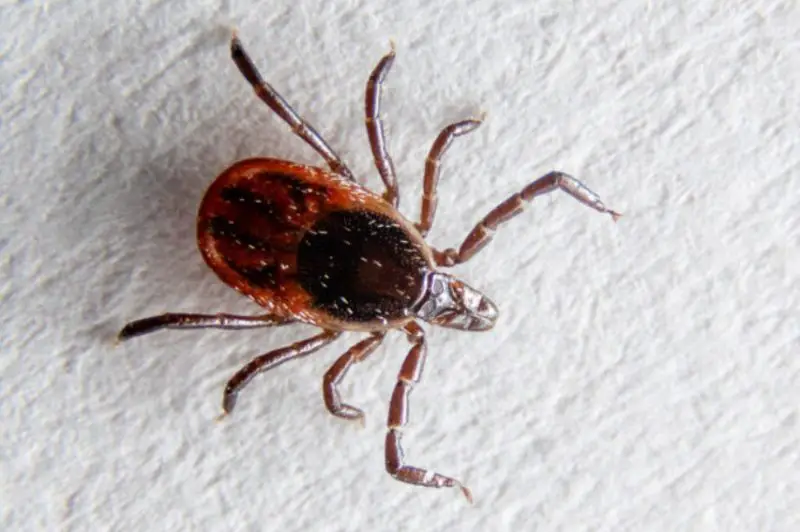
Although they are often grouped with insects in casual conversation, deer ticks are not insects at all. They belong to the class Arachnida, the same group that includes spiders, scorpions, and mites.
Like other arachnids, ticks have eight legs as adults rather than six like insects. Their bodies are also structured differently, consisting of a single fused segment rather than the three-part body typical of insects.
The species commonly referred to as the deer tick is scientifically known as Ixodes scapularis, often called the blacklegged tick. This species is responsible for transmitting Lyme disease in parts of the United States.
Adult deer ticks are extremely small. A fully grown female tick is only about the size of a sesame seed before feeding. After feeding on blood, however, her body may swell dramatically, sometimes reaching the size of a small grape.
Male ticks are usually smaller and feed less frequently.
Their tiny size is one reason deer ticks are difficult to detect. Many people never notice them until they have already attached and begun feeding.
Because they are so small, deer ticks can hide in places such as behind the knees, along the hairline, under the arms, or around the waistline where clothing meets skin.
Understanding how small these ticks truly are helps explain why they can be so easily overlooked.
Deer Ticks Do Not Actually Jump or Fly
One of the most common myths about ticks is that they jump or fall from trees onto people and animals.
In reality, deer ticks do neither.
Instead, ticks use a behavior known as questing to find hosts.
Questing involves climbing onto vegetation such as grass blades, shrubs, or low branches and extending their front legs outward. When a passing animal brushes against the plant, the tick quickly grabs onto the host.
Because of this behavior, ticks are usually found in areas where animals frequently travel, such as along trails, forest edges, and tall grass.
They tend to remain relatively low to the ground rather than climbing high into trees.
Deer ticks are also extremely patient. A tick may wait for hours or even days on a blade of grass before encountering a suitable host.
During this time, it senses body heat, carbon dioxide, and movement produced by nearby animals.
These cues help the tick detect when a host is approaching.
Once contact occurs, the tick crawls across the host’s body until it finds a suitable place to attach.
This process can take several minutes or longer, which means quick tick checks after outdoor activities can often prevent bites.
The Life Cycle of a Deer Tick Takes Two Years
The life cycle of the deer tick is surprisingly complex and usually spans about two years.
Ticks develop through four stages: egg, larva, nymph, and adult.
In spring, adult female ticks lay thousands of eggs in leaf litter on the forest floor.
When the eggs hatch, tiny six-legged larvae emerge. These larvae are extremely small, often no larger than a grain of sand.
Larval ticks must find a host to obtain their first blood meal. Small mammals such as mice, birds, and other wildlife commonly serve as hosts.
After feeding, the larvae drop back into the environment and molt into the next stage.
During the following year, the tick enters the nymph stage.
Nymphs are slightly larger and have eight legs like adult ticks. This stage is particularly important from a public health perspective because nymphs are capable of transmitting diseases and are difficult to detect.
After feeding again, the tick molts into an adult.
Adult ticks often seek larger hosts such as deer, raccoons, or humans.
Once the adult female feeds and mates, she lays eggs and the cycle begins again.
White-Tailed Deer Play an Important Role in Tick Populations
Despite their name, deer ticks do not rely exclusively on deer for survival. However, white-tailed deer play an important role in supporting tick populations.
Adult ticks often feed on deer because these animals provide large amounts of blood and travel widely across landscapes.
When deer move through forests and fields, they can carry ticks with them to new areas.
This helps ticks spread across habitats.
However, deer are not the primary source of Lyme disease bacteria. That role is often played by smaller animals such as white-footed mice.
These mice frequently host larval and nymphal ticks and can carry the bacteria responsible for Lyme disease.
When ticks feed on infected mice, they may acquire the bacteria and later transmit it to other hosts.
This complex interaction between ticks, mice, deer, and other wildlife forms the foundation of the Lyme disease cycle.
Understanding these relationships helps scientists predict where disease risks may increase.
North Carolina Has Lower Lyme Disease Rates Than the Northeast
Although deer ticks exist in North Carolina, the state generally experiences lower rates of Lyme disease compared to northeastern states such as Pennsylvania, Connecticut, and New York.
Researchers believe several factors contribute to this difference.
One key factor involves tick behavior.
In parts of the Northeast, nymphal ticks often feed on humans more frequently. In the southeastern United States, however, nymphs appear more likely to feed on reptiles and other animals instead.
This reduces the chances of disease transmission to humans.
Climate and habitat differences also influence tick populations.
North Carolina’s warmer temperatures and diverse wildlife communities may alter how ticks interact with hosts.
Despite the lower risk compared to northern states, deer ticks are still present and capable of transmitting disease.
For this reason, awareness and preventive measures remain important.
Ticks Have Remarkable Survival Adaptations
Although they are small and vulnerable, deer ticks possess impressive adaptations that allow them to survive in challenging environments.
One of their most remarkable abilities is their capacity to withstand long periods without feeding.
A tick may survive months or even more than a year without a blood meal.
This endurance allows ticks to wait patiently until a suitable host appears.
Ticks also have specialized mouthparts designed for feeding.
When attaching to a host, the tick inserts a structure called a hypostome into the skin. This barbed structure anchors the tick firmly while it feeds.
The tick also secretes saliva that helps prevent the host’s blood from clotting.
This process allows the tick to feed slowly over several days.
Because the feeding process takes time, removing ticks promptly can significantly reduce the risk of disease transmission.
Changing Landscapes Are Influencing Tick Populations
Over the past several decades, land use patterns across North Carolina have changed significantly.
Suburban development, forest fragmentation, and expanding wildlife populations have all influenced tick habitats.
As forests are divided by housing developments and roads, wildlife species such as deer and mice may become more concentrated in smaller areas.
This concentration can increase interactions between ticks, animals, and humans.
Climate change may also influence tick activity.
Warmer temperatures can extend the seasons during which ticks remain active.
In some areas, milder winters allow more ticks to survive into the following year.
These environmental shifts mean that tick populations and disease risks may continue evolving in the future.
Researchers continue studying how climate and landscape changes affect tick ecology across the southeastern United States.
Prevention and Awareness Are Key to Reducing Tick Bites
For people living in or visiting tick habitats, awareness remains one of the most effective tools for prevention.
Wearing long sleeves and pants while hiking in wooded areas can help reduce skin exposure.
Using insect repellents approved for tick prevention can also provide protection.
After spending time outdoors, performing a thorough tick check is important.
Checking areas such as the scalp, behind the ears, under the arms, and around the waistline helps ensure ticks are removed quickly.
Showering soon after returning indoors may also help wash away ticks that have not yet attached.
Pets should also be checked regularly because they can carry ticks into homes.
These simple habits significantly reduce the chances of tick bites.
FAQs About Deer Ticks in North Carolina
Are deer ticks common in North Carolina?
Yes. Deer ticks are present in the state, although they are generally less abundant than in northeastern regions.
Can deer ticks transmit Lyme disease in North Carolina?
Yes, but Lyme disease occurs less frequently than in northern states.
How small are deer ticks?
Adult deer ticks are about the size of a sesame seed, while nymphs can be as small as a poppy seed.
Do ticks fall from trees?
No. Deer ticks typically wait on low vegetation and attach when animals brush against them.
When are ticks most active?
Ticks can be active during much of the year but are often most noticeable in spring and early summer.
How long does it take for a tick to transmit Lyme disease?
Transmission usually requires the tick to remain attached for many hours, often more than 24.
What animals carry deer ticks?
Ticks feed on many animals including mice, birds, deer, raccoons, and humans.
What should you do if you find a tick attached?
Remove it carefully with fine-tipped tweezers and clean the bite area with antiseptic.
Final Thoughts
Deer ticks may be tiny creatures, but their presence reflects a complex web of ecological relationships involving wildlife, landscapes, and climate.
In North Carolina, these ticks occupy forests, fields, and suburban environments where humans and wildlife often intersect.
Understanding how deer ticks live, feed, and interact with animals provides valuable insight into both environmental health and public safety.
Although they can pose risks, awareness and simple preventive habits allow people to enjoy the outdoors while minimizing those risks.
At the same time, deer ticks remind us that even the smallest organisms play roles in the natural systems surrounding us.
Sometimes the most important wildlife stories unfold not in large animals roaming forests, but in tiny creatures quietly waiting on a blade of grass beneath our feet.