
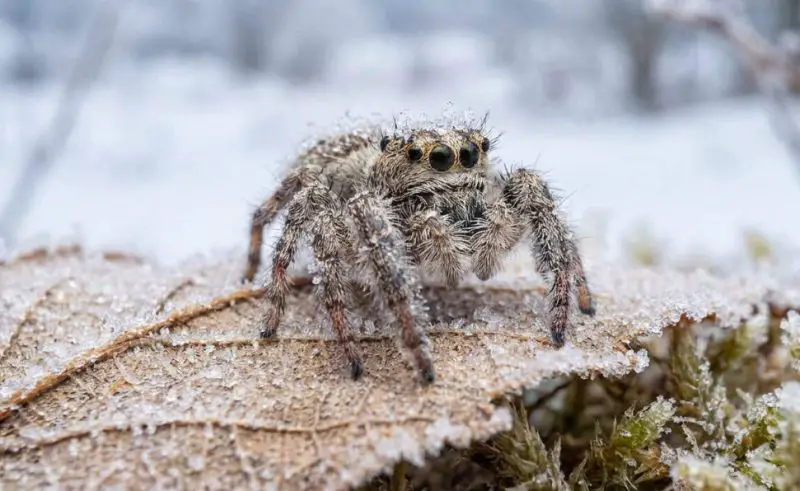
Minnesota winters are shaped by continental climate and Arctic air masses. Cold snaps regularly push temperatures to -20°F or lower, and wind chills can drop far beyond that. Snow cover often persists from November through March, sometimes forming deep, layered snowpacks.
These conditions create two very different winter environments.
Above the snow, exposure is deadly.
Below the snow, conditions are surprisingly stable.
Under leaf litter, soil, logs, and bark, temperatures fluctuate far less than the air above. Snow acts as insulation, trapping ground heat and protecting organisms from extreme cold. This hidden layer becomes the key to winter survival for many small creatures, including spiders.
Table of Contents
- 1 Spiders Are Ectotherms and Why That Matters
- 2 Freeze Avoidance vs Freeze Tolerance
- 3 Natural Antifreeze Inside Spider Bodies
- 4 Where Spiders Spend the Winter in Minnesota
- 5 Snow Is Not the Enemy
- 6 Life Stage Matters: Eggs, Juveniles, and Adults
- 7 Metabolism Slows to Near Standstill
- 8 How Different Spider Types Handle Minnesota Winters
- 9 Moisture Is as Important as Temperature
- 10 Predation Risk in Winter
- 11 Climate Change and Winter Survival
- 12 Why Spiders Matter Even in Winter
- 13 FAQs About Spider Winter Survival in Minnesota
- 14 Final Thoughts
Spiders Are Ectotherms and Why That Matters
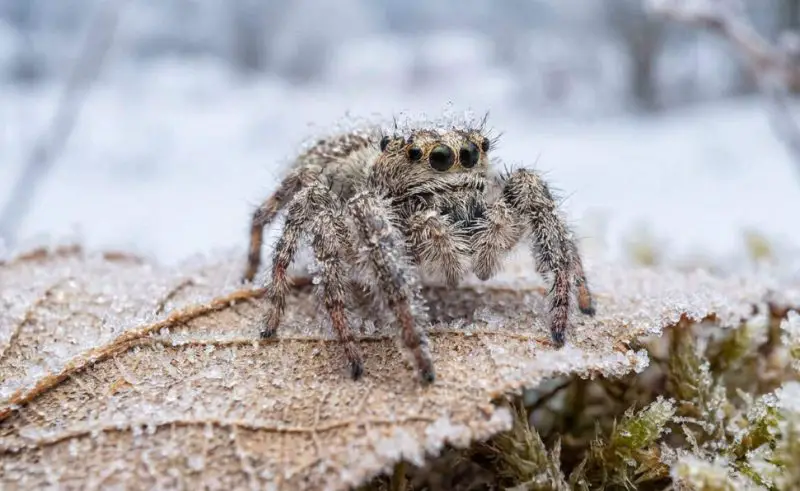
Spiders are ectothermic animals, meaning their body temperature is controlled almost entirely by their surrounding environment. In Minnesota, where winter temperatures routinely fall far below freezing, this biological trait shapes every aspect of spider survival.
Unlike mammals or birds, spiders cannot generate internal heat. There is no insulation, no shivering, no metabolic heat production to counter the cold. Instead, their physiology slows in direct response to dropping temperatures. As cold intensifies, heart rate decreases, muscle activity weakens, and digestion shuts down completely. Movement becomes sluggish and eventually stops.
During deep winter, spiders enter a state similar to dormancy. They are still alive, but life processes run at the bare minimum needed to sustain cells and tissues. At this stage, survival depends on a single critical factor: preventing lethal ice formation inside the body. Once ice crystals form within cells, damage is rapid and often irreversible. Avoiding or controlling freezing is the central challenge spiders must solve to survive Minnesota winters.
Freeze Avoidance vs Freeze Tolerance
Spiders survive winter using two primary physiological strategies. These strategies are not interchangeable and are tightly linked to species, habitat, and life stage.
Some spiders avoid freezing entirely.
Others tolerate freezing in highly controlled ways.
Both approaches are effective, but each requires precise biological regulation.
Freeze Avoidance Strategy
Most spiders found in Minnesota rely on freeze avoidance. This strategy prevents ice from forming inside the body at all.
As temperatures drop, these spiders lower the freezing point of their bodily fluids so that internal tissues remain liquid even when external temperatures fall well below 32°F. This does not mean they are immune to cold. It means they can supercool, staying unfrozen at temperatures that would normally cause ice formation.
Freeze avoidance is highly effective but fragile. If temperatures drop too quickly or too far, or if ice crystals form externally and trigger internal freezing, the spider may not survive.
Freeze Tolerance Strategy
A smaller number of spider species use freeze tolerance. These spiders allow parts of their bodies to freeze while protecting vital organs and cells.
Ice formation is restricted to non-critical spaces, such as extracellular fluids, while specialized proteins and cellular structures prevent damage to essential tissues. This is a risky strategy but can be effective in environments where extreme cold is unavoidable.
Freeze tolerance requires extraordinary biological control and is less common among spiders than freeze avoidance.
Natural Antifreeze Inside Spider Bodies
Cryoprotectants Explained
As autumn temperatures begin to fall, many spiders undergo a quiet but dramatic internal transformation. They start producing cryoprotectants.
Cryoprotectants are chemical compounds that function like antifreeze. Common examples include glycerol, sorbitol, and other sugar alcohols. These substances lower the freezing point of bodily fluids and stabilize cell membranes, reducing damage if temperatures approach freezing.
In effect, spiders rewrite their internal chemistry. Water inside their bodies becomes less likely to crystallize, and cells become more resistant to cold-induced stress.
This process is one of the most important winter survival adaptations in spiders.
Seasonal Timing Matters
Cryoprotectant production is not instantaneous. It occurs gradually over weeks as temperatures decline in fall.
Spiders rely on environmental cues such as shortening day length and cooling nights to trigger this process. If an unusually early or sudden hard freeze occurs before cryoprotectant levels are high enough, mortality can be severe.
Minnesota’s typically gradual autumn cooling allows most spiders sufficient time to prepare. Years with abrupt temperature drops are far more dangerous.
Where Spiders Spend the Winter in Minnesota
Under Leaf Litter and Soil
Forest floors are among the most important winter refuges for spiders. Fallen leaves trap air and moisture, creating a buffered microclimate just above the soil.
Beneath snow cover, soil temperatures remain far more stable than air temperatures. Even during extreme cold snaps, soil a few centimeters below the surface rarely reaches lethal lows.
Many ground-dwelling spiders burrow shallowly into soil or leaf litter and remain there until spring warmth returns.
Beneath Tree Bark and Logs
Tree bark and deadwood provide excellent winter shelter. Cracks in bark, loose plates on mature trees, and decaying logs offer insulated, humid spaces protected from wind and rapid temperature swings.
These microhabitats remain relatively stable throughout winter. For spiders, deadwood becomes a dense network of safe overwintering sites, shared with beetles, mites, and other invertebrates.
Inside Human Structures
Some spiders exploit human-made environments. Basements, garages, sheds, and crawl spaces stay significantly warmer and more stable than outdoor habitats.
Spiders in these locations may remain semi-active during winter, though movement and feeding are still limited. This is why spiders are sometimes seen indoors even during the coldest months of the year.
Snow Is Not the Enemy
Snow as Insulation
Snow plays a crucial role in spider survival. Deep snow acts as a thermal blanket, trapping heat from the ground and preventing extreme cold from penetrating downward.
Temperatures beneath snow often hover near 30°F even when air temperatures drop far below zero. For spiders hidden under leaf litter or soil, snow provides protection rather than danger.
Winters with consistent snow cover often result in higher overwinter survival rates for spiders.
Problems with Snow Loss
Ironically, winters with little snow but extreme cold can be more lethal. Without insulating snow, ground temperatures plunge closer to air temperature.
Exposed leaf litter and soil lose heat rapidly, increasing mortality among overwintering spiders. Snow loss is often more dangerous than cold itself.
Life Stage Matters: Eggs, Juveniles, and Adults
Overwintering as Eggs
Many spider species avoid winter risk entirely by overwintering as eggs. Females lay egg sacs in late summer or fall and die as temperatures drop.
Egg sacs are hidden under bark, in soil, or attached to low vegetation. The silk casing provides insulation, moisture retention, and physical protection. Eggs remain dormant until spring warmth triggers development and hatching.
Juveniles in Winter
Juvenile spiders face greater challenges. Their small size makes them prone to dehydration and rapid heat loss, and they have limited energy reserves.
Young spiders rely heavily on well-insulated microhabitats. Survival rates are lower for juveniles than for eggs or well-adapted adults, making this life stage particularly vulnerable.
Adult Spiders
Adult spiders overwinter only if their species has evolved strong freeze resistance. In many species, adults do not survive winter at all.
Instead, reproduction occurs in fall, and the next generation persists through eggs or juveniles. Adult overwintering is the exception, not the rule.
Metabolism Slows to Near Standstill
Energy Conservation
During winter dormancy, spiders do not hunt or feed. Metabolism drops to a fraction of summer levels.
Stored energy accumulated during warm months must sustain the spider through winter. This energy budgeting is unforgiving. Individuals that enter winter underfed or stressed often do not survive until spring.
No Movement, No Waste
Minimal movement reduces energy loss and lowers the need for metabolic activity. Waste production also declines, which helps spiders avoid dehydration.
Winter survival is not about endurance through action. It is about survival through stillness.
How Different Spider Types Handle Minnesota Winters
Wolf Spiders
Wolf spiders are among the most winter-hardy species. Many remain active late into fall and overwinter as juveniles or adults beneath leaf litter.
Some have even been observed moving across snow during warm winter days, demonstrating remarkable cold tolerance.
Orb Weavers
Most orb weavers do not survive winter as adults. They build egg sacs in late summer or fall and die as temperatures drop.
The species persists through eggs that endure winter and hatch in spring.
Jumping Spiders
Jumping spiders often seek sheltered locations such as bark crevices, rock piles, or buildings. Their compact bodies and efficient freeze avoidance strategies allow them to survive subzero temperatures in protected spaces.
Moisture Is as Important as Temperature
Avoiding Dehydration
Cold air holds very little moisture. Winter dehydration is one of the most serious threats to small arthropods.
Spiders select overwintering sites that retain humidity. Leaf litter, soil, and snow-covered environments help prevent moisture loss.
Dry, exposed sites are often fatal even if temperatures are tolerable.
Snow Helps Retain Humidity
Snow limits evaporation and traps moisture near the ground. This humid microenvironment reduces dehydration stress and improves winter survival.
Predation Risk in Winter
Fewer Predators, Lower Activity
Many spider predators are also inactive in winter. Birds migrate or reduce foraging, while reptiles and amphibians are dormant.
This significantly lowers predation pressure. Combined with reduced movement, winter becomes a relatively safe period from predators.
Hidden But Not Invincible
Winter habitat disturbance can be deadly. Digging, logging, landscaping, or construction can expose overwintering spiders to lethal cold.
Because spiders are immobile and hidden, winter disturbance can be more damaging than summer activity.
Climate Change and Winter Survival
Warmer Winters Are Not Always Better
Milder winters with frequent freeze-thaw cycles can be more stressful than consistent cold. Repeated warming can activate metabolism, burning energy reserves.
If a sudden freeze follows, spiders may lack the energy or chemical protection to survive.
Loss of Snow Cover
Climate change threatens consistent snowpack in Minnesota. Less snow means less insulation and greater exposure to extreme cold at ground level.
This shift could reduce spider survival in some regions despite overall warming trends.
Why Spiders Matter Even in Winter
Spiders are major predators of insects and play a crucial role in regulating pest populations.
Their survival through winter ensures that ecosystems rebound quickly in spring. Without spiders, insect populations could explode unchecked, disrupting food webs and plant communities.
Even in winter, spiders matter.
FAQs About Spider Winter Survival in Minnesota
Do spiders freeze solid in winter?
Most Minnesota spiders avoid freezing by producing antifreeze-like compounds. Some tolerate partial freezing in controlled ways.
Are spiders alive under the snow?
Yes. Many spiders remain alive but dormant beneath snow, leaf litter, or soil throughout winter.
Why do spiders appear indoors in winter?
Buildings provide warmer, stable conditions. Some spiders move indoors to avoid lethal outdoor temperatures.
Can spiders survive -20°F temperatures?
Yes, if insulated and chemically prepared. Exposure without shelter is usually fatal.
Do spiders wake up during warm winter days?
Sometimes. Brief movement can occur, but full activity waits until spring.
Does snow help spiders survive?
Yes. Snow insulates the ground and protects spiders from extreme cold.
Are all spider species winter-hardy?
No. Survival strategies vary widely by species and life stage.
Final Thoughts
Spiders are not fragile summer creatures that vanish when winter arrives.
In Minnesota, they endure some of the harshest cold in North America using chemistry, behavior, and patience. By hiding beneath snow, altering their internal biology, and slowing life to a near standstill, spiders wait out the cold months quietly and efficiently.
When spring warmth returns, they emerge once again.
Unseen.
Uncelebrated.
But very much alive.