

Blue flashes through the trees are a common sight across Georgia. In neighborhoods from Atlanta’s leafy suburbs to quiet rural properties surrounded by pine forests, one bird appears again and again with bold colors and an unmistakable voice. The blue jay is one of the most recognizable birds in the southeastern United States. Its bright blue feathers, crest-topped head, and loud calls make it easy to notice.
Yet what most Georgia residents don’t realize is how observant these birds truly are.
Blue jays are not simply passing through backyards looking for a quick meal. They are constantly watching their surroundings, paying attention to movement, sound, and patterns in the landscape. To homeowners who spend time in their yards, it can sometimes feel as if these birds are studying them from nearby trees or fences.
In many ways, they are.
Blue jays belong to the corvid family, one of the most intelligent bird groups on Earth. Crows, ravens, and magpies share this family, and they are known for their memory, problem-solving abilities, and awareness of their environment. Blue jays display many of these same traits.
Across Georgia’s forests and neighborhoods, blue jays quietly observe everything around them: squirrels hiding nuts, hawks circling overhead, people filling bird feeders, and even pets moving through yards. Their sharp senses and strong memory allow them to build a mental map of their territory.
This behavior helps them survive in environments that change constantly. It also explains why these birds often appear to be watching homes and yards so closely.
For many Georgia residents, the blue jay is just another backyard bird. But beneath its bold colors and noisy personality lies a highly intelligent animal constantly studying the world around it.
Once people begin noticing how blue jays behave, it becomes clear that these birds are far more aware of their surroundings than most people ever realize.
Table of Contents
- 1 Blue Jays Are Among the Smartest Backyard Birds
- 2 Blue Jays Watch Human Activity Closely
- 3 Blue Jays Have Exceptional Vision
- 4 Blue Jays Serve as Alarm Birds for Other Species
- 5 Blue Jays Remember the Layout of Their Territory
- 6 Blue Jays Cache Food for Later Use
- 7 Blue Jays Can Recognize Individual Animals
- 8 Blue Jays Thrive in Georgia’s Mixed Landscapes
- 9 Blue Jays Have Complex Social Behavior
- 10 FAQs About Blue Jays in Georgia
- 11 Final Thoughts
Blue Jays Are Among the Smartest Backyard Birds
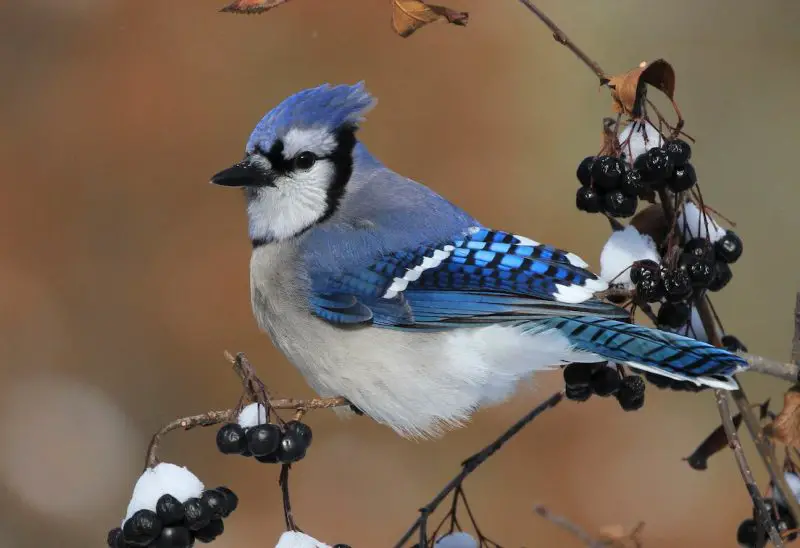
Blue jays belong to the Corvidae family, the same group that includes crows, ravens, and magpies. Birds in this family are widely recognized as some of the most intelligent animals in the avian world. Researchers who study animal cognition frequently examine corvids because their behavior demonstrates levels of awareness, memory, and problem-solving ability that rival those of many mammals. Experiments have shown that corvids can manipulate objects, solve puzzles, remember specific locations over long periods of time, and even adapt their strategies when circumstances change.
Blue jays show many of these same mental abilities in their everyday lives. One of the most impressive traits they possess is their remarkable memory. These birds regularly collect seeds, acorns, and other foods and hide them in dozens or even hundreds of locations across their territory. Weeks or months later, they return to these hidden caches and recover the stored food. To accomplish this, a blue jay must remember the precise location of each buried item, often among a landscape filled with similar-looking trees and shrubs.
Researchers studying corvid behavior have found that these birds can remember hundreds of separate hiding places. They do this by carefully observing their surroundings and creating what scientists call spatial maps in their memory. Every tree trunk, fence line, rooftop, and garden structure becomes part of this mental map.
When a blue jay sits quietly on a branch overlooking a backyard, it may appear to be simply resting. In reality, the bird is often gathering information about the landscape. It studies the positions of feeders, trees, buildings, and other features so it can move efficiently through its territory later.
This constant observation allows blue jays to locate food quickly, avoid danger, and navigate complex environments with remarkable precision.
Blue Jays Watch Human Activity Closely
In suburban neighborhoods across Georgia, blue jays often live remarkably close to people. Backyards filled with trees, shrubs, gardens, and bird feeders provide ideal conditions for these birds to thrive. Because they share the same spaces as humans, blue jays frequently observe human behavior and learn patterns in daily activity.
Over time, blue jays become surprisingly familiar with household routines. For instance, if a homeowner regularly refills a bird feeder each morning, blue jays may begin appearing in the yard shortly before that time. They learn when food is most likely to appear and position themselves nearby in anticipation.
These birds are also capable of recognizing which yards consistently offer safe feeding opportunities. If a particular property provides food while remaining relatively free of threats such as roaming cats or loud disturbances, blue jays may return again and again.
From a human perspective, this behavior can create the impression that blue jays are intentionally watching homes. People often notice the birds perched quietly on fences or tree branches as they move through their yard.
In reality, the blue jay is doing what it does best: observing its environment carefully. By monitoring human activity, the bird learns when it is safe to approach and when it should remain cautious.
This awareness helps blue jays maximize their feeding opportunities while minimizing the risks posed by predators or sudden disturbances.
Blue Jays Have Exceptional Vision
One reason blue jays appear so observant is their extraordinary eyesight. Like many birds, they possess vision that far surpasses human visual ability. Their eyes are highly adapted for detecting motion and identifying objects across considerable distances.
From a perch high in a tree, a blue jay can survey an entire yard or even a large section of the surrounding neighborhood. This vantage point allows the bird to monitor activity on the ground as well as in nearby trees and shrubs.
They watch for insects moving through grass, squirrels climbing branches, and other birds approaching feeding areas. Even subtle movements that humans might overlook are easily detected by the sharp eyes of a blue jay.
Their vision also helps them identify food items such as seeds, acorns, berries, and insects. These birds can quickly spot small objects among leaves or grass and swoop down to retrieve them.
Equally important is their ability to detect predators. Hawks, owls, and snakes are constant threats to smaller birds. Blue jays frequently act as early detectors of these dangers.
When a blue jay notices a predator, it often reacts immediately with loud alarm calls. These calls not only warn other blue jays but also alert many other bird species nearby.
As a result, the blue jay becomes an essential observer in the backyard ecosystem.
Blue Jays Serve as Alarm Birds for Other Species
One of the most important ecological roles blue jays perform is acting as a warning system for other animals. Their loud, distinctive calls carry across forests, neighborhoods, and parks, alerting nearby wildlife to potential danger.
Blue jays are extremely vigilant birds. They constantly scan their surroundings for movement, especially the flight patterns of predators such as hawks or owls. When a predator is spotted, the blue jay often begins calling loudly while moving rapidly between branches.
These alarm calls spread quickly through the local bird community. Songbirds such as chickadees, wrens, sparrows, and finches recognize the warning signals and react by hiding in dense foliage or flying away from open areas.
This behavior creates a kind of natural alarm network in wooded and suburban environments.
Because blue jays are larger and more aggressive than many other birds, they often detect predators first. In some cases they even mob predators, flying toward them and calling loudly to drive them away.
For homeowners, a sudden burst of sharp blue jay calls in the yard often means a hawk or owl is nearby—even if the predator itself is not immediately visible.
Blue Jays Remember the Layout of Their Territory
Memory plays a central role in blue jay survival. These birds develop detailed mental maps of the places where they live. Every tree, shrub, fence, and structure becomes part of the bird’s understanding of its territory.
Within this mental map, blue jays track important resources such as food sources and nesting sites. They remember where acorns fall during autumn, where bird feeders provide seeds, and where fruit trees produce seasonal food.
They also remember locations where food has been hidden. Because blue jays cache food in many separate spots, the ability to recall those locations is critical.
At the same time, the birds keep track of potential dangers within their environment. Areas where predators frequently appear may be avoided, while safer locations become preferred feeding sites.
In suburban Georgia neighborhoods, this memory often leads blue jays to return to the same yards year after year. Residents may notice the same birds visiting regularly and assume they are seeing familiar individuals.
In many cases, that assumption is correct.
The birds have simply incorporated the yard into their long-term territory map.
Blue Jays Cache Food for Later Use
One of the most fascinating behaviors blue jays display is their habit of storing food for the future. This behavior becomes especially important during autumn when acorns and nuts are abundant.
Blue jays gather large numbers of these foods and hide them in separate locations throughout their territory. This strategy is known as scatter hoarding.
Rather than storing all food in a single nest or storage area, the bird distributes food across dozens or even hundreds of hiding spots. Some seeds may be buried in soil, others tucked beneath leaves, and some wedged into cracks in tree bark.
These hidden caches serve as emergency food supplies during winter or periods when fresh food becomes scarce.
Remarkably, blue jays can remember many of these hiding places for months.
However, they do not recover every buried seed.
Many acorns remain forgotten beneath the soil. When spring arrives, these forgotten seeds may germinate and grow into new trees.
Because of this behavior, blue jays play a crucial role in spreading oak trees and shaping forest landscapes across the eastern United States.
Blue Jays Can Recognize Individual Animals
Scientists studying corvid behavior have discovered that these birds possess the ability to recognize individual animals and even human faces. While research has focused more heavily on crows, similar abilities likely exist in blue jays.
Birds that regularly encounter people in suburban environments begin distinguishing between individuals who behave differently.
For example, a blue jay may learn that one person regularly fills a feeder with seeds while another person walks a dog through the yard. Over time, the bird adjusts its behavior based on these observations.
This recognition ability helps blue jays determine when it is safe to approach and when caution is necessary.
It also explains why some birds appear comfortable feeding close to certain people while remaining wary of others.
By remembering these patterns, blue jays improve their chances of obtaining food while avoiding potential threats.
Blue Jays Thrive in Georgia’s Mixed Landscapes
Georgia’s varied landscape provides an ideal environment for blue jays. The state contains extensive hardwood forests, pine woodlands, suburban neighborhoods, and agricultural areas.
This diversity allows blue jays to access many different food sources.
Oak trees produce acorns that serve as a staple food during autumn and winter. Insects and berries provide additional nutrition during warmer months.
Backyards often supply even more resources. Bird feeders stocked with sunflower seeds, peanuts, and corn attract blue jays regularly. Fruit trees and ornamental plants also offer seasonal food.
Blue jays are highly adaptable birds that quickly learn how to use human structures to their advantage. They perch on fences, rooftops, and power lines to observe their surroundings.
This flexibility has allowed them to remain one of the most successful bird species across the eastern United States.
Blue Jays Have Complex Social Behavior
Although blue jays often appear alone or in pairs during the breeding season, they maintain complex social relationships with other birds.
During winter months especially, blue jays frequently form loose flocks. These groups travel together while searching for food across forests and suburban landscapes.
Within these flocks, communication plays an important role. Blue jays produce a wide variety of calls that convey different meanings.
Some calls warn of predators. Others signal the discovery of food sources.
Young birds learn these vocal signals by observing and listening to older birds within the flock.
Another intriguing aspect of blue jay communication is their ability to mimic the calls of other birds.
In particular, blue jays sometimes imitate the screams of hawks. This mimicry may serve several purposes. It may scare away smaller birds competing for food or confuse potential predators.
Such vocal flexibility demonstrates the advanced intelligence of these birds.
The more researchers study blue jays and other corvids, the more they discover that these animals possess complex social behaviors once thought unique to mammals.
FAQs About Blue Jays in Georgia
Are blue jays common in Georgia?
Yes. Blue jays are widespread across Georgia and can be found in forests, suburbs, and city parks.
Why do blue jays seem to watch people?
They observe their surroundings carefully to locate food sources and detect threats.
Are blue jays aggressive birds?
They can be territorial during nesting season but usually avoid direct conflict with humans.
What do blue jays eat?
Their diet includes acorns, seeds, berries, insects, and occasionally small animals.
Do blue jays migrate?
Some blue jays migrate short distances in winter, while others remain in the same area year-round.
Why do blue jays scream loudly?
Their calls often serve as alarm signals warning other birds about predators.
Do blue jays help forests grow?
Yes. By burying acorns and other seeds, they help spread trees across the landscape.
How long do blue jays live?
In the wild, blue jays typically live around 7–10 years, though some individuals survive longer.
Final Thoughts
Blue jays are far more than colorful backyard birds.
Across Georgia’s neighborhoods and forests, they quietly observe the world around them with remarkable intelligence and awareness.
Their sharp eyesight, powerful memory, and complex communication allow them to monitor their environment in ways most people never notice.
To homeowners, it may seem as though these birds are simply perched on a tree branch.
But in reality, the blue jay may be studying everything happening below—from bird feeders and garden plants to pets and passing predators.
Their ability to adapt to human landscapes has made them one of the most successful birds in the eastern United States.
And for those who pay close attention, the blue jay reveals a fascinating truth about nature.
Even in the quiet spaces of a backyard, wildlife may be watching far more closely than we ever imagine.