
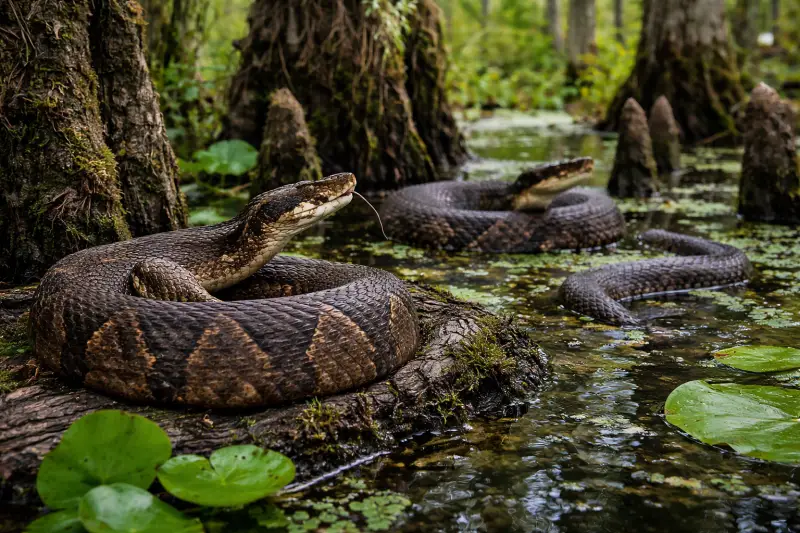
Georgia wetlands provide ideal habitat for many reptile species, including the water moccasin, also known as the cottonmouth. These snakes prefer slow moving waters, marsh edges, cypress swamps, ponds, drainage canals, and wooded riverbanks where cover and prey are abundant. Warm temperatures, high humidity, and consistent aquatic environments support stable populations throughout much of southern and coastal Georgia.
Despite their widespread presence, most people rarely encounter water moccasins closely. These snakes tend to remain concealed in vegetation, driftwood, or muddy banks. Their coloration blends naturally with wetland surroundings, making them difficult to notice unless actively moving.
Public concern often increases when outdoor recreation expands. Fishing, kayaking, hiking, birdwatching, and residential development near wetlands all increase chances of brief sightings. These encounters sometimes spark stories suggesting the snakes aggressively chase humans, which leads to persistent myths.
Table of Contents
- 1 What Water Moccasins Actually Are
- 2 Do Water Moccasins Actually Chase Humans
- 3 Why Georgia Wetlands Increase Encounter Frequency
- 4 Behavioral Traits That Shape Public Perception
- 5 Comparing Cottonmouths With Non Venomous Water Snakes
- 6 Ecological Role of Water Moccasins in Georgia
- 7 Human Expansion Into Wetland Areas
- 8 Are Water Moccasins Aggressive Toward Humans
- 9 Typical Encounter Scenarios in Georgia Wetlands
- 10 Safety Tips for Georgia Wetland Visitors
- 11 What To Do If You Encounter One
- 12 Understanding Venom Risk
- 13 Seasonal Patterns in Georgia
- 14 Why the Chasing Snake Myth Persists
- 15 Role of Education in Wildlife Coexistence
- 16 Environmental Changes Affecting Cottonmouth Visibility
- 17 Identifying True Risk Versus Perceived Risk
- 18 FAQs About Water Moccasins in Georgia Wetlands
- 19 Final Thoughts
What Water Moccasins Actually Are
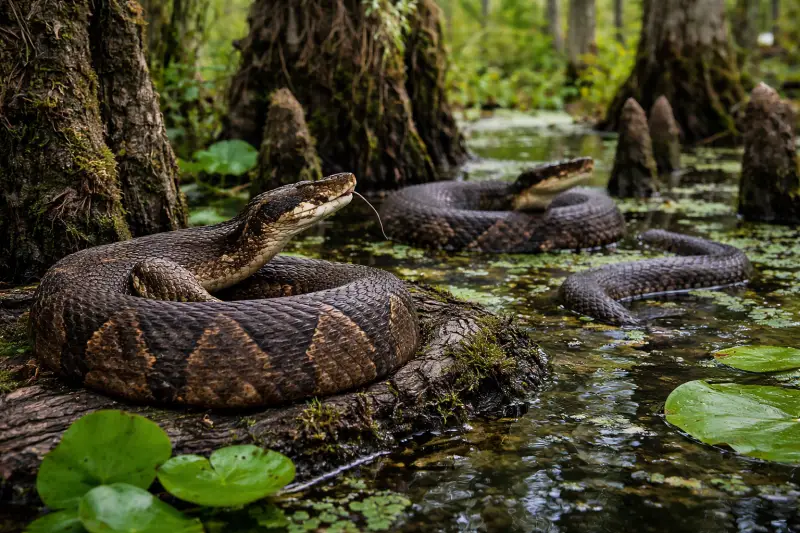
Water moccasins, commonly called cottonmouths, belong to the pit viper family. They are venomous snakes that have evolved to thrive in aquatic and semi aquatic environments across the southeastern United States. Their bodies are thick and muscular, their scales are strongly keeled, and their swimming ability allows them to hunt efficiently in swamps, marshes, ponds, and slow moving rivers. These traits help distinguish them from the many harmless water snakes that people often confuse with them.
One of their most recognizable defensive features is the bright white interior of the mouth. When threatened, a cottonmouth may open its mouth widely, exposing this pale lining. The display serves as a warning rather than an attack signal. It communicates discomfort and encourages predators or humans to keep their distance. Most snakes rely on camouflage first, but when concealment fails, visual warning displays become important survival tools.
Ecologically, cottonmouths function as versatile predators. Their diet includes fish, frogs, rodents, small birds, carrion, and occasionally other reptiles. This broad feeding behavior helps regulate prey populations in wetland ecosystems. By maintaining balance among species, they contribute to overall ecosystem stability. Their presence often indicates functioning wetland habitats rather than environmental problems.
Do Water Moccasins Actually Chase Humans
Defensive Movement Often Misinterpreted
Many stories about water moccasins chasing people arise from misunderstanding snake escape behavior. When startled, these snakes typically move toward the nearest safe cover such as water, dense vegetation, fallen logs, or muddy banks. If a person happens to stand between the snake and that refuge, the snake may appear to move directly toward them. From a human perspective this can feel like pursuit, but from the snake’s perspective it is simply an urgent retreat.
Rapid movement also exaggerates perception. Snakes can accelerate quickly over short distances. A startled observer may instinctively move away at the same moment the snake moves forward toward cover. This simultaneous motion can create a strong impression of intentional chasing even though the snake is focused entirely on escape.
Understanding this context explains why many dramatic encounter stories sound convincing yet do not reflect actual aggressive behavior. Wildlife research consistently supports the idea that cottonmouths prefer avoidance whenever possible.
Territorial Defense Is Limited
Unlike mammals that defend territory actively, snakes generally avoid confrontation. Their survival strategy emphasizes concealment, energy conservation, and escape rather than aggression. Fighting large animals such as humans offers no advantage and increases risk of injury.
Water moccasins may briefly hold position if cornered or repeatedly disturbed. This defensive stance allows them to assess threats and create an opportunity for escape. However, sustained pursuit of humans is not typical snake behavior. Scientific observations show that once an escape path opens, cottonmouths almost always retreat.
Why Georgia Wetlands Increase Encounter Frequency
Dense Aquatic Habitat
Georgia wetlands create ideal conditions for cottonmouths. These environments support abundant prey including frogs, fish, rodents, and birds. Slow water, thick vegetation, and warm temperatures allow these snakes to hunt effectively while remaining concealed.
Human recreation often overlaps with these same habitats. Fishing docks, kayaking routes, shoreline homes, and boardwalk trails all intersect with areas where cottonmouths naturally live. Increased human presence leads to more sightings, which can give the impression of population growth or aggressive behavior even when neither is occurring.
The overlap reflects shared habitat rather than conflict. Both humans and snakes are drawn to water resources. Understanding this reduces unnecessary fear.
Seasonal Activity Peaks
Snake activity increases noticeably during warmer months. Spring emergence from winter inactivity leads to basking behavior as snakes regulate body temperature. Summer brings peak feeding activity, while autumn often involves movement before cooler weather.
These seasonal patterns often coincide with outdoor recreation seasons. People spend more time fishing, hiking, or boating during the same months snakes are most visible. Timing alone can make encounters seem sudden or unusual even though they follow predictable biological cycles.
Behavioral Traits That Shape Public Perception
Freeze Before Flight Strategy
Cottonmouths often remain motionless when first disturbed. Their coloration blends well with mud, leaf litter, and wetland vegetation. This camouflage helps avoid detection by predators.
If the perceived threat continues approaching, the snake may suddenly move away quickly. The abrupt shift from stillness to rapid motion can startle observers. Because the movement happens late in the encounter, it sometimes appears aggressive even though it is defensive.
Recognizing this freeze before flight behavior helps reduce surprise and misinterpretation.
Warning Displays Before Biting
Cottonmouths usually give clear warning signals before biting. These may include body coiling, head elevation, mouth gaping, tail vibration, and slow defensive positioning. Each behavior communicates discomfort and encourages distance.
Actual bites typically occur only when the snake feels trapped, stepped on, or directly handled. Observers who recognize warning signals can avoid escalation simply by backing away slowly.
Education about these cues significantly reduces risk.
Comparing Cottonmouths With Non Venomous Water Snakes
Many reported cottonmouth encounters involve harmless water snakes. These species share aquatic habitats and similar coloration, which leads to frequent misidentification.
Non venomous water snakes often flee rapidly when disturbed. Their sudden escape movement can appear aggressive to observers unfamiliar with snake behavior. Without clear identification, people may assume the snake is venomous.
Cottonmouths generally display heavier bodies, broader triangular heads, vertical pupils, and more subdued banding compared with common water snakes. Learning these distinctions improves confidence outdoors and reduces unnecessary alarm.
Ecological Role of Water Moccasins in Georgia
Predator Balance in Wetlands
Cottonmouths help regulate amphibian, fish, and rodent populations. This predator role prevents overpopulation of prey species that could otherwise damage vegetation or spread disease. Balanced predator presence contributes to healthier wetland ecosystems.
Predators also influence prey behavior. The presence of snakes encourages prey species to remain cautious, which shapes feeding patterns and habitat use. These subtle effects ripple throughout ecosystems.
Scavenging Contribution
Water moccasins occasionally consume carrion. This scavenging behavior aids nutrient recycling in aquatic environments. Removing decaying organic material helps maintain water quality and supports ecological stability.
Though less visible than active hunting, scavenging remains an important ecological function. Diverse feeding strategies strengthen ecosystem resilience.
Human Expansion Into Wetland Areas
Residential Development Near Water
Many Georgia communities have expanded near lakes, marshes, and river systems. Scenic waterfront living attracts development but also places homes within existing wildlife corridors.
Snakes are not necessarily moving closer to people. Instead, human development increasingly overlaps with long established snake habitat. This shift alters perception and increases encounter frequency.
Understanding this context helps frame realistic expectations.
Recreational Access Improvements
Nature trails, kayak launches, fishing platforms, and observation decks encourage outdoor activity. These amenities improve access to wetlands but also increase wildlife visibility.
Greater visibility does not always reflect population growth. It often reflects increased observation. Awareness helps interpret sightings accurately.
Are Water Moccasins Aggressive Toward Humans
Scientific evidence consistently indicates defensive rather than aggressive behavior. Most bites occur under specific circumstances such as accidental stepping, handling attempts, blocked escape routes, or persistent close approach after warning displays.
Unprovoked attacks remain extremely rare. Maintaining respectful distance prevents nearly all incidents.
Understanding behavior rather than relying on myths supports safer coexistence.
Typical Encounter Scenarios in Georgia Wetlands
Fishing Shorelines
Anglers frequently encounter cottonmouths because both occupy productive aquatic environments. Snakes may rest along banks where prey activity concentrates. Remaining observant reduces surprise encounters.
Kayaking and Canoeing
Floating logs and vegetation provide basking sites. Snakes often slip quietly into water when boats approach. This retreat behavior sometimes startles paddlers but usually ends quickly. Calm observation helps prevent panic.
Yard Encounters Near Wetlands
Homes bordering wetlands occasionally see snakes passing through. These movements often relate to prey tracking or seasonal dispersal rather than permanent residence. Managing rodent populations reduces attraction.
Safety Tips for Georgia Wetland Visitors
Stay on established paths whenever possible.
Wear sturdy footwear near water edges.
Avoid placing hands where visibility is limited.
Keep pets supervised near wetlands.
Use flashlights during nighttime walks.
These simple precautions significantly reduce risk while allowing continued enjoyment of outdoor environments.
What To Do If You Encounter One
Remain calm and avoid sudden movements. Slowly back away to give the snake space. Most cottonmouths retreat once they feel safe.
Do not attempt to provoke, capture, or kill the snake. Unnecessary interaction accounts for most bite incidents. Observing from a distance remains the safest option.
Understanding Venom Risk
Cottonmouth venom primarily helps immobilize prey. While medically significant, serious outcomes remain uncommon with prompt treatment. Modern medical care has improved recovery rates considerably.
Avoidance remains the best prevention strategy. Knowledge about snake behavior improves safety more effectively than fear driven reactions.
Seasonal Patterns in Georgia
Spring often brings increased basking as snakes warm after cooler months. Summer represents peak feeding activity. Autumn may involve dispersal before winter.
Mild winters in parts of Georgia allow occasional activity, especially during warm spells. Seasonal awareness helps anticipate encounters.
Why the Chasing Snake Myth Persists
Human memory often amplifies dramatic experiences. A brief encounter can feel longer or more threatening in retrospect. Storytelling traditions emphasize memorable details, sometimes exaggerating threat.
Social media accelerates this process. Photos and anecdotes spread rapidly without scientific context. Balanced education helps counter misconceptions.
Role of Education in Wildlife Coexistence
Understanding snake behavior promotes responsible outdoor activity. Knowledge of warning signs, habitat preferences, and avoidance strategies reduces unnecessary conflict.
Education also supports conservation. Fear driven eradication efforts can disrupt ecological balance. Respectful coexistence benefits both wildlife and communities.
Environmental Changes Affecting Cottonmouth Visibility
Climate variability influences prey populations, vegetation density, and water availability. These factors affect snake movement patterns. Urban landscaping sometimes creates artificial wet habitats that attract prey, indirectly attracting snakes.
Environmental context often explains changing encounter patterns more than behavioral change.
Identifying True Risk Versus Perceived Risk
Venomous snake bites remain statistically rare compared with other outdoor hazards such as heat exposure, slips, or insect stings. Maintaining perspective reduces exaggerated fear while still encouraging sensible precautions.
Preparedness, awareness, and education allow safe enjoyment of Georgia’s wetland environments.
FAQs About Water Moccasins in Georgia Wetlands
Do cottonmouths really chase people
No credible research supports active pursuit behavior. Most apparent chasing results from defensive escape movements.
Are they common in Georgia wetlands
Yes. Suitable wetland habitats across much of the state support stable populations.
Are bites common
Bites are uncommon and usually linked to accidental contact or attempted handling.
How can I tell one from a water snake
Cottonmouths generally have heavier bodies, triangular heads, vertical pupils, and defensive mouth displays.
Should I kill one near my home
Relocation by professionals is safer. Killing snakes often increases risk of bites.
Are they active year round in Georgia
Activity slows during colder months but may continue during mild winters.
Do they enter homes
This is rare. They typically remain near water and natural cover.
Is swimming in wetlands safe
Yes when standard precautions are followed. Awareness and avoidance reduce risk.
Final Thoughts
Water moccasins form a natural part of Georgia wetland ecosystems. Their reputation for chasing humans largely stems from misunderstanding defensive behavior rather than actual aggression. Most encounters end peacefully when space is respected and awareness remains high.
Learning about wildlife replaces fear with informed caution. With basic knowledge, outdoor activities near wetlands can remain safe, enjoyable, and ecologically respectful.