

In Texas homes, small ants are one of the most common indoor pest complaints, especially in warm months. Homeowners often describe the same scenario. Tiny ants appear in kitchens, bathrooms, or along baseboards. Trails seem to come from nowhere. Some ants vanish overnight, while others return daily, no matter how often surfaces are cleaned. Most people assume they are dealing with the same kind of ant every time.
In reality, two very different ants are responsible for many of these indoor invasions: sugar ants and ghost ants. Although they are similar in size and often mistaken for one another, their behavior inside Texas houses is dramatically different. They enter homes for different reasons, move through structures in different ways, and respond very differently to control efforts.
This article explains how sugar ants and ghost ants behave differently inside Texas houses, why those differences matter, and how understanding their behavior helps explain why some infestations feel impossible to eliminate.
Table of Contents
- 1 Sugar Ants and Ghost Ants in Texas Homes
- 2 Why Sugar Ants Enter Texas Houses
- 3 Why Ghost Ants Enter Texas Houses
- 4 Differences in Colony Structure
- 5 How Movement Patterns Differ Indoors
- 6 Response to Cleaning and Disturbance
- 7 Reaction to Insect Sprays and Repellents
- 8 Seasonal Behavior Differences in Texas
- 9 Visual Differences That Affect Behavior Perception
- 10 Why Ghost Ants Feel Harder to Eliminate
- 11 Why Sugar Ants Feel Easier to Control
- 12 Common Misidentifications in Texas Homes
- 13 What These Differences Mean for Homeowners
- 14 Why Professional Identification Matters
- 15 FAQs About Sugar Ants and Ghost Ants in Texas Houses
- 16 Conclusion
Sugar Ants and Ghost Ants in Texas Homes
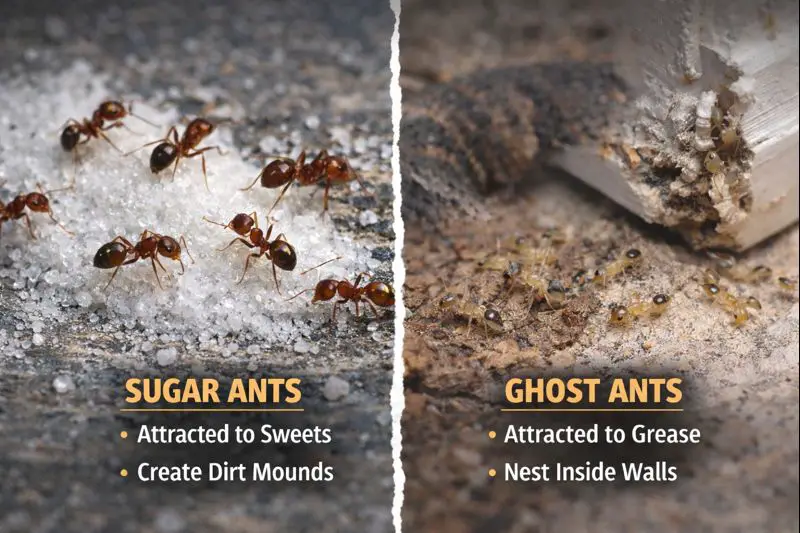
Two Ants, Two Very Different Lifestyles
The term “sugar ant” is commonly used in Texas to describe several sweet-loving ant species, most often odorous house ants or similar small ants that forage heavily for carbohydrates. Ghost ants, by contrast, are a distinct species with unique physical traits and behavioral patterns.
Both ants are small. Both are attracted to human food. Both can appear suddenly indoors. That similarity causes confusion. But once inside a house, their priorities and movement patterns diverge almost immediately.
Understanding those differences starts with how each ant views the home environment.
Why Sugar Ants Enter Texas Houses
Food Is the Primary Trigger
Sugar ants enter homes for one reason above all others: accessible food. They are strongly attracted to sugars, syrups, crumbs, and residues left behind on counters and floors.
In Texas, warm temperatures allow sugar ant colonies to remain active for long periods. When outdoor food sources fluctuate due to rain, drought, or landscaping changes, ants quickly redirect foraging into homes.
Once a reliable food source is found, sugar ants establish strong, repeatable trails between the colony and the food.
Trails Are Intentional and Structured
Sugar ants rely heavily on pheromone trails. When a worker finds food, it lays a chemical trail back to the nest. Other workers follow that trail precisely.
Inside Texas houses, this creates very visible ant lines. Trails often follow baseboards, countertop edges, plumbing lines, or electrical conduits. The movement looks organized and persistent because it is.
As long as the food source remains available, sugar ants will continue using the same path.
Why Ghost Ants Enter Texas Houses
Moisture and Shelter Matter More Than Food
Ghost ants are less motivated by exposed food than sugar ants. Inside Texas houses, their primary interest is stable moisture and protected nesting sites.
Bathrooms, kitchens, laundry rooms, wall voids, and areas around plumbing attract ghost ants even when food is minimal. High humidity and warmth allow them to thrive indoors year-round.
Food is still important, but ghost ants often nest first and forage second.
Homes Become Part of the Colony
Unlike sugar ants, ghost ants frequently establish nests inside structures. Wall cavities, under sinks, behind cabinets, inside potted plants, and within insulation all serve as nesting locations.
This means a Texas house is not just a feeding site for ghost ants. It can become the colony itself.
This difference alone explains why ghost ant infestations feel more persistent and unpredictable.
Differences in Colony Structure
Sugar Ant Colonies Are Usually Outside
Most sugar ant colonies remain outdoors. Nests are commonly found under soil, mulch, stones, or landscaping near the home.
Workers enter houses to forage, then return outside. The structure of the colony remains separate from the house.
This separation makes sugar ant infestations easier to disrupt once trails and food access are removed.
Ghost Ant Colonies Are Fragmented and Mobile
Ghost ant colonies are highly flexible. They form multiple small nests rather than one central colony. These nests can split, move, and re-form easily.
Inside Texas houses, ghost ants may have several nests spread across different rooms or wall voids. If one nest is disturbed, ants relocate rather than collapse.
This fragmented structure makes ghost ants extremely difficult to eliminate with surface treatments alone.
How Movement Patterns Differ Indoors
Sugar Ants Move Predictably
Sugar ant movement inside houses is usually straightforward. Workers travel back and forth along fixed routes.
Homeowners often notice ants entering from a specific crack, window frame, or door threshold. Once that entry point is sealed and the trail disrupted, activity declines rapidly.
Predictability is a defining trait of sugar ant behavior.
Ghost Ants Move Erratically
Ghost ants behave very differently. Their movement appears scattered and disorganized. Workers may emerge from walls, ceilings, electrical outlets, or plumbing penetrations.
Trails are faint or inconsistent. Ants may disappear suddenly, only to reappear in a different room days later.
This erratic behavior reflects their nesting strategy. Ghost ants are not commuting from outside. They are relocating internally.
Response to Cleaning and Disturbance
Sugar Ants Retreat When Food Is Removed
When food sources are eliminated, sugar ant activity usually declines quickly. Cleaning counters, sealing containers, and removing attractants disrupt their foraging success.
Without reward, pheromone trails fade. Ant numbers drop as workers redirect elsewhere.
This is why sugar ant problems often seem seasonal or temporary in Texas homes.
Ghost Ants Ignore Surface Cleaning
Ghost ants often continue appearing even when kitchens are spotless. This frustrates homeowners who assume cleanliness alone should solve the problem.
Because ghost ants nest indoors, they are not dependent on obvious food sources. They feed on microscopic residues, moisture, and even other insects.
Surface cleaning does little to affect colonies hidden behind walls.
Reaction to Insect Sprays and Repellents
Sugar Ants Are Quickly Repelled
Spraying sugar ants often produces immediate results. Workers die or retreat, and trails disappear.
However, sprays do not address the outdoor colony. Ants may return if food access remains.
Still, sugar ants respond directly to chemical disruption.
Ghost Ants Scatter and Multiply
Spraying ghost ants often makes the problem worse. Repellents cause colonies to split and relocate.
This leads to ants appearing in new areas of the house within days or weeks. What looked like success turns into expansion.
This behavior is known as budding and is a hallmark of ghost ant infestations.
Seasonal Behavior Differences in Texas
Sugar Ant Activity Follows Weather
Sugar ant invasions in Texas often spike after heavy rain, drought, or sudden temperature changes. These conditions disrupt outdoor foraging.
Once conditions stabilize, sugar ants often retreat outdoors again.
Their presence indoors is often temporary.
Ghost Ants Persist Year-Round
Ghost ants thrive in climate-controlled environments. Texas houses provide stable temperature and humidity regardless of season.
As a result, ghost ant infestations can persist year-round, especially in newer homes with complex wall systems.
Seasonal change has little impact once they are established indoors.
Visual Differences That Affect Behavior Perception
Sugar Ants Are More Visible
Sugar ants tend to be darker and easier to see. Trails are obvious, which helps homeowners track their movement.
Visibility creates the impression of control. You can see where they are coming from.
Ghost Ants Seem to Appear From Nowhere
Ghost ants have pale legs and abdomens, making them hard to see against light surfaces. Their small size and erratic movement add to the illusion that they “appear out of thin air.”
This visual confusion reinforces the belief that ghost ants are everywhere, even when numbers are modest.
Why Ghost Ants Feel Harder to Eliminate
Multiple Nest Sites Inside the Structure
Because ghost ants nest in many hidden locations, eliminating one group rarely ends the infestation.
Each nest can produce workers independently.
Chemical Resistance Through Avoidance
Ghost ants are not resistant in a biological sense. They avoid treated areas rather than crossing them.
This avoidance allows colonies to survive and shift position inside the house.
Why Sugar Ants Feel Easier to Control
Single Colony Dependency
Disrupting a sugar ant trail affects the entire foraging operation. Without food access, workers lose purpose.
Over time, the colony redirects or collapses.
Outdoor Nest Vulnerability
Outdoor nests are more exposed to environmental stress, predators, and treatment options.
This makes long-term control more achievable.
Common Misidentifications in Texas Homes
Sugar ants are often mistaken for ghost ants when they are small. Ghost ants are often mistaken for sugar ants because they show up in kitchens.
This misidentification leads to ineffective treatment choices.
Understanding behavior is more important than appearance.
What These Differences Mean for Homeowners
Sugar ant problems are usually about access. Ghost ant problems are about nesting.
One responds to sanitation and exclusion. The other requires targeted treatment of nesting areas.
Treating both the same way leads to frustration.
Why Professional Identification Matters
Accurate identification allows for targeted solutions.
Using the wrong approach can worsen ghost ant infestations or cause sugar ants to relocate temporarily.
Behavior-based diagnosis is more reliable than size or color alone.
FAQs About Sugar Ants and Ghost Ants in Texas Houses
Are sugar ants and ghost ants the same?
No. They are different ants with different behaviors and nesting habits.
Why do ants keep coming back after cleaning?
Ghost ants often nest inside walls and are not dependent on surface food.
Which ant is harder to eliminate?
Ghost ants are generally more difficult due to indoor nesting and colony fragmentation.
Do ghost ants bite?
They rarely bite and pose no direct threat to people.
Can DIY sprays solve ant problems?
They may help with sugar ants but often worsen ghost ant infestations.
Are ghost ants common in Texas?
Yes. They are especially common in warm, humid regions and newer homes.
Will ants leave on their own?
Sugar ants sometimes do. Ghost ants usually do not without intervention.
Conclusion
Sugar ants and ghost ants behave very differently inside Texas houses, even though they are often mistaken for one another. Sugar ants are driven by food, follow predictable trails, and usually nest outdoors. Ghost ants are driven by moisture and shelter, nest inside structures, and respond to disturbance by spreading.
These differences explain why some ant problems resolve quickly while others persist despite repeated efforts. Understanding behavior, not just appearance, is the key to effective control.
Inside Texas homes, ants are not all the same. Recognizing which ant you are dealing with transforms frustration into clarity and turns guesswork into informed action.